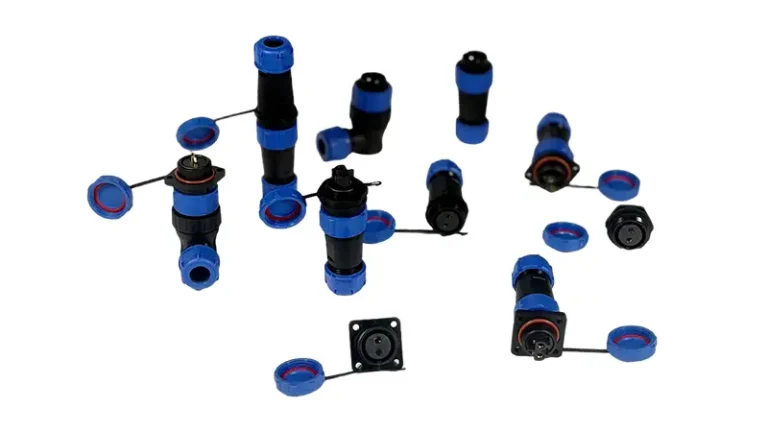
A waterproof connector is an electrical connector with a sealing system that helps protect the mating interface, cable entry, or wire joint from moisture, dust, splash, rain, immersion, or washdown exposure under defined conditions.
This guide explains the main waterproof connector types, IP rating logic, material and sealing checks, and the correct Verchil guide to use for each application. If the project involves a cable gland, plug connector, wire connector, splice connector, RJ45 connector, 12V connector, or circular aviation connector, use the routing tables below before choosing a product.
Do not choose a connector by IP number alone. The real selection depends on cable outer diameter, mated or unmated sealing condition, housing material, contact material, gasket design, installation environment, and whether the connector must be opened during maintenance.
Waterproof Connector Quick Selection Guide
Different waterproof connectors solve different sealing problems. Before comparing IP ratings or materials, first decide whether the project needs a removable connector, a permanent wire joint, a sealed cable entry, or a protected data/power interface.
| Application Need | Best Connector Direction | Why It Fits | Related Verchil Guide |
|---|---|---|---|
| Outdoor multi-pin signal or power connection | Waterproof aviation / circular connector | Good for lockable, panel-mounted, multi-core wiring | Waterproof aviation connector |
| Sealing a cable entry into an enclosure | Waterproof cable gland | Seals the cable where it enters a box, cabinet, or device housing | Waterproof cable gland |
| Outdoor Ethernet, CCTV, LED display, or communication equipment | RJ45 waterproof connector | Protects Ethernet interfaces while maintaining network cable compatibility | RJ45 waterproof connector |
| Repeated male-female connection and disconnection | Waterproof plug connector | Designed for plug-and-socket mating, service access, and modular equipment | Waterproof plug connector |
| Permanent wire-to-wire joint in a wet area | Waterproof splice connector | Protects joined wires where repeated unplugging is not required | Waterproof splice connectors IP68 |
| Outdoor low-voltage DC wiring | Waterproof 12V connector | Useful for RV, marine, automotive, LED, solar accessory, and low-voltage power circuits | Waterproof 12V connector guide |
| Outdoor stage lighting or locking power connection | PowerCon waterproof connector | Fits field power connections where locking and repeated setup matter | PowerCon waterproof connector |
Need Help Choosing the Right Waterproof Connector?
If you are not sure whether to use a cable gland, plug connector, splice connector, aviation connector, RJ45 connector, or 12V waterproof connector, send Verchil your cable OD, pin count, current, voltage, mounting method, and target IP rating.
Request a Waterproof Connector Quote | Chat on WhatsApp
What is a waterproof connector?
Because an ordinary connector in a waterproof enclosure relies on passive protection — once the enclosure fails, everything inside fails — a true waterproof connector adds active, self-sealing protection at the live contacts. Because most waterproof connectors combine three sealing mechanisms — interface sealing (O-ring at the mating face), cable-entry sealing (grommet/boot against wicking), and overmolding/potting (epoxy at the crimp) — they hold their rating even on exposed panels or partial immersion.
How does the waterproof connector work?
Most waterproof connectors are sealed by a combination of the following three mechanisms:
Interface Sealing – When the plug is connected to the socket, the O-ring or silicone gasket is compressed between the contact surfaces of the two, forming a waterproof barrier in the electrical contact area.
Cable / Wire Entry Sealing – strain-relief rubber grommet or heat-shrink boot seals the position where the wire passes through the connector body to prevent wicking (water infiltration along the wire).
Overmolding / Potting – In high-reliability applications (military, medical), the back end of the connector is filled with epoxy resin or silicone to permanently encapsulate the wire crimping point.
Detailed explanation of IP protection grade of waterproof connector
Ingress Protection Rating (IP), defined by the international standard IEC 60529, is a common language for evaluating the waterproof and dustproof performance of connectors. Every regular waterproof electrical connector should be marked with IP grade – if a product is not marked, it should be highly vigilant.
The IP code format is IPXX, where:
- The first digit (0-6) represents the protection level of solid particles / dust.
- The second digit (0-9K) represents the level of protection against water / liquid.
| IP Rating | Water Protection Level | Typical Use Case |
|---|---|---|
| IP65 | Protected against water jets from any direction | Outdoor enclosures, garden lighting |
| IP66 | Protected against powerful water jets | Industrial wash-down environments |
| IP67 | Immersion up to 1 meter for 30 minutes | Consumer electronics, automotive connectors |
| IP68 | Continuous immersion beyond 1 meter (depth specified by manufacturer) | Subsea equipment, underwater sensors |
| IP69K | High-pressure, high-temperature water jets (80°C, 80–100 bar) | Food processing, agricultural machinery |
The IP Rating Trap: A Higher Number Does Not Solve Every Problem
The IP Rating Trap happens when a connector is selected only by IP65, IP67, IP68, or IP69K without checking the real installation conditions. IP rating describes ingress protection under defined test conditions, but it does not automatically prove corrosion resistance, UV stability, oil resistance, cable jacket compatibility, or unmated waterproof performance.
For example, an IP68 waterproof connector may be suitable for immersion under manufacturer-defined conditions, but that does not automatically mean it is suitable for high-pressure washdown. In the same way, an IP67 connector may be enough for rain-exposed outdoor equipment, but it may not be enough for continuous submersion, direct burial, or saltwater environments.
When selecting a waterproof connector, check four points together: the target IP rating, the mated or unmated sealing condition, the cable outer diameter, and the housing/contact material. If any of these four points is wrong, water can still enter the connection even when the product name says “waterproof”.
Common Waterproof Cable Connector Selection Mistakes
- Choosing by IP rating alone: IP rating does not automatically confirm cable jacket compatibility, corrosion resistance, UV resistance, or unmated sealing.
- Ignoring cable outer diameter: even a well-designed connector can leak if the cable OD does not match the rear seal or cable gland range.
- Mixing connector halves without checking fit: similar-looking waterproof connectors may not seal correctly when different brands or series are mixed.
- Skipping strain relief: vibration, pulling, bending, or repeated movement can loosen the cable entry and reduce sealing performance.
- Using a connector outside its real environment: rain, immersion, washdown, salt fog, buried use, and UV exposure require different material and test-condition checks.
Ask for the IP Test Condition Before Ordering
For outdoor, washdown, marine, buried, or industrial applications, do not select a waterproof connector by the IP number alone. Ask for the datasheet, mating condition, cable OD range, material specification, and available IP test report before confirming the connector.
Ask Verchil for Datasheet or IP Test Report
Professional tips
IP level can not be superimposed. IP68 connectors are not automatically equivalent to IP69K. Be sure to check the specific test conditions in the manufacturer’s data manual. For high-pressure flushing environment, please clearly require IP69K.
Other standards: MIL-SPEC and NEMA
In the field of national defense and heavy industry applications, it is necessary to pay attention to standards other than IP level:
- MIL-DTL-38999 / MIL-C-5015: American military circular connector standard; high requirements for vibration, temperature and electromagnetic interference (EMI) shielding
- NEMA 6P: Protection rating for IP68 in the NEMA enclosure system of the United States
- UL 2238: UL standard for cable assemblies and fittings in industrial control and signal distribution (≤60 A, ≤600 V).
Waterproof Connector Types: Which Direction Should You Choose First?
This section is a high-level map, not a full product catalog. Use it to identify the right connector direction first, then move to the dedicated Verchil guide for detailed sizing, wiring, materials, and product selection.
Waterproof Aviation Connector
A waterproof aviation connector is usually a circular, multi-pin connector for outdoor signal, control, or power wiring. It is suitable when the project needs a lockable connector body, panel mounting, and repeated mating.
For detailed product options, pin counts, shell styles, and application examples, see the waterproof aviation connector page.

Circular Push-Pull Connectors
It adopts a cylindrical shell with a push-in locking and pull-out unlocking mechanism. Because it can be operated by one hand and supports blind-mateable, it is favored by the field of medical equipment and broadcasting equipment. IP level is usually up to IP68 after complete docking.
M12 / M8 Industrial Connectors
M8 and M12 waterproof connectors are common in industrial automation, sensors, actuators, and field wiring. They are useful when compact size, standardized circular interfaces, and reliable field connection are required.
For system-level application selection, see industrial automation connector solutions.
Marine-Grade Connectors
Marine waterproof connectors must be evaluated beyond the IP rating. Salt spray, corrosion, UV exposure, cable movement, and galvanic reaction can affect long-term reliability even when the connector body appears sealed.
For the specific alloys, platings, and gasket materials that hold up against salt spray over years of coastal service, see our salt-spray-resistant connector guide.
MC4 Photovoltaic Connector (Solar Connector)
MC4-style photovoltaic connectors are used in solar DC wiring systems where connector compatibility, polarity, cable type, UV exposure, and product certification must be verified. Do not select them by waterproof claims alone.
For MC4, Anderson, Deutsch, and other sealed electrical connector families, see the waterproof electrical connectors guide.
Nano / Micro Waterproof Connector
Nano and micro waterproof connectors are used when space is limited and the connector must protect a compact signal or power interface. Selection depends on pin count, cable OD, mating condition, assembly process, and available datasheet.
Use this section only as a category overview. For a production design, confirm dimensions, sealing method, electrical rating, and environmental test condition with the supplier.
Waterproof Cable Gland
A waterproof cable gland seals the point where a cable enters an enclosure, junction box, cabinet, or device housing. It is not a plug connector and does not create a removable electrical interface by itself.
Choose this direction when the main problem is cable-entry sealing, strain relief, and enclosure protection. For thread types, sealing structure, and product selection, see the waterproof cable gland page.
Waterproof Plug Connector
A waterproof plug connector is a male-female connector set designed for repeated mating and unmating. It is suitable when equipment needs service access, modular replacement, or field assembly.
The key question is whether the IP rating applies only when mated and locked. If the socket may be exposed while unplugged, check whether a sealing cap or unmated protection is required. For more detail, see the waterproof plug connector guide.
RJ45 Waterproof Connector
An RJ45 waterproof connector protects Ethernet ports and network cable interfaces in outdoor communication equipment, CCTV systems, LED displays, industrial cabinets, and exposed control boxes.
Unlike a simple power connector, RJ45 selection also depends on cable category, shielding continuity, panel mounting, and signal reliability. For detailed Ethernet selection, see the RJ45 waterproof connector page.
Waterproof Cable Connector Selection Tips
A waterproof cable connector is a broad selection term. It may refer to a circular connector, rectangular connector, push-pull connector, cable gland, plug connector, or sealed wire connector depending on how the cable enters, mates, locks, and seals. Use this section as a routing guide before choosing a specific Verchil product family.
| Connector direction | Best use | What to check first | Go deeper |
|---|---|---|---|
| Circular waterproof cable connector | Outdoor sensors, industrial control, signal and power wiring, panel-mounted equipment | Pin count, shell size, cable OD, locking method, mated IP rating | Waterproof aviation connector |
| M8 / M12 waterproof connector | Industrial sensors, actuators, Ethernet, automation field wiring | Coding, shielding, cable diameter, vibration, field installation method | Industrial automation connector solutions |
| Waterproof cable gland | Cable entry into enclosure, cabinet, junction box, or device housing | Thread type, cable OD range, gasket, strain relief, enclosure material | Waterproof cable gland |
| Waterproof plug connector | Reusable male-female connection for equipment, lighting, power, or field service | Mated/unmated sealing, locking style, cap, cable entry, mating cycles | Waterproof plug connector guide |
| Waterproof wire connector | Wire-to-wire joint, pigtail, branch connection, or cable repair | AWG, conductor material, sheath compatibility, seal method, serviceability | Waterproof wire connectors guide |
| Waterproof splice connector | Enclosed IP68-style repair joint or fixed wet-location splice | Housing, gland, conductor connection, burial condition, rework access | Waterproof splice connectors IP68 |
Explore Waterproof Connector Guides by Application
This page is the main waterproof connector guide. For a specific connector family or application, use the focused guides below. Each guide narrows the selection by installation method, cable type, environment, or connector function.
- Waterproof wire connectors — for wire gauge, conductor material, jacket compatibility, and wire-to-wire sealing.
- Outdoor waterproof wire connectors — for rain, UV exposure, direct burial, garden wiring, and outdoor lighting circuits.
- Waterproof electrical connectors — for automotive, solar, high-current DC, Deutsch-style, Anderson-style, and industrial electrical applications.
- Waterproof plug connectors — for male-female plug-and-socket connections that need repeated mating.
- Waterproof splice connectors IP68 — for sealed wire joints, enclosed splices, and wet-location cable repairs.
- Waterproof 12V connectors — for low-voltage DC power systems in vehicles, RVs, boats, solar accessories, and LED lighting.
- Waterproof landscape lighting connectors — for low-voltage outdoor lighting, buried cable, and garden installation.
- RJ45 waterproof connectors — for outdoor Ethernet, CCTV, communication cabinets, and LED display signal wiring.
For product-level selection, browse the Verchil waterproof connector category or send the cable OD, pin count, current, voltage, and target IP rating through the contact page.
How to choose the right waterproof connector: purchase guide
In the face of a variety of options, the following is a structured decision-making framework for selecting the best waterproof electrical connector:
Step 1: Clear IP protection level requirements
Starting from the use environment:
- Occasional rain or splash → IP65
- Frequent immersion (underwater ROV, bilge area) → IP68
- High pressure washing (food factory, agricultural machinery) → IP69K
- Military anti-vibration + EMI shielding + moisture proof → MIL-SPEC
Because IP68 connectors cost significantly more than IP65, don’t oversize — if the connector only mounts on a covered outdoor panel, IP68 may be entirely unnecessary. Match the rating to the actual environment.
Step 2: Consider Electrical Parameters
| Parameter | Why It Matters |
|---|---|
| Voltage rating | Exceeding it causes arcing and insulation breakdown |
| Current rating (per contact) | Undersizing causes thermal failure and contact welding |
| Contact resistance | Low resistance = less heat, more reliable signal integrity |
| Pin count | Match exactly — unused pins create assembly errors |
| Wire gauge compatibility | Must match your wire AWG or mm² cross-section |
Step 3: According to the environment matching material
- Polyamide (PA66 nylon): Universal outdoor scene, good chemical resistance, cost-effective
- Polycarbonate: High transparency, impact resistance, but low chemical resistance
- Stainless steel / aluminum alloy housing: suitable for marine, military and high vibration environment
- Contact material: gold-plated contact for low signal level; silver- or tin-plated contacts for power supply applications
Step 4: Evaluate the number of insertions and durability
The industrial M12 connector has a rated insertion number of 100-500 times, and the push-pull LEMO connector can exceed 5,000 times. For frequently plugged equipment (on-site maintenance equipment, test and measurement equipment), even if the cost is higher, should also choose the rated plug times higher products.
Industry Applications of Waterproof Connectors
Use the application section as a routing map. The goal is not to list every possible waterproof connector, but to match each environment with the right Verchil product page or solution page.
Outdoor LED Displays and Signage
Outdoor LED display systems usually need sealed power, signal, and enclosure-entry protection. Compare PowerCon-style connectors, RJ45 waterproof connectors, waterproof aviation connectors, and cable glands according to power load, signal type, and maintenance access. See LED display waterproof connector solutions.
Industrial Automation
Industrial automation equipment often needs compact field connectors for sensors, actuators, and control boxes. Focus on vibration resistance, dust exposure, cable strain, and maintenance access. See industrial automation connector solutions.
Communication and Outdoor Equipment
Outdoor routers, CCTV cabinets, network boxes, and communication devices need both waterproof Ethernet interfaces and sealed cable-entry points. Use RJ45 waterproof connectors for network ports and waterproof cable glands for enclosure entries. See communication and outdoor equipment connector solutions.
Stage Lighting and Temporary Outdoor Power
Stage lighting and event equipment need fast setup, locking power connections, and durable field wiring. Start with PowerCon waterproof connectors or circular waterproof connectors, then confirm current rating, locking structure, and cable assembly method. See stage lighting connector solutions.
Installation Techniques and Common Errors
Installation affects waterproof performance as much as connector design. For this Hub page, use the points below as general checks, then move to the dedicated wire, plug, splice, cable gland, or RJ45 guide for detailed installation requirements.
- Match cable OD to the seal: a waterproof connector can leak if the cable is too small, too large, or incompatible with the rear seal.
- Check mated and unmated condition: some connectors are protected only when fully locked or capped.
- Avoid mixing unmatched connector halves: similar-looking products may not seal correctly across brands or series.
- Do not ignore strain relief: pulling, vibration, bending, and movement can open the cable-entry seal.
- Follow the datasheet: crimping, torque, heat-shrink, gasket, and test conditions should come from the product datasheet or project standard.
Frequently Asked Questions About Waterproof Connectors
Is IP67 enough for outdoor use?
For most outdoor applications – rain, humidity, occasional ponding – IP67 is sufficient. If the connector needs to be continuously fully submerged or subjected to high-pressure flushing, it is necessary to specify IP68 or IP69K.
Can IP68 connectors be used in saline (seawater) environments?
IP68 level is only for fresh water immersion test. In the salt water (marine) environment, in addition to the IP68 protection level, the connector also needs to use corrosion-resistant materials (316 stainless steel, gold-plated contacts, UV-stabilized casing). Please check the material specification, not just the IP level.
For a full rundown of which connector families and shell materials suit coastal and marine deployments beyond the IP number, see our guide to connectors for coastal environments.
What’s the difference between IP67, IP68, and IP69K?
IP67 means 30-minute immersion at 1m; IP68 means continuous immersion beyond 1m (depth set by the maker); IP69K means high-pressure, high-temperature washdown (80°C, 80–100 bar). Because the ratings don’t stack, an IP68 connector isn’t automatically IP69K — always check the datasheet’s test conditions for your specific environment.
Which waterproof connector type should I choose for my application?
Choose by function first. Use a cable gland for enclosure entry, a plug connector for repeated mating, a splice connector for fixed wire joints, an RJ45 waterproof connector for outdoor Ethernet, an aviation connector for multi-pin circular wiring, and a PowerCon-style connector for locking power applications. If the application is still unclear, start from the waterproof connector category.
What is the difference between a waterproof connector and a cable gland?
A waterproof connector creates an electrical connection between two sides, while a cable gland seals a cable where it enters an enclosure. Use a waterproof connector when the circuit needs mating contacts, and use a waterproof cable gland when the main problem is sealing the cable entry into a box, cabinet, or panel.
Do waterproof connectors stay waterproof when unplugged?
Not always. Many waterproof connectors are rated only when fully mated and locked. If the socket or receptacle will be exposed while unplugged, specify a sealing cap, dust cap, or connector design that clearly supports unmated environmental protection.
Conclusion
Because choosing the right waterproof connector directly determines system reliability, safety, and service life, it’s far more than a routine selection task. Whether you need an IP67 connector for automotive sensors, an IP69K stainless M12 for food processing, an MC4 for rooftop solar, or a MIL-SPEC circular for defense, the framework stays consistent: environment first, electrical parameters second, mechanical durability third.
Verchil designs and manufactures waterproof connectors across the full range — aviation circular, M12/M8, PowerCon, cable glands, and sealed wire connectors, all tested to IEC 60529 (IP), UL, and RoHS. Explore Verchil’s waterproof connector range, or dive into the specifics: waterproof aviation connector, waterproof wire connectors, PowerCon, and waterproof cable gland. For custom sealed assemblies, contact Verchil’s engineering team.