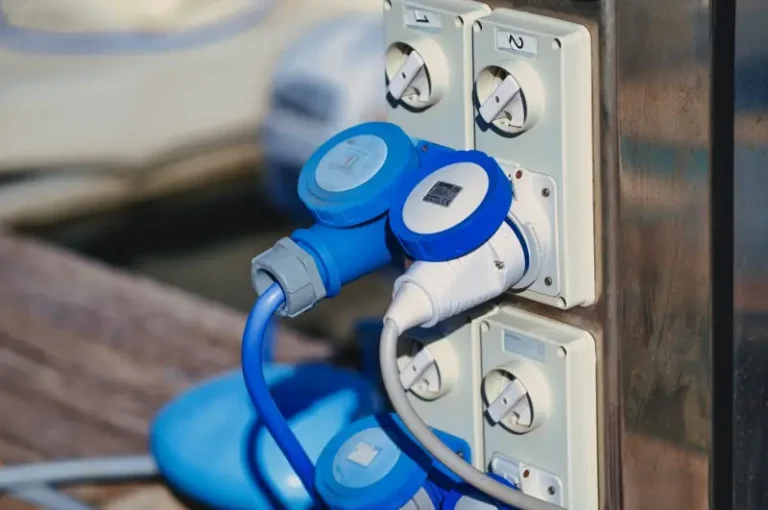
Outdoor waterproof wire connectors seal the wire entry against rain, UV, and burial — the six main types are gel-filled (DBY), heat-shrink butt, lever push-in, sealant wire nuts, self-fusing tape, and submersible gel-splice kits. For buried splices, require both IP68 and a UL 486D direct-burial listing — not just a “weatherproof” claim.
Failed landscape lights, dead irrigation valves, corroded trailer sockets — what do they share? Because the wrong connector was used outdoors, water found the wire entry and destroyed the splice. Because outdoor connections face rain, UV, soil burial, and temperature swings that indoor wire nuts can’t survive, this guide covers the six main types, how to read IP and direct-burial ratings, a field-tested selection framework, seven applications, and step-by-step installation. For general wire selection (conductor, jacket, AWG), see our waterproof wire connectors guide.
What is ‘Outdoor Waterproof’ wire connector?
Because water always finds the weakest path — the wire entry — an outdoor connector must seal around the wire entries, not just the body. Because unstabilized nylon chalks and cracks within 12–18 months of direct sun, a UV-stabilised housing isn’t optional outdoors: even a perfect internal seal fails once the shell degrades.
Outdoor grade wire connectors solve this problem through one or more of the following mature sealing technologies:
Gel filling – Insulating silicone or polybutene gel is pre-installed in the connector housing. When the wire is pushed in, the gel is filled around each wire core, completely isolating air and moisture. No tool required, seal completed immediately.
Adhesive-lined heat-shrink tubing – a double-wall tubing containing an inner layer of low-melting thermoplastic binder. When heated, the outer casing shrinks, the inner adhesive melts and flows around the wire, forming a watertight bond on the conductor and insulation.
Wire entry grommets – an independent molded silicone plug-in designed according to the size of the outer diameter of the wire. When each wire passes through, it will squeeze its corresponding sealing ring to form a radial seal, which can not only prevent water inflow, but also resist drawing.
Epoxy or resin potting – A two-component compound injected or pre-installed in a connector after termination. Once cured, it completely encloses the conductor for permanent, unmaintainable outdoor splices (joints).
UV-stabilised housing materials – Although it is not a sealing mechanism in itself, UV-stabilised is essential for outdoor connectors. Unstabilized nylon will start chalk and cracking within 12-18 months of continuous sun exposure, and eventually the shell seal will be damaged regardless of the quality of the internal seal.
If a connector is advertised only as ‘weatherproof’ without specifying a specific sealing mechanism or IP rating, it should be considered a marketing statement rather than an engineering specification.
Detailed explanation of IP level in outdoor wire application
The IP (Ingress Protection) level defined by the IEC 60529 standard is an authoritative standard for measuring the dust and water resistance of connectors. For outdoor wire connectors, the number of waterproof bits (i.e., the second number) is a crucial indicator.
| IP Rating | Protection Level | Field Meaning for Wire Connectors |
|---|---|---|
| IP54 | Splash-resistant from any direction | Sheltered outdoor locations; under eaves, inside enclosures |
| IP65 | Low-pressure water jet resistant | Exposed above-ground wiring; outdoor lighting, exterior walls |
| IP67 | Immersion to 1 m for 30 minutes | Near-ground and deck-level wiring; areas subject to pooling |
| IP68 | Continuous immersion beyond 1 m (depth per manufacturer spec) | Direct burial, pond edges, irrigation manifolds |
| Direct Burial Rated | UL-listed for continuous soil contact | In-ground wire splices; landscape, irrigation, underground feeds |
Key difference
Because “direct burial rated” is a UL listing category — not an IP level — a connector can be IP68 yet still lack a direct-burial UL listing if its material isn’t approved for long-term soil contact. For any underground splice, verify both the IP68 rating and the UL 486D direct-burial listing.
For most exposed outdoor applications – such as garden cabling, terrace lighting, security cameras – IP67 is the minimum of the actual requirements. For any connection that may be in standing water or buried in soil, be sure to require both IP68 rating and direct burial rating.
6 types of outdoor waterproof wire connectors
Gel-filled connectors, also known as ‘DBY connectors’ (named after the promotion of this form of 3M DBY series), are the most widely used outdoor waterproof wire connectors in landscape and irrigation wiring. The connector body is pre-filled with dielectric gel (insulating gel); the installer only needs to insert the end of the stripped wire and press the lid. The gel immediately wraps each conductor core, providing an IP68 seal without the need for tools, heating, and adhesives.
3M’s DBY and IDC series, King Innovation’s Dryconn and Ideal’s Wire-Nut Waterproof series all adopt this mechanism. These connectors are rated for direct burial and immersion environments, making them the preferred connector for irrigation solenoid valve wiring, landscape lighting splices, and underground feeder connections.
- Most suitable for: landscape lighting, irrigation solenoid valve wiring, directly buried joints, and any connection buried in soil or mulch.
- Line gauge range: usually AWG 22 to AWG 10, depending on the product size. Be sure to verify the wire gauge range on the connector specification before purchasing.
The heat shrinkable butt connector with adhesive on the inner wall is a standard solution for dealing with exposed outdoor wire splices when linear in-line connection is required. The crimp barrel of brass or tin-plated copper is responsible for providing the mechanical connection, while the glued heat shrinkable sleeve is responsible for waterproofing. The heat gun is used to shrink the sleeve and allow the adhesive to flow to both ends of the wire to form an IP67 or higher level of watertight seal.
These are the preferred connectors for ship deck wiring, trailer wiring harnesses, automotive exterior circuits, and any exposed ground joints. They are available in pre-insulated versions and are color-coded according to the gauge (red for AWG 22-18, blue for AWG 16-14, and yellow for AWG 12-10).
- Most suitable for: ship wiring, trailer lighting, automotive external wiring harnesses, and any exposed above-grade (above the ground) joints that require a compact, streamlined shape.
Push-in lever connectors – the well-known WAGO 221 series of outdoor rated derivatives – use spring-clamping terminals instead of crimping to achieve tool-free installation and reuse. The outdoor rated version adds a silicone gasket to each wire entry port and features an IP65-compliant sealed housing. They can be directly connected to single-strand hardwires and multiple-strand softwires without the use of ferrules, and support the mixing of wires with different wire gauges in the same connector – a significant advantage when a landscape transformer cable needs to be connected to fixture leads with multiple different wire gauges.
WAGO’s 221 LEVER-NUTS and WAGO 2273 series, as well as Ideal In-Sure waterproof in-line connectors are leading products in this field. Landscape electricians attach great importance to these products because they need to be connected multiple times quickly, and the circuit may need to be modified later without cutting the wire and terminating again.
- Ideal for: low-voltage landscape lighting wiring points, multi-way outdoor LED cabling, security camera power distribution, and any installation that requires future accessibility.
For residential outdoor electricians, sealant-cap wire nut is the most familiar shape specification. It looks exactly the same as the standard wire nut (wire cap), but contains a cover insert filled with silicone or grease inside, which seals around the conductor when the cover is tightened. King Innovation Dryconn Aqua and Ideal 30 series Weatherproof Wire Connectors are common examples. These products are UL-listed for use in damp and wet locations, making them compliant when used in outdoor junction boxes, outdoor luminaires cabling and conduit terminations.
Please note that these connectors differ from standard caps with simple plastic caps – sealant filling is a key element. In most jurisdictions, it is a code violation to leave an ordinary connection cap in a wet environment connection box.
- It is most suitable for: outdoor junction boxes, conduit terminations, outdoor lamp connections, and any humid environment box that requires familiarity and does not require tool connection.
This is not a connector in the traditional sense, but an efficient system for handling outdoor wire splices in harsh or chemically aggressive environments. Tinned copper crimp sleeve (ferrule) is responsible for providing mechanical and electrical connections; the silicone self-fusing tape with 50% overlap and slight stretching on the joint will form a seamless waterproof sheath that can achieve self-fusion without adhesive. The result is a flexible, UV-resistant and chemical-resistant seal layer that remains effective in the temperature range of -60°C to + 260°C.
This method is favored by ship electricians, industrial outdoor installers, and anyone working in an environment where the connector shell may be eroded by fuel, fertilizer, or salt.
- Most suitable for: ship engine room, agricultural chemicals exposure environment, high temperature outdoor industrial wiring, existing outdoor wire runs (wire lines) maintenance.
A fully encapsulated solution for wire splices (connectors) that require permanent immersion in water – such as pond lighting, fountain pumps, aquaculture sensors, and subsurface irrigation control cables – gel-splicing kits (gel connector assemblies). The rigid or flexible shell is equipped with a two-component self-curing gel, which is poured or injected around the joint after termination. Once cured, the component can reach the IP68 level at the manufacturer’s specified depth (usually 1-3 meters). The 3M Scotchcast, Tyco Electronics GeliKit and nVent RAYCHEM’s cold-shrink splice kits are the most widely used products in this category.
- Ideal for: submersible pond and fountain lighting, aquaculture and aquaponics cabling, permanently buried irrigation control cables, and any splice that requires indefinite immersion.
How to choose: a field-tested decision-making framework
Choosing the wrong outdoor waterproof wire connector is a costly mistake – the cost of excavating the buried splice (connector) or rewiring the conduit run far exceeds the cost of pre-accurate specifying. Please consider the following five questions in order:
Will the junction be buried in soil or submerged in water?
If yes, select IP68 + direct burial rated (e.g., gel-filled DBY connectors or submersible gel joint assemblies). If it is intermittently moist but not buried, the minimum requirement is IP67 (e.g. heat-shrink butt or sealant cap).
What kind of wire gauge range must the connector adapt to?
Each outdoor waterproof wire connector will specify a wire gauge range. Gel-filled connectors typically cover AWG 22-10 in products of different sizes. Heat-shrink butts are designed for specific wire gauges. Push-in lever connectors typically cover the AWG 24-12 in a single model. Please be sure to confirm gauge compatibility before placing an order.
Does the installation need to be operated / maintained again in the future?
If yes, use push-in lever connectors or sealant-cap wire nuts (both are re-openable). If it is permanent, select gel-filled direct burial connector, heat-shrink butt connector or gel-splice kit.
What is the working voltage and current?
Most outdoor wire connectors have a rated voltage of 600 V and a rated current of up to 20-30 A, depending on the gauge. For a 12 V / 24 V low-voltage DC system, almost any of these six types meets the electrical requirement — for connector selection specific to low-voltage DC, see our waterproof 12V connector guide.
What are the exposure conditions of UV, temperature and chemicals?
For continuous direct sunlight installation environment, please select the connector with UV-stabilised housings (usually marked as ‘UV-resistant’ or ‘UV-stabilised nylon’ in the product datasheet). Heat-shrink adhesive or self-fusing silicone tape performed better than gel-filled products in the presence of chemical exposure (fertilizer, fuel, salt spray).
Outdoor Application Routing: Where Each Connector Type Fits
Landscape and garden lighting
Low-voltage (12 V) landscape lighting is the single scene with the largest application of outdoor waterproof wire connectors. The output cable of the system transformer usually adopts 12 AWG or 14 AWG direct burial rated cable. A single fixture leads is 16 AWG or 18 AWG. The gel-filled DBY connector is responsible for the main cable on the ground to the splice (connector) of the luminaire, while the push-in lever connectors allow multiple luminaires to be added without cutting the main cable line. For ground-level landscape lighting connections, IP67 is a safer minimum target because the splice may face rain splash, irrigation water, wet mulch, and short-term puddling. For buried fixture-lead joints and low-voltage garden runs, see our waterproof landscape lighting connectors guide.
Irrigation system control wiring
The control wiring voltage of the irrigation system is 24 V AC, and the wiring path will pass through the soil, mulch and seasonal water environment. From the buried multi-core control cable to the splice (connector) of the solenoid double-wire lead, it is the most prone to failure in any irrigation system. Gel-filled direct-buried connectors – especially UL-listed products for wet locations, such as the 3M DBY series – are the industry standard for this application field. A single failed splice can cause the entire irrigation zone to collapse.
Security Cameras and Sensors
Security cameras, motion sensors and access card readers require power and data connections at outdoor installation points. The IP65 rated push-in lever connectors or heat-shrink butt connectors can be used to protect low-voltage power supply feeders. For PoE (Power over Ethernet) camera installation, the weather-resistant RJ45 connector with silicone gasket can handle the combination of data and power under a single IP67 rated shell.
Solar panel grounding wiring and off-grid system
Although the MC4 connector is responsible for handling string wiring between panels, in outdoor or shed-mounted off-grid systems, lines from combiner boxes to charge controllers, and from battery banks to inverters. Weather-resistant wire connectors are usually required for field splices and junction points. For systems with voltages up to 600V DC, the IP67 rated heat-shrink butt connectors with the appropriate gauge size can be used for these connections.
Ship deck and bilge wiring
For exposed marine deck splices, use tinned-copper conductors, corrosion-resistant terminals, adhesive-lined heat-shrink protection, and strain relief suitable for vibration and salt spray. For bilge areas or locations that may be temporarily immersed, select a connector or gel-splice kit with a clearly stated IP68 immersion rating and confirm marine-use suitability from the product datasheet.
Outdoor LED light belt and signboard lighting
The waterproof LED lamp requires an IP67 or IP68 level of wire connection at each power injection point and the connection between the lamp strips. The compact IP67 push-in connectors or heat-shrink solder sleeve connectors, designed specifically for 2- and 4-core RGBW LED ribbons, simplify these connections and eliminate corrosion hazards that can damage standard welded joints in just one outdoor season.
Agriculture and irrigation control panel
Field wiring of agricultural equipment – including irrigation pump control, fertiliser dosing systems, and remote sensor arrays – must be able to withstand chemical exposures to burial, immersion, UV, rodent activity, and fertilizers and pesticides. The IP68 rated gel-filled connectors together with the gel-splice kits for the main-line splices provide the required multi-layer protection. Section 547 of the National Electrical Code (NEC) sets out electrical installation requirements in agricultural buildings and mandates that all outdoor and wet-location wiring must use weather-resistant connections.
Step-by-step installation guide
The correct installation is the key to determining whether an outdoor connection can be maintained for 20 years or only 6 months. Regardless of the connector type, follow these steps:
Because the connector only seals the splice — the cable must also be rated for the environment, use UF-B for direct burial, SOOW/SJOOW for flexible runs, and tin-plated marine wire for boats. For full conductor and AWG selection, see our waterproof wire connectors guide.
For the full connector-type and IP-rating overview, start with our waterproof connector types & IP ratings guide.
Under-stripping will cause the insulating layer to enter the crimp zone or terminal chamber, thereby forming a high resistance connection. Over-stripping will cause the exposed conductor to be exposed outside the seal. Gel-filled connectors usually require a stripping length of 15-20mm; for heat-shrink butt connectors, the barrel length plus 5 mm is required.
Strands (cores) with nicks, kinks or oxidation increase resistance and may puncture gel seals. If any wire core is damaged, cut it off and peel it again.
First use the correct ratcheting crimping tool matched with the wire gauge for crimping, and then use the heat gun set to mid-range (about 150°C) to evenly heat. Keep moving the hot air gun – don’t hold it somewhere. When the adhesive is seen flowing out of the sleeve at both ends, the heat shrinkage is completed.
Insert both ends of the wire completely into the gel-filled housing, then squeeze or tighten the lid until you hear a click or bottoms out. A moderate pull-test (tensile test, about 3-5 kg) is performed to confirm mechanical retention.
Open the handle, insert the stripped wire until you can see the conductor tip through the inspection window, and then close the handle. Pull-test each wire – the right wire will not be pulled off.
Please take photos of each buried splice before covering it with soil or mulch. Record the GPS coordinates or measurement positions of each buried connection. These data are of great value for subsequent maintenance and troubleshooting.
Top Brands of Outdoor Waterproof Wire Connector
| Brand | Specialty | Flagship Product |
|---|---|---|
| Verchil | Custom outdoor sealed assemblies, OEM | IP67/IP68 circular, sealed wire connectors |
| 3M | Direct burial, gel-filled | DBY, IDC series |
| King Innovation | Landscape & irrigation | Dryconn Aqua, Snap-Tite |
| Ideal Industries | Residential outdoor | Weatherproof Wire-Nut, In-Sure |
| WAGO | Push-in lever connectors | 221 LEVER-NUTS, 2273 series |
| Gardner Bender | General outdoor | WireGard Gel, Silicone Wire Nut |
| nVent RAYCHEM / Tyco | Submersible, industrial | Gel-splice kits, SYWF series |
Frequently Asked Questions
Can I use a standard cap in an outdoor junction box?
No. The standard wire nuts do not provide any moisture seal. Article 314 of the NEC requires that connections in outdoor and wet-location junction boxes must either use listed weather-resistant wire connectors or be packaged in weathertight fittings. The use of standard terminal caps outdoors is a code violation and is a common cause of ground-fault failures.
What is the difference between ‘Weatherproof’ and ‘Waterproof’ wire connectors?
‘Weatherproof’ usually means splash resistance (IP54-IP65); ‘Waterproof’ means immersion resistance (resistance to immersion, IP67-IP68). These terms are not standardized in marketing, so be sure to verify the actual IP rating and UL listing, rather than relying solely on the product description.
How deep can gel-filled direct-buried connectors be buried?
Most gel-filled DBY-type connectors are rated for direct burial in soil without depth limitation, provided that they are also in line with direct burial rated. However, they are usually not rated for continuous immersion in standing water. For connections near the edge of the pond or areas susceptible to long-term flooding, select a connector with a clear IP68 submersion rating.
Can outdoor waterproof wire connectors be used for aluminum wire?
Most are not, because the gel and terminal materials are specifically designed for copper conductors. Aluminium wires require the use of antioxidant compounds, as well as connectors specifically listed for aluminium-to-aluminium or aluminium-to-copper connections. Before using the connector for aluminum wire, it is important to check the conductor material compatibility in UL listing.
How long can outdoor waterproof wire connectors last?
Properly installed gel-filled and heat-shrink connectors on UV-rated (rated UV-resistant) cables are typically used for 15-25 years in buried applications. The above-ground connector under direct sunlight is limited by the UV resistance of the shell material-products with UV-stabilised nylon shells can usually maintain integrity for 10-15 years outdoors. It is recommended that a visual inspection should be carried out annually for above-ground connections.
What’s the difference between IP68 and “direct burial rated”?
IP68 (IEC 60529) certifies water immersion resistance, while “direct burial rated” is a UL listing (UL 486D) confirming the material survives long-term soil contact. Because a connector can pass IP68 yet lack soil-contact approval, any underground splice needs both ratings — verify the UL 486D listing, not just the IP number.
Do I need a different connector outdoors than for general wire splices?
Yes — outdoor connectors add UV-stabilized housings, soil/burial approval, and sealed wire entries that indoor or general connectors lack. Because UV and burial destroy unrated connectors within months, never reuse an indoor wire nut outdoors. For conductor and AWG selection that applies to both, see our waterproof wire connectors guide.
Conclusion
Because outdoor connection failures are expensive to dig up and rewire, choosing the right connector comes down to three non-negotiables: the correct IP rating for the moisture level, the correct wire-gauge match, and the correct UL listing for the environment (direct burial, wet location, marine). Whether you’re splicing buried irrigation cable, landscape lighting, or marine deck wiring, use gel-filled DBY for buried splices, heat-shrink adhesive for exposed above-ground joints, push-in levers where future access matters, and gel-splice kits for permanent immersion. Once wires leave the building envelope, never reuse a standard indoor wire nut.
Verchil designs and manufactures outdoor-rated waterproof connectors and custom sealed assemblies — IP67/IP68 circular, sealed wire, and direct-burial-ready configurations, certified to IEC 60529 (IP), UL, and RoHS. Explore Verchil’s waterproof connector range, or see related guides: waterproof wire connectors, waterproof connector types & IP ratings, and waterproof electrical connectors. For custom outdoor assemblies, contact Verchil’s engineering team.
💡 For regulatory reference, see NEC Article 300.5 (burial depth/splicing) and UL 486D (direct-burial connector listing).