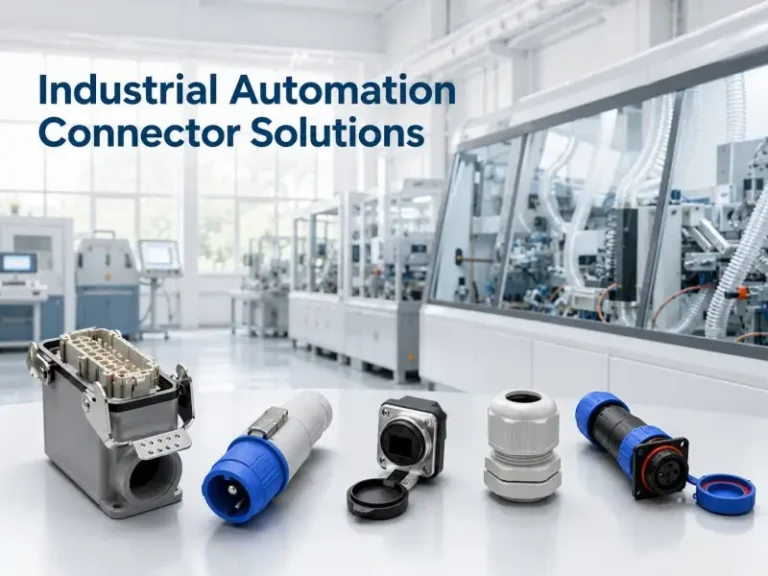
Industrial Automation Connector Solutions
The industrial automation connector solution is a comprehensive connection system designed for modern factory equipment (such as robots, PLC control cabinets, and automated assembly lines).
Unlike general-purpose connectors, the industrial solution must still guarantee the absolute reliability of power supply, sensor signal feedback, and high-speed data communication in an environment of continuous vibration, oil pollution erosion, electromagnetic interference (EMI), and extreme temperature differences.
- Robot Manipulator
- Sensor Control Box
- Automatic Control Panel
- Conveying and Driving System
Why must high-level connectors be selected in an industrial environment?
Why are ordinary civil connectors incompetent? This is determined by the ‘harshness’ of industrial production. Connectors used in industrial environments need to pay attention to three indicators: vibration resistance, corrosion resistance, and electromagnetic compatibility (EMC).
- Vibration resistance: The continuous high-frequency vibration generated by mechanical operation is easy to cause the plug to loosen, and the industrial automation connector solution adopts a thread or bayonet locking mechanism.
- Corrosion resistance: The cutting fluid, lubricating oil and cleaning agent present in the factory will corrode ordinary plastics, and industrial grade connectors usually use anticorrosive alloys or oil-resistant polymers.
- Electromagnetic compatibility (EMC): Electromagnetic noise generated by high-power motors can interfere with weak electrical signals. Shielded connectors are the key to ensuring accurate data.
How to implement efficient industrial automation connector solutions?
The industrial environment is quite complex, so during connector deployment, Verchil advises installers to follow the following technical path:
- Structure planning: distinguish power line and signal line, prevent high voltage interference low voltage signal.
- Interface selection: For frequently moving parts (such as robot end effector), priority is given to aviation plugs with high plug-in life.
- Sealing verification: When deploying waterproof joints in the control cabinet panel, it is necessary to ensure that the cable outer diameter matches the seal ring specifications to achieve the nominal IP protection level.
- Shielding grounding: In high-speed bus communication, it is necessary to use the RJ45 connector of the metal shell and ensure that the shielding layer is correctly grounded.
Industrial Automation Connector Products

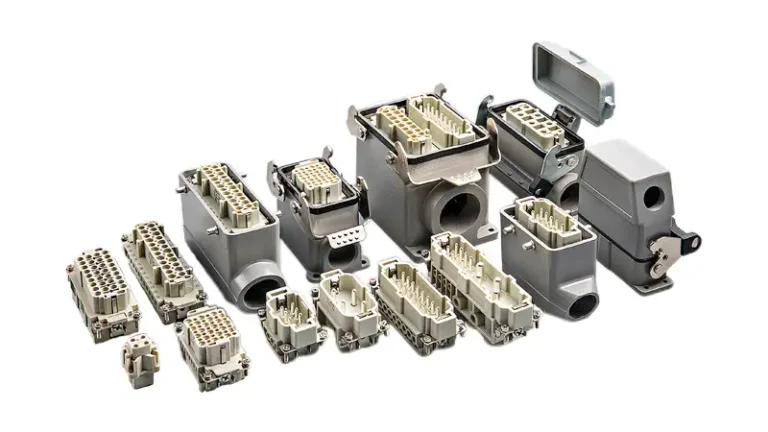
Heavy-Duty Connector (HDC)
HDC rectangular connectors are the backbone interface between a control cabinet and the machine it drives, bundling power, signal, and pneumatic lines into one keyed, lever-locked housing. On a robot cell, CNC, or conveyor line that lets a whole sub-assembly be unplugged and swapped without rewiring. Verchil's range runs from light signal inserts to high-current power modules across eight series cross-referenced to Harting, ILME, and Weidmüller.
Harting & ILME Cross-Reference: A Drop-In Heavy Duty Connector Alternative
Pin counts, current classes, and series selection live on the heavy-duty connector page; the heavy-duty connector guide walks the selection logic end to end.

PowerCon
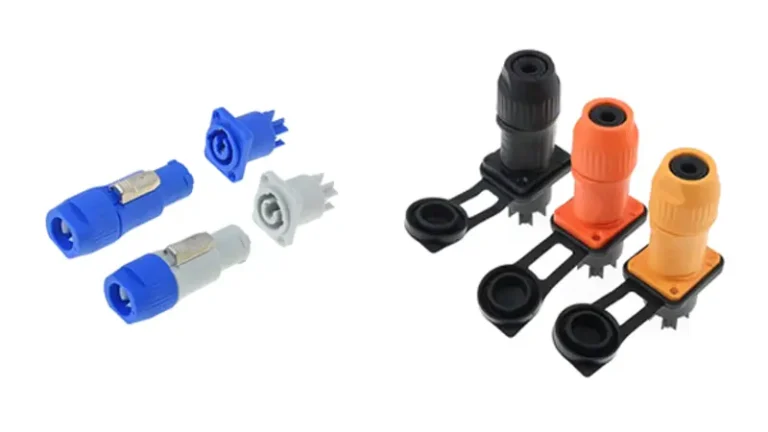
PowerCON twist-lock connectors carry single-phase AC into and between cabinets and machine modules, with a rotary lock that will not shake loose under continuous vibration. They fit power distribution where a drive, sub-panel, or breaker needs a quick, secure mains connection rather than a hard-wired terminal.
Ratings and the sealed TRUE1 variant are on the PowerCon page; wiring and safety steps are in the PowerCon guide.

RJ45 Connector
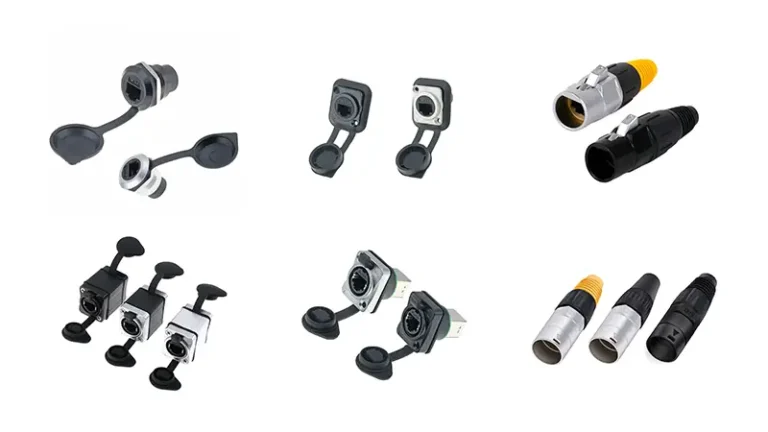
On the factory floor, industrial Ethernet — Profinet, EtherCAT, EtherNet/IP — rides on a fully shielded RJ45 in a sealed, locking shell that an office patch lead cannot match. The 360-degree shield drains the electrical noise of nearby drives and motors instead of letting it into the data line, and the seal keeps coolant and dust off the contacts.
Sealed options are on the waterproof RJ45 page; selection sits in the waterproof RJ45 connector guide.

Waterproof Cable Gland
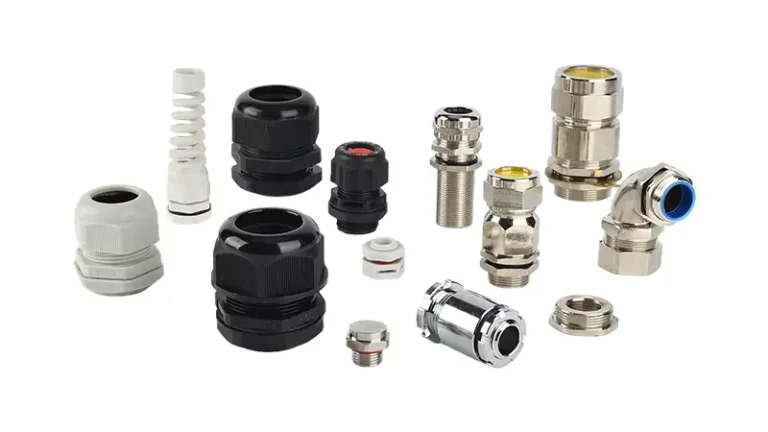
A cable gland seals every cable entry into a junction box, drive enclosure, or motor terminal box, holding the enclosure's IP rating while taking strain off the terminals inside. On a washdown line it is the quiet difference between a dry panel and a corrosion fault months later.
Thread sizes and sealing ranges are on the cable gland page; sizing help is in the waterproof cable gland guide.

Waterproof Aviation Connector
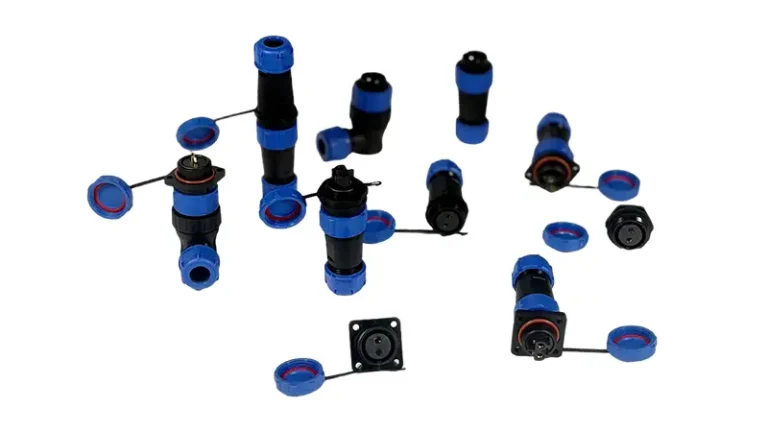
Circular M-series and SP connectors handle sensor, actuator, and signal wiring where a small, threaded, vibration-proof interface matters more than a high pin count. They bring power and control to a single field device on one sealed cable.
Configurations from compact M-shells to larger SP housings are on the waterproof aviation connector page; the aviation connector guide covers selection and pinouts.
Industrial connector comparison at a glance
| Connector | Locking / mechanism | Sealing | Carries | Best for |
|---|---|---|---|---|
| Heavy-Duty (HDC) | Stainless lever latch | IP-rated when mated | Power + signal, mixed, high pin count | Cabinet-to-machine, robot cells, CNC, conveyors |
| PowerCON | Rotary twist-lock | Sealed (TRUE1 variant) | Single-phase AC power | Cabinet/module mains, drives, sub-panels |
| RJ45 (shielded) | Latching / bayonet shell | Sealed when mated | Industrial Ethernet data | Profinet / EtherCAT / EtherNet-IP backbone |
| Cable Gland | Compression nut | Holds enclosure IP rating | Cable entry + strain relief | Junction boxes, drive & motor enclosures |
| Aviation (M-series / SP) | Threaded coupling | Sealed circular | Sensor / actuator power + signal | Field sensors, actuators, control links |
Designing for vibration, EMC, and washdown on the factory floor
Three forces break connectors in a plant, and each one maps to a design choice rather than a hope.
- Vibration. Continuous machine vibration backs off any connector that holds by friction alone. Lever latches on HDC housings and threaded couplings on circular connectors keep mating pressure where a push-fit would walk loose.
- EMC. Drives and motors flood the floor with electrical noise. A 360-degree shielded RJ45 and a properly grounded HDC shell give that noise a path to earth instead of into the data line.
- Washdown and coolant. Food, pharma, and machining lines get hosed down. Sealing every entry — glands, mated shells, gaskets — is what keeps an IP rating real instead of nominal.
Across all three, the connector is where field reliability is won or lost. Verchil builds these parts to IP65/67/68 with third-party test reports, runs UL 94 V-0 housings rated for a −40 °C to +125 °C range on the HDC line, and works to a five-stage, lot-traceable QC process — so the weakest link on the machine is not the one carrying its power and data.
Why choose Verchil as your industrial partner?
Verchil is focused on providing a full stack industrial automation connector solution.
Our products not only meet the international IEC standards, but also pass the rigorous salt spray test and vibration simulation test.
Facing the demand of high-speed industrial networks such as EtherCAT, Verchil’s shielded connection technology can significantly reduce the data retransmission rate and improve production efficiency.
What is the difference between aviation plug and ordinary circular connector?
Aeronautical plugs refer specifically to industrial-grade connectors with locking mechanisms, metal housings, and high-performance insulators. Their electrical performance and physical strength are much higher than civil standards.
How to deploy connectors in high temperature environment?
Fluorine rubber sealing rings and special alloy housings should be selected, and some connectors provided by Verchil can operate stably at temperatures up to 125°C.
How to choose the pin coating of aviation plug?
In industrial automation scenarios, it is strongly recommended to select gold-plated contacts. Although the cost is slightly higher, it can effectively prevent the contact oxidation caused by industrial waste gas and ensure that the signal remains stable for several years.
What is the reason for the leakage of Cable Glands?
The most common reason is that the cable outer diameter does not match the joint specification. The industrial automation connector solution requires that the sealing ring and the cable must form an interference fit, and too large or too small wire diameter will damage the seal.