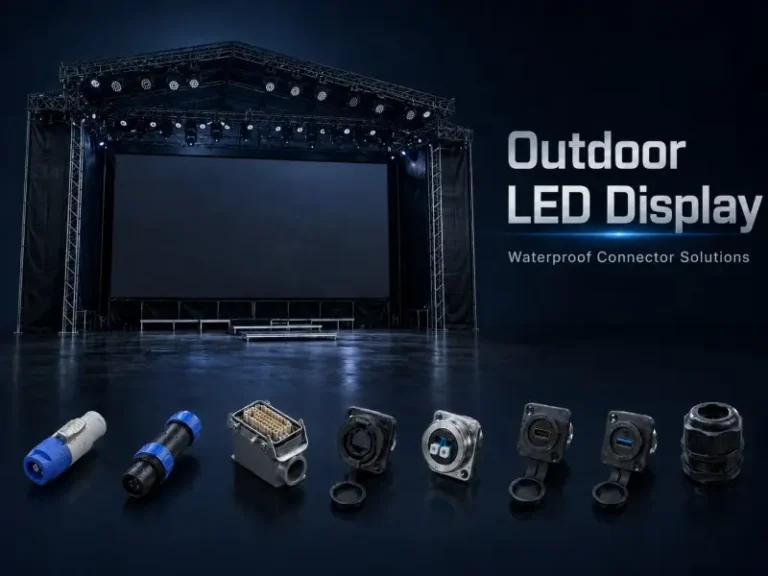
Outdoor LED Display Waterproof Connector Solutions

Outdoor LED Display Waterproof Connector Solutions

In the outdoor LED large screen display system, the connector not only undertakes power transmission and signal communication, but also directly affects the stability, waterproof performance and installation efficiency of the system.
A reliable LED connection solution must meet the high current load, stable data transmission and IP65 / IP67 protection level at the same time.
Verchil provides a complete LED display connector solution, covering power connection, data transmission and waterproof protection. It is widely used in outdoor advertising screens, stadium LED screens, rental stage screens and other scenes.
Why is connector selection crucial for outdoor LED display systems?

How bad is the outdoor LED operating environment?

The outdoor LED box is subjected to the composite stress that the indoor electronic equipment has never encountered:

A large outdoor LED display may span dozens of boxes and contain hundreds of independent connection points.

Any power or signal connector failure can result in a black screen for the entire display segment – whether during live or paid advertising broadcasts.

For this reason, each connection point of the outdoor LED system should reach at least IP65 protection level, and the key interface is recommended to use IP67 or even IP68 level.

LED Display Connection System Structure

An outdoor LED wall is one signal-and-power chain, and every connector earns its place by where it sits in that chain. Read the wall as five layers that hand off to each other:

  1. Video input. A source feeds the processor through an HDMI input at the enclosure wall — the only point raw video crosses into the system.
  2. Data distribution. The processor’s sending card pushes pixel data to the first cabinet over Ethernet; from there the signal cascades cabinet-to-cabinet. Copper (RJ45) covers runs inside ~100 m; fibre (LC) takes over for long backbones and noisy or cross-building paths.
  3. Cabinet receiving. Each cabinet’s receiving card converts the data stream into the module-level drive signals that light the LEDs, then passes the link on down the string.
  4. Power cascade. Mains enters through PowerCON or heavy-duty connectors and daisy-chains between cabinets; aviation connectors fan power and control out to the modules inside each box.
  5. Sealing. Cable glands and IP-rated panel mounts close every entry the data and power layers create, so the wall keeps its rating at hundreds of junctions, not just a few.

The layers fail together, which is why this page treats them as one system: a single unsealed RJ45 or an under-rated gland can drop the protection of an otherwise IP67 wall. Connector selection, then, is not eight separate part choices — it is one decision about how the chain stays intact end to end. The sections below take each layer in turn; the comparison table near the end maps every connector to its layer and rating at a glance.

LED Power Connection Solutions

PowerCon

PowerCON Connector

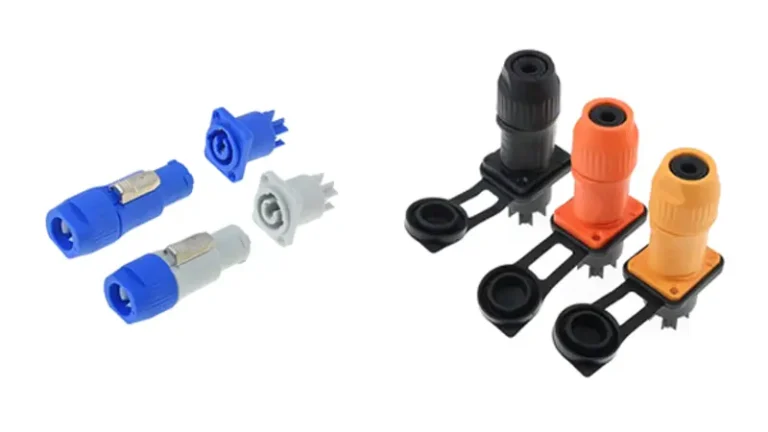
PowerCON sits at the top of the power layer — main AC distribution into the wall and daisy-chaining between cabinet strings. Its rotary lock holds under vibration, so a run of cabinets shares one protected feed without a plug shaking loose.

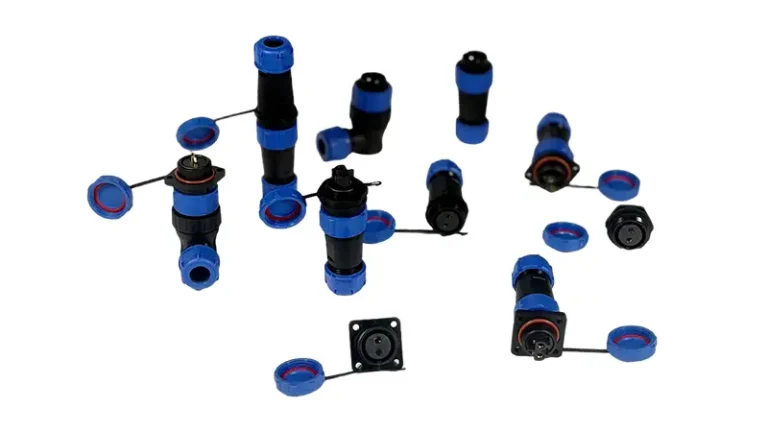
Waterproof Connector Aviation

Waterproof Aviation Connector

Aviation connectors handle module-level feeders and control signals inside the cabinet — compact circular bodies carrying hybrid power-plus-signal through one threaded IP67/IP68 coupling. They suit fixed installs where a thread-lock matters more than fast swaps.

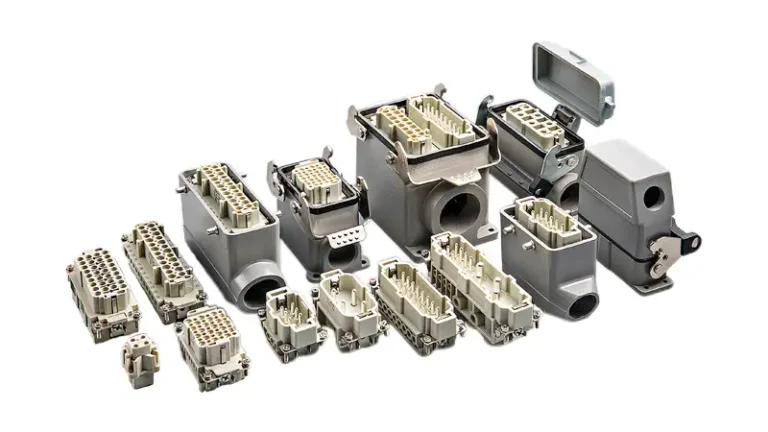
Heavy Duty Connector

Heavy Duty Connector

Heavy-duty rectangular connectors are the choice when one mating point must carry many power and signal circuits at once — rental and touring walls that get reconfigured fast. Modular inserts and anti-error keying let crews break a wall down and rebuild it without miswiring.

LED Signal Connection Solutions

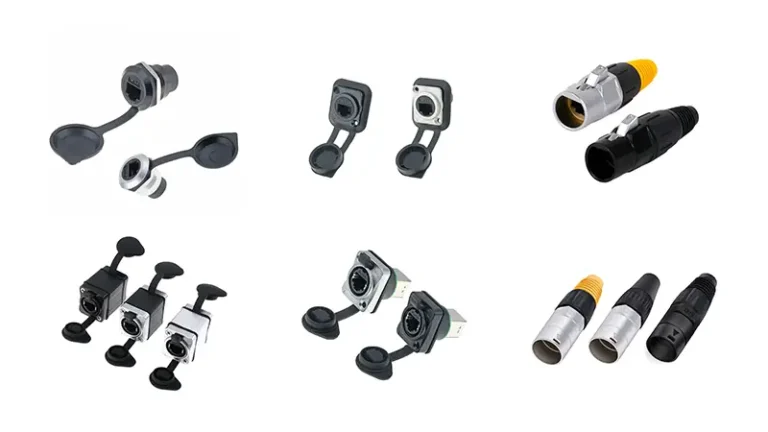
RJ45 Waterproof Connector

RJ45 Waterproof Connector

RJ45 waterproof connectors carry the data layer cabinet-to-cabinet — sealed panel-mount sockets that hold an outdoor Ethernet link at IP67 while staying field-terminable. They are the default signal link for runs inside copper's ~100 m reach.

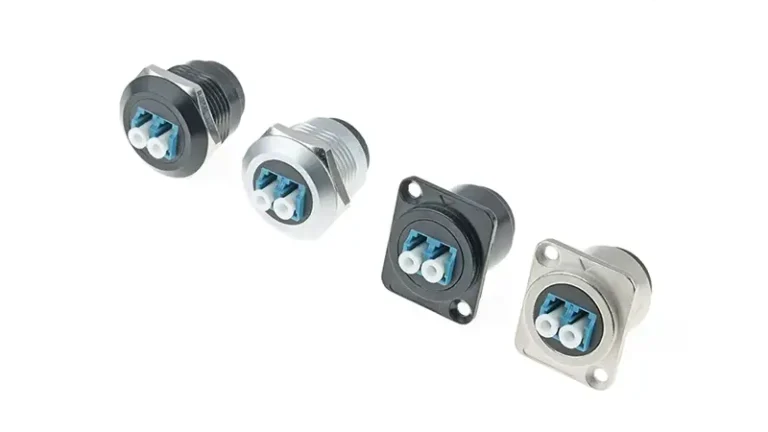
LC Panel Mount

LC Panel Mount Connector

When a signal run outgrows copper, the LC panel mount terminates the fibre backbone — electrically isolated, EMI-immune, and good for hundreds of metres up to 10 km. Whether to stay on copper or move to fibre comes down to distance, noise, and cost.

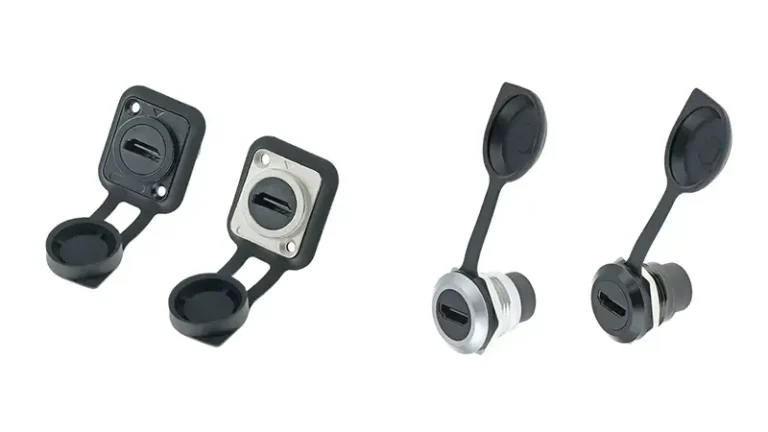
HDMI Panel Mount

HDMI Panel Mount Connector

The HDMI panel mount brings 4K video into the processor at the enclosure wall — a flush, sealed chassis pass-through so the source cable never breaches the cabinet. It serves the video-input layer, not the modules.

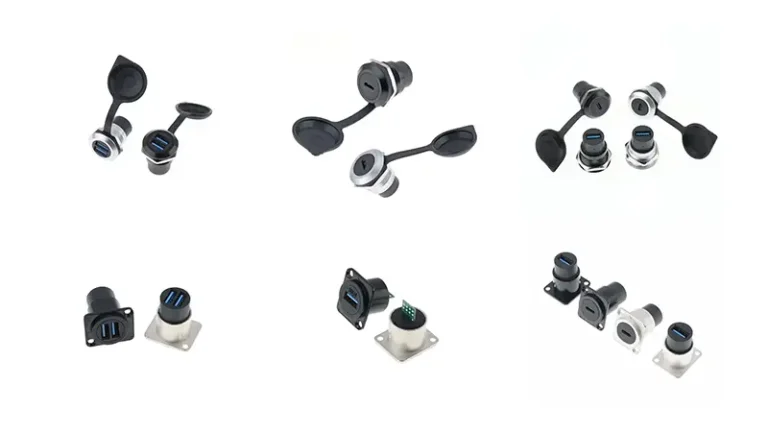
USB Panel Mount

USB Panel Mount Connector

USB panel mounts give service engineers sealed external access for firmware updates and diagnostics without opening the enclosure — an IP67 maintenance port on the cabinet skin.

LED Waterproof and Protection Solutions

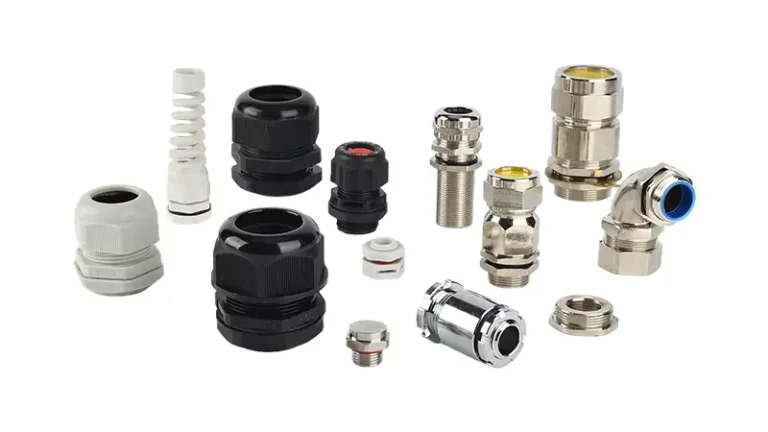
Waterproof Cable Gland

Waterproof Cable Gland

Cable glands seal every cable entry the connectors don't — compression seals through knock-out holes that hold IP68 and take the strain off internal contacts. They are the protection layer that makes the rest of the system's IP rating real.

How to Choose Connectors for Your LED Wall

Selection follows the install conditions, not a parts catalogue. Four questions settle most of it.

Indoor or outdoor? Indoor walls can run lighter sealing; outdoor walls need IP65 as a floor and IP67–68 on any exposed face — that single answer sets the rating on every connector and gland in the chain.

How long is the signal run? Under ~80 m, copper over waterproof RJ45 is the cheaper, power-carrying default. Past 100 m, or past 55 m at 10 Gbps, or through electrically noisy space, fibre on an LC panel mount is the reliable choice — the full trade-off is in when to move an LED signal run to fibre.

Fixed or rental? Permanent walls reward thread-locked aviation and PowerCON feeds; touring and rental walls reward heavy-duty modular connectors that crews can break down and rebuild fast without miswiring.

How much power per junction? A few modules off one feed can share an aviation coupling; a cabinet string drawing real current wants PowerCON or heavy-duty at the distribution point.

Work those four answers down the five-layer chain and the part list writes itself: a rating, a signal medium, a power connector, and a sealing method per junction. The comparison table below lines up every option against its layer, so you can confirm the choices before you quote.

LED Screen Connector Function Comparison Summary Table

Each row maps a connector to the layer it serves and the rating it should hold on an outdoor wall.

Connector TypeFunction in Outdoor LED SystemIP RatingKey Feature
PowerCON (TRUE1)AC mains power distributionIP65 (mated)Locking, color-coded, high-current
RJ45 WaterproofEthernet data signal (cabinet-to-cabinet)IP67Panel-mount, sealed, Cat6 compatible
LC Panel MountFiber optic long-distance signalIP67EMI-immune, 10GbE, 10 km+ range
HDMI Panel MountVideo input to LED processorIP54–IP674K/60Hz, no enclosure breach
Heavy Duty ConnectorBundled power + signal, multi-cabinetIP65–IP68High density, fast-mate, vibration-proof
Waterproof Aviation ConnectorCabinet power/control, sensorsIP67–IP68Compact circular, threaded lock
USB Panel MountMaintenance, firmware updateIP67External service access, no enclosure opening
Waterproof Cable GlandCable entry sealing, strain reliefIP68All cable types, PG/Metric thread

Designing Out the Single Points of Failure

A wall with hundreds of junctions does not fail gracefully — one open contact drops a whole segment, and the cost lands during a live broadcast, not a maintenance window. Three failure modes account for most outdoor call-backs, and each is a design choice made before the first cabinet ships.

The unmated port. Every panel connector is only sealed when it is mated or capped. An RJ45 or USB left open on an outdoor face is an IP-rated socket running at IP20 — a direct path for water into the cabinet. Spec dust caps on every spare port and the rating you paid for survives the first storm.

The under-rated entry. A cabinet can carry an IP67 panel mount and still flood through a cable gland sized to the wrong diameter. The gland’s seal range has to match the cable’s actual outer diameter; a gap there quietly defeats every sealed connector upstream of it.

The unlocked feed. Vibration and wind work a non-locking power plug loose over weeks, and the intermittent contact arcs before it fails open. Rotary-locking power connectors and thread-locked aviation couplings remove the mechanism that causes it.

The pattern across all three is the same: the wall holds the rating of its weakest junction, not its average one. Selection and installation are two halves of one reliability budget — the connectors set the ceiling, and the sealing discipline at every entry decides how much of that ceiling you keep.

Outdoor LED Display Connector Installation Best Practice

How to ensure the long-term reliability of connectors in outdoor LED installation?

Maximize the connector’s service life in outdoor LED display systems by following the following field-proven operating specifications:

Preparing before installation:

Verify that the IP level of each connector is not lower than the IP level of the box where it is located - an IP54 connector mounted on the IP67 box will become a weak link in overall protection.
Dielectric grease is coated on non-gilded contacts to inhibit oxidative corrosion in high humidity climate.
The compatibility between the actual outer diameter of the cable and the sealing range of the cable gland is verified before routing.

In the installation process:

Tighten the cable gland nut according to the manufacturer's specified torque value - too tight will tear the seal core, too loose will leave a gap.
Use anti-rotation washers or threaded locking adhesive for panel mount connectors in vibration environments.
A drip loop-down bending arc is made for the cable before the entrance of each box to prevent the water from climbing into the fixed head along the cable sheath.

After the installation is completed:

Before the system is put into operation, the IP integrity test (pressure decay test or smoke test) is carried out on the completed box.
Install dust-proof caps for all unused panel mount interfaces-HDMI panel mount, USB panel mount, and aviation connectors should be capped when not wired.
After the first heavy rain event, check all waterproof cable gland and tighten the cable when it is stable.

FAQ

Loader image

No. Ordinary RJ45 connectors and non-rated Ethernet cables will quickly fail in outdoor environments. All box interface positions must use waterproof RJ45 panel mount connectors, and all exposed segments must use outdoor-grade UV-stable shielded Cat6 cables.

The maximum transmission distance of standard Cat6 Ethernet is 100 meters. Beyond this distance, switch to fibre and terminate both ends on LC panel mount connectors. Multimode fibre then carries the signal roughly 300–400 metres at 10 Gbps — and further at lower data rates — while single-mode fibre reaches up to 10 kilometres with no practical attenuation.

The Heavy duty connector (rectangular, modular insert structure) is suitable for occasions where a large number of power and signal contacts need to be integrated into a single connector, especially for modular LED display wall systems that require frequent reconfiguration. Waterproof aviation connectors (round, thread locking) have more advantages in fixed installation occasions where the installation position is compact, the size is limited, and the anti-vibration thread locking is required.

When not in use, be sure to cover the IP rated dust cap of the USB panel mount connector. Before inserting the USB device, wipe the interface end face with a dry cloth. O-ring seals are inspected once a year and replaced when flattening, cracking or deformation is found.

The ordinary power plug is easy to be accidentally knocked off, and the intermittent contact caused by vibration causes the arc, and there is no protection for the cable pull-out. The rotary locking mechanism of PowerCON is fixedly connected from the mechanical level. The strong shell can withstand the rough treatment of on-site operation. The high rated contact parameters meet the continuous high current demand of large LED display power supply.

They need to match the box they sit on, not each other. A shaded junction can run IP65 while an exposed face needs IP67–68 — but the wall only holds the rating of its weakest sealed point, so an under-rated gland or an unmated panel port can pull down an otherwise IP67 cabinet. Rate each junction to its exposure, then verify the lowest one.

Copper has a hard ceiling, not a gentle fade. Past the ~100 m Cat6 channel limit (or ~55 m at 10 Gbps), more cable does not help — you either insert a powered switch or convert to fibre. For most outdoor walls past 100 m, a single fibre pull is simpler and more reliable than a mid-run powered box that itself needs sealing and power.

Ensure Stable Transmission and Long-term Equipment Reliability

Every connector above ships from one vertically integrated factory, third-party tested to IP65/67/68 and built under ISO 9001 with lot-traceable QC — so the rating on the datasheet is the rating on the wall.

As a professional manufacturer specializing in connector assembly, VERCHIL has been adhering to its commitment and dedication to customers, delivering premium quality connectors at reasonable prices.

Send us your wall’s distances, exposure, and power per cabinet, and we will spec the full connector chain. Request a quote or message us on WhatsApp.