The best connector for a coastal environment depends on where it sits. Enclosures need a stainless steel (SS316) or nickel-plated brass cable gland. Deck-level equipment needs a waterproof aviation connector rated IP67 or higher. Outdoor network runs need an IP65-rated waterproof RJ45 — built for wind-driven rain and dust, not submersion.
So which connector actually survives a coastal deployment — the aviation plug, the gland, or the RJ45 jack? There’s no single winner: salt fog attacks metal and rubber seals differently than it disrupts a signal path, and overbuilding for the wrong zone just adds cost. We hear this question often from customers spec’ing dockside and marine equipment. This guide breaks the choice down by where the connector actually sits, not by a marketing claim on a datasheet.
Jump to: What damages coastal connectors · Cable glands · Aviation connectors · RJ45 for coastal networks · Match by installation zone
What actually damages connectors in coastal environments
Coastal environments attack connectors through four separate stress mechanisms — salt spray, moisture, vibration, and UV exposure — and a high IP rating only addresses one of them directly. Amphenol LTW’s marine connector guidance confirms this exact list, noting that “marine electrical connectors are designed for wiring systems exposed to salt spray, moisture, vibration, UV exposure, and temperature swings” (retrieved July 17, 2026). A high IP rating and corrosion resistance are two different claims, and coastal environments punish the gap between them. Salt fog deposits an electrolyte film on exposed metal that drives galvanic corrosion, especially where two dissimilar metals touch. UV breaks down rubber and plastic seals over months, long after the connector passed its original IP test in a lab. Vibration works a seal loose millimeter by millimeter, letting the first two mechanisms in.
Connector Supplier’s marine connector overview by Rob Iversrud (Waytek) makes the same point from the design side: “connectors used in marine applications will typically have high IP ratings and operating temperature ranges, and will be constructed to handle shock, vibration, and exposure to corrosive chemicals and environmental conditions” (retrieved July 17, 2026). None of that is captured by an IP digit alone — see our waterproof connector types and IP ratings guide for what the IP code actually tests, and our salt-spray testing standards guide for how corrosion resistance gets measured separately, under ASTM B117 and IEC 60068-2 hour ratings, not an IP chamber.
Cable glands: stainless steel vs. nickel-plated brass for coastal installs
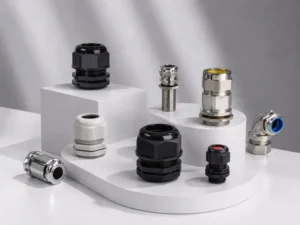
Three cable gland materials cover nearly every coastal exposure level, and the right one is dictated by how directly the gland faces salt spray, not by budget alone. As of 2026, independent salt-spray testing data compiled by HR Fastener’s plating comparison shows plain zinc plating holding “about 120–200 hours” before red rust under continuous ASTM B117 salt fog, zinc-nickel plating reaching “500 to 1000 hours,” and stainless 304/316 running past 1,000 hours with “often no red rust” at all (retrieved July 17, 2026) — the same underlying data we sourced in full for our salt-spray resistance guide.
Translated into a buying decision: a nickel-plated brass cable gland is the right call for enclosures set back from direct spray — control cabinets under a canopy, equipment rooms with coastal-air exposure but no standing salt film. Once the gland is on an open deck, a dockside rail, or anything that gets washed down or spray-hit directly, step up to a stainless steel (SS316) cable gland — see the full type comparison in our cable gland guide for thread size and sealing-insert options beyond material.
| Material | Best-fit zone | Salt-spray life (ASTM B117) |
|---|---|---|
| Standard zinc-plated | Sheltered/indoor only — not recommended near salt air | ~120–200 hours |
| Nickel-plated brass | Enclosed coastal cabinets, canopy-covered equipment | 500–1000 hours |
| Stainless steel (SS316) | Open deck, dockside, direct spray or wash-down exposure | 1000h+ — often no red rust |
Source: HR Fastener zinc-nickel/salt-spray plating comparison (ASTM B117), retrieved July 17, 2026.
Waterproof aviation connectors for coastal and outdoor equipment
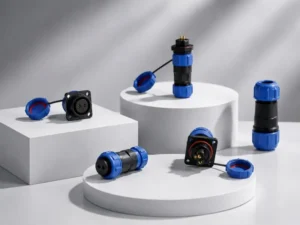
IP67 or higher is the baseline rating for waterproof aviation connectors on coastal and outdoor equipment that still needs to be unplugged for service. Circular aviation-style connectors are the default choice for that use case, and Amphenol LTW’s guidance confirms it directly: “waterproof circular connectors are suitable for boats when they match the required IP rating, current rating, contact count, and cable size,” and are “commonly used for marine electronics, sensors, lighting, control panels, and NMEA 2000-style network connections” (retrieved July 17, 2026).
The same logic applies to any coastal-adjacent installation, not just boats — outdoor lighting controllers, dockside sensor housings, and communications cabinets all sit in the same exposure category. For that tier of exposure, Verchil’s waterproof aviation connector range is built to the same IP67-and-above bracket the guidance above describes for deck-level equipment; see our aviation connector guide for pin-count, locking-mechanism, and contact-plating options once the IP tier is settled.
Waterproof RJ45 for coastal networks — and where IP65 stops
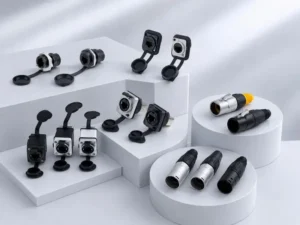
IP65 covers wind-driven rain, dust, and general outdoor exposure on a waterproof RJ45 connector — it does not cover submersion, and that distinction matters most at coastal sites. Ethernet infrastructure at a coastal site — CCTV, dockside comms, environmental sensors — needs the same sealing logic as power connectors, and the industry reasoning is well established for harsh-environment networking generally. Cabling Installation & Maintenance reported on an industrial Ethernet switch built to “ensure tight, waterproof and dustproof robust connections” and “reliable operation, even in applications subject to high vibration and shock” (retrieved July 17, 2026) — that’s the general principle harsh-environment networking hardware is designed around, even though that specific report covers an IP67 industrial switch rather than a marine-specific product.
Here’s the honest limit on Verchil’s side: our IP65 waterproof RJ45 connector is sealed against wind-driven rain, spray, and dust — the second-digit-5 tier explained in our IP65 vs. IP68/IP69K breakdown — not against submersion. If the network run genuinely sits in a splash zone or below a waterline at any point, an IP65 RJ45 is the wrong part for that job, full stop; that calls for a fully potted or immersion-rated data connector, which isn’t what this product line is built or sold to do.
How to match your connector choice to the installation zone
Three installation zones — enclosed cabinets, open deck or dockside equipment, and splash-zone or below-waterline connections — cover nearly every coastal installation, and matching connector to zone matters more than a “marine” label on a datasheet. As of 2026, Amphenol LTW’s own application table maps this by zone: cabin wiring at IP54–IP67 for “basic insulation and service access,” deck electronics at IP67–IP68 for “sealing against spray and rain,” and engine harnesses at IP67-plus for vibration resistance (retrieved July 17, 2026).
Translated to the product categories in this guide: equipment fully enclosed away from direct weather can usually run on a nickel-plated brass gland and a standard sealed connector; equipment on open deck, dockside, or anywhere exposed to direct spray and rain needs the SS316 gland plus an IP67-or-higher waterproof aviation connector; data runs anywhere in that same open-air zone need the IP65 RJ45 — provided the run never sits in standing water or a splash zone at the connector itself. Connector Supplier points buyers toward the same discipline, noting that marine electrical systems should follow American Boat and Yacht Council (ABYC) wiring standards as the baseline before connector selection even starts (retrieved July 17, 2026).
One honest gap: fully submerged or splash-zone connections sit outside every product referenced in this guide — Verchil does not currently offer a hermetically sealed or deep-submersion connector line, and forcing an IP65 or IP67 part into that role is a real failure mode, not a rounding error.
| Installation zone | Recommended gland | Recommended connector | Typical IP rating |
|---|---|---|---|
| Enclosed cabinet | Nickel-plated brass | Standard sealed connector | IP54–IP67 |
| Open deck / dockside | Stainless steel (SS316) | IP67+ waterproof aviation connector; IP65 waterproof RJ45 for data (no standing water at the connector) | IP67–IP68 |
| Splash zone / below waterline | — | Outside Verchil’s current product range — no hermetic/deep-submersion line offered | N/A |
Source: Amphenol LTW marine application-to-IP-rating table, retrieved July 17, 2026 — zone labels adapted to Verchil’s product categories.
Vessel-specific projects — where power, data, sensor and audio connectors all need to be specified together, not just cable glands — are covered in more depth in Verchil’s guide to marine connector solutions for shipboard systems.
The bottom line on coastal connector selection
There’s no single “best” coastal connector — there’s a best match for where salt air, spray, and vibration actually reach the part. Enclosed equipment gets a nickel-plated brass gland; open-deck and dockside equipment gets SS316 plus an IP67+ aviation connector; outdoor network runs get an IP65 RJ45, provided the run stays clear of standing water. If your installation doesn’t fit neatly into one of these three zones — or sits somewhere between them — WhatsApp Verchil’s engineering team with the specifics, or request a quote and we’ll match the spec to the actual environment, not the label.
Frequently Asked Questions
Are marine-grade connectors the same as waterproof connectors?
No. “Waterproof” describes IP-rated ingress protection against water and dust; “marine-grade” implies both that IP rating and a material or plating choice that resists salt-fog corrosion over time. A connector can be fully waterproof and still corrode in a coastal environment if its base metal or plating isn’t suited to salt exposure — the two properties are tested separately and neither one implies the other.
Can I use a standard cable gland in a coastal environment?
It depends on exposure, not just distance from the water. A gland fully enclosed indoors, away from direct salt spray, can often use standard nickel-plated brass. Anything on an open deck, dockside, or exposed to direct wash-down should move to stainless steel (SS316), which independent salt-spray data shows lasting several times longer before red rust than standard plating.
Does a higher IP rating mean better corrosion resistance?
No — the two are unrelated test families. An IP rating measures how well a seal keeps out dust and water under a lab-controlled jet or immersion test; it says nothing about whether the connector’s metal or plating survives long-term salt exposure. A connector can carry IP68 and still corrode in a coastal environment if its material isn’t rated for salt fog.
What connector type is best for boat deck electronics?
A waterproof aviation-style (circular) connector rated IP67 or higher, matched to the required current rating, contact count, and cable size for the specific device. This is the connector type manufacturer guidance consistently recommends for deck-level sensors, lighting, and control panels exposed to direct spray and rain.
Is IP65 enough for outdoor network (RJ45) connections in coastal areas?
Yes, for wind-driven rain, dust, and general outdoor exposure — that’s exactly what IP65’s second-digit-5 rating is tested against. No, if the run sits in a splash zone or any point of standing water; IP65 does not cover immersion, and forcing it into that role is a genuine failure mode, not a technicality.
How long do marine-grade connectors last before they corrode?
There’s no single honest number — real-world coastal exposure varies too much by wind direction, distance from the waterline, and wash-down frequency to translate directly from a lab hour-rating. What is measurable is the material’s relative performance under controlled salt-spray testing (see our salt-spray resistance guide for ASTM B117 and IEC 60068-2 hour comparisons); treat those hours as a comparison tool between materials, not a field lifespan guarantee.