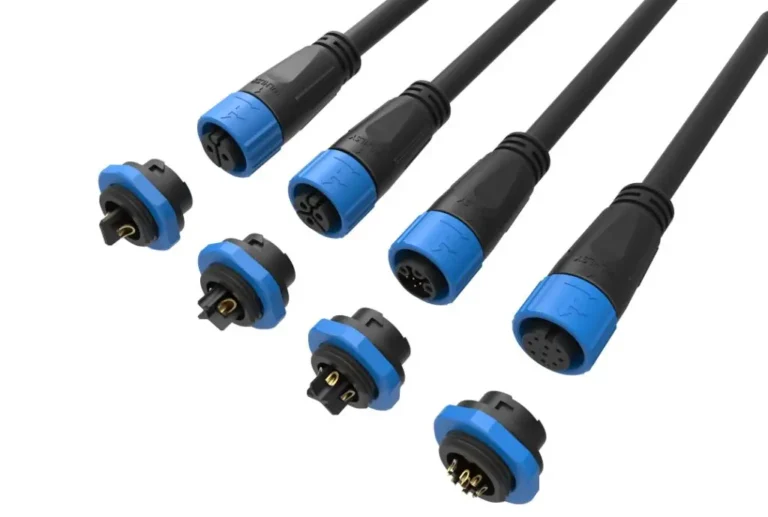
A waterproof wire connector is a sealed connector that protects a wire-to-wire or wire-termination joint from moisture, dust, and corrosion using gaskets, silicone seals, heat-shrink adhesive, or potting. Achieving its rated IP protection depends equally on the wire — conductor material, strand structure, jacket compatibility, and AWG must all match the connector’s seal.
Picked a quality IP67 connector but still seeing premature seal failures? Because the wire is the other half of every sealed joint — conductor material, jacket, and AWG all affect whether the seal holds — choosing the right connector is only half the job. This guide covers wire selection, AWG sizing, the five waterproof wire connector types, step-by-step wiring, and industry applications, so you can select and install correctly for any environment.
This page focuses on waterproof wire connectors for wire-to-wire joints, wire terminations, and wet-location wiring. If you need a broader comparison of waterproof connector types, IP ratings, plug connectors, cable glands, RJ45 connectors, or circular connectors, start with our waterproof connector types and IP ratings guide.
What is a waterproof wire connector?
Waterproof wire connectors are sealed connectors used to join or terminate wires in wet, outdoor, buried, or corrosive environments. Choose them by wire gauge, wire count, conductor material, jacket diameter, seal method, and whether the joint must be serviceable, direct-buried, or protected inside an enclosure.
- Confirm whether the location is wet, outdoor, buried, or serviceable.
- Match the connector to the wire gauge and number of conductors.
- Check whether the connector is suitable for the conductor material.
- Match the seal to the cable jacket, insulation, and outer diameter.
- Verify datasheet limits before using the connector in production.

Why wires are as important as connectors
Because even a correctly chosen IP67 connector fails prematurely on the wrong wire, the wire is the other half of the system — common failures include the conductor oxidizing, a jacket material incompatible with the seal, or vibration fatigue breaking the crimp interface. For a waterproof wire connector to reach its rated protection, evaluate the wire across four dimensions: conductor material, conductor structure, insulation jacket material, and wire gauge (AWG).
Choose the right wire for the waterproof connector
Conductor material: bare copper vs. tinplated copper vs. aluminum conductor
Conductor material is the primary decision when selecting a waterproof wire connector.
Select the conductor type according to the application environment; tinned copper is the first choice for ship and outdoor applications.
| Conductor Type | Corrosion Resistance | Compatibility | Recommended Application |
|---|---|---|---|
| Bare Copper | Moderate | Universal | Indoor / low-humidity environments |
| Tinned Copper | Excellent | Universal | Marine, outdoor, industrial |
| Aluminum | Poor (untreated) | Aluminum-rated connectors only | High-current, weight-sensitive builds |
| Silver-Plated Copper | Excellent | Universal | High-frequency, aerospace, medical |
Conductor structure: Solid Wire and Stranded Wire
Conductor insulation and Jacket compatibility
The wire insulation sheath must be physically compatible with the connector cable inlet seal, usually a silicone rubber sealing gland (Cable Gland), an elastic sealing sheath, or a heat-shrinkable rubber tube. The material incompatibility will cause the seal to not be completely compressed around the sheath, forming a seepage channel.
The following is the compatibility of common insulating materials and waterproof connector sealing systems:
| Insulation Material | Temp Range | Seal Compatibility | Common Use |
|---|---|---|---|
| PVC | -20°C to +80°C | Good — flexible, seals well | General wiring, automotive |
| XLPE | -50°C to +125°C | Good | Automotive, industrial |
| Silicone | -60°C to +180°C | Excellent | High-temp, industrial |
| TPE / TPU | -40°C to +105°C | Excellent — high abrasion resistance | Mobile equipment, robotics |
| PTFE | -65°C to +260°C | Moderate — glands must close tightly | Aerospace, chemical processing |
| Neoprene | -40°C to +90°C | Excellent — oil and UV resistant | Marine, outdoor |
The sheath material must match the connector seal type and the working temperature range at the same time; the outer diameter (OD) of the sheath must also be within the specified range of the sealing gland.
For how these insulation temperature ratings roll up into an overall connector’s rated operating range — and where derating applies — see our connector temperature range guide.
Waterproof connector AWG wire diameter selection guide
The wire diameter determines the current carrying capacity, voltage drop and mechanical strength. For waterproof wire connectors, the correct AWG selection is also the key to achieving good crimping seals – the bushing must compress the correct conductor cross-sectional area in order to simultaneously clamp the wire and enable the back-end seals to mesh effectively.
Current carrying capacity and AWG wire diameter comparison table (copper wire, 60°C-75°C insulation level)
| AWG | Cross-Section (mm²) | Max Current (Chassis) | Max Current (Engine Bay) | Typical Connector Application |
|---|---|---|---|---|
| 22 AWG | 0.35 mm² | 7A | 5A | Sensor signals, low-current lighting |
| 20 AWG | 0.50 mm² | 11A | 8A | Control circuits, LED strips |
| 18 AWG | 0.75 mm² | 16A | 12A | Automotive accessories, marine nav lights |
| 16 AWG | 1.00 mm² | 22A | 16A | Pumps, fans, auxiliary loads |
| 14 AWG | 1.50 mm² | 32A | 22A | Main branch circuits, bilge pumps |
| 12 AWG | 2.50 mm² | 41A | 30A | High-current accessories, solar PV |
| 10 AWG | 4.00 mm² | 55A | 40A | Battery cables, inverter feeds |
Because sealed connector assemblies may dissipate heat differently from open-air wiring, confirm continuous current, conductor size, temperature rise, and derating requirements from the connector datasheet or project standard before production use.
Wire Fit First: The Waterproof Wire Connector Selection Rule
Wire Fit First means choosing waterproof wire connectors by the wire and seal fit before comparing brands, colors, or general waterproof claims. A connector can have a strong sealing design, but it can still fail if the wire gauge, conductor count, insulation diameter, or jacket material does not match the connector body.
| Selection Point | What to Check | Risk If Ignored | Where to Go Next |
|---|---|---|---|
| Wire gauge / AWG | Check the manufacturer’s accepted wire range and wire combination chart. | Loose contact, poor compression, overheating, or pull-out failure. | Send wire gauge and quantity through the Verchil contact page. |
| Wire count | Confirm how many conductors will be joined in one connector. | The connector may be too small, too loose, or unable to seal evenly. | Ask for a wire combination check. |
| Conductor material | Confirm whether the wire is copper, tinned copper, aluminum, or mixed material. | Wrong material pairing may cause compatibility or corrosion problems. | Request datasheet confirmation before ordering. |
| Insulation / sheath material | Check PVC, XLPE, rubber, silicone, TPE, or other jacket materials. | The seal may not compress correctly or may age faster in the application environment. | Submit cable sheath information for review. |
| Cable outer diameter | Match the cable OD to the sealing range or connector body design. | Water can enter through the cable entry even if the connector is called waterproof. | Provide cable OD in the RFQ. |
| Installation environment | Separate indoor wet area, outdoor exposure, direct burial, valve box, marine, or industrial use. | The connector may be used outside its intended wet-location or burial condition. | See outdoor waterproof wire connectors for outdoor and burial scenarios. |
| Serviceability | Decide whether the joint must be reopened later. | Some sealed wire connectors are not suitable for repeated reuse after opening. | Use a waterproof plug connector if repeated mating is required. |
5 Waterproof Wire Connector Termination and Sealing Methods
Understanding the main connector types enables the procurement and engineering teams to accurately match the dimensions to the wire type and application requirements.
The heat-shrinkable connector combines the Crimp butt sleeve with the double-wall heat-shrinkable pipe, and the heat-shrinkable pipe is lined with hot melt adhesive. After heating, the outer layer shrinks and the inner layer melts, forming a complete environmental seal between the conductor insulation layer and the outer wall of the casing. It is most suitable for the use of stranded wire with PVC and XLPE sheath.
- Most applicable scenarios: on-site maintenance, car wiring, ship wire docking
- Conductor compatibility: stranded copper or tinned copper, 22-10 AWG
- Core advantage: only hot air gun, quick installation
This type of connector uses a spring-loaded or lever-driven clamping mechanism in conjunction with a pre-installed silicone rubber sealing washer or O-ring. Reusable, suitable for installation occasions that require regular maintenance, compatible with single strand and stranded wire.
- Most suitable scene: outdoor LED lighting, junction box, distribution panel wiring
- Wire compatibility: single strand or strand, 24-12 AWG; confirm the minimum strand grade
- Core advantages: tool-free, repeatable opening, suitable for multi-conductor applications
Circular M8 / M12 / M23 waterproof connectors can be used when a wire connection must become a removable, lockable field interface instead of a permanent wire joint. In this guide, treat them as an alternative direction, not the main waterproof wire connector type.
- Use when: the wiring needs repeated mating, panel mounting, or a standardized field connector.
- Check first: cable outer diameter, wire gauge, conductor type, rear seal range, and whether the IP rating applies only when fully mated.
- Go deeper: for sensor, actuator, PLC, or machine wiring, see industrial automation connector solutions.
A waterproof butt splice connector is used when two wire ends need a fixed inline joint. On this page, the main selection point is wire fit: conductor size, conductor material, crimp compatibility, insulation diameter, and whether the seal can close evenly around the wire jacket.
- Best for: fixed wire-to-wire joints where a removable plug is not required.
- Check first: accepted AWG range, conductor material, crimp method, seal compression, and whether the connector is intended for the actual wet-location condition.
- Go deeper: for enclosed IP68-style splice selection, see waterproof splice connectors IP68.
A potted or encapsulated connector uses resin or compound to seal the wire end after assembly. It can improve environmental protection for fixed installations, but it is usually not serviceable after sealing and must be checked for compatibility with the wire jacket and potting material.
- Best for: fixed installations where reopening the joint is not expected.
- Check first: jacket material, bonding compatibility, conductor preparation, curing process, and whether the assembly method is suitable for the target environment.
- Avoid assuming: potting does not automatically mean every IP, marine, underwater, or high-vibration requirement is satisfied. Ask for the datasheet or test condition before using it in production.
Before Following Any Wiring Step
The steps below should be treated as a general installation checklist. For production wiring, always follow the connector manufacturer’s datasheet for stripping length, crimp tool, torque, heat-shrink temperature, pull test, IP test condition, and reuse limit.
For this page, the key selection rule remains the same: verify wire gauge, conductor material, cable outer diameter, sheath material, and seal compatibility before assembly.
When a Waterproof Wire Connector Is Not the Right Choice
A waterproof wire connector is best for joining or terminating wires. It is not always the right solution for every waterproof connection problem. Use the table below to route the application correctly.
| If the project needs… | Use this direction | Page |
|---|---|---|
| A cable entering an enclosure, box, cabinet, or device housing | Waterproof cable gland | Waterproof cable gland |
| A reusable male-female connection | Waterproof plug connector | Waterproof plug connector guide |
| An enclosed IP68-style joint or repair splice | Waterproof splice connector | Waterproof splice connectors IP68 |
| Outdoor, UV-exposed, garden, irrigation, or direct-burial wiring | Outdoor waterproof wire connector | Outdoor waterproof wire connectors |
| Low-voltage DC wiring in RV, boat, solar accessory, LED, or vehicle systems | Waterproof 12V connector | Waterproof 12V connector guide |
| A general overview of connector types and IP ratings | Main waterproof connector guide | Waterproof connector types and IP ratings guide |
| Automotive / solar / high-current product families (MC4, Anderson, Deutsch) | Waterproof electrical connector | waterproof electrical connectors guide |
Need Verchil to Check Your Wire Fit?
Send the wire gauge, conductor material, wire count, cable outer diameter, sheath material, current, voltage, and installation environment. Verchil can help confirm whether a waterproof wire connector, splice connector, plug connector, or cable gland is the better direction.
Request Waterproof Wire Connector Support | Chat on WhatsApp
Waterproof Connector Wiring Steps Guide
The steps below are a general installation checklist for waterproof wire connectors. For production wiring, always follow the connector manufacturer’s datasheet for stripping length, crimp tool, torque, heat-shrink temperature, pull test, IP test condition, and reuse limit.
Step 1: Select the correct connector and verify wire compatibility
Verify that the AWG range of the connector bushing matches your wire diameter. It is verified that the conductor structure (single strand, strand, ultra-fine strand) is supported. Check that the OD of the wire sheath falls within the specified range of the connector cable inlet. It is confirmed that the conductor material (copper, tin-plated copper, aluminum) is compatible with the connector contact coating.
Step 2: Remove the wire insulation layer according to the correct length
Remove the insulation according to the connector manufacturer’s specified stripping length. Use a calibrated stripping tool that matches the wire size. Avoid cutting or nicking individual strands, because damaged strands can reduce conductor area, weaken the termination, and increase failure risk. After stripping, check that the conductor is clean, straight, and fully inserted according to the connector instruction.
Step 3: Pre-thread the seals before termination (suitable for sealed lid connectors)
Because forgetting to pre-thread the seal means a complete redo after crimping, thread the wire through the locking nut, cable gland, and O-ring before terminating — this is the single most common installation error.
Step 4: Process the conductor and prepare the termination
For the stranded wire to be crimped, do not tin with solder in advance. The single-strand conductor filled with solder is rigid, and will break at the edge of the crimping sleeve under vibration, forming a stress concentration point and a potential fracture position. Direct crimping bare copper or tinned copper stranded wire.
For the Fine-Stranded Wire, the stripped conductor is twisted in a clockwise direction (from the end direction) for 3-4 turns and then inserted into the sleeve. In this way, the single strand can be gathered together to prevent the single conductor from spreading out of the casing during crimping.
Step 5: Terminate the conductor
Terminate the conductor according to the connector type and datasheet. For crimp connectors, use the specified contact, die profile, and ratcheting crimp tool. For screw-terminal connectors, tighten with a calibrated torque screwdriver to the manufacturer’s specified torque. For push-in connectors, confirm full insertion and engagement according to the product instruction. Do not use one generic torque, crimp profile, or pull-test value for all waterproof wire connectors.
Step 6: Close and compress the wire seals
Close the rear seal, gland, sleeve, O-ring, or heat-shrink body according to the connector instruction. The seal should compress around the cable jacket or sheath, not only around the inner conductor insulation. For heat-shrink waterproof wire connectors, use the heating method, temperature range, and dwell time specified by the manufacturer, and confirm that the seal closes evenly around the wire jacket.
Step 7: Docking the connector and verifying the overall assembly
After assembly, check that no conductor is exposed, the seal is fully seated, the rear cable entry is compressed evenly, and any locking or mating structure is correctly engaged. For critical applications, perform the verification method specified by the connector manufacturer or project requirement. Do not apply a generic air-pressure, immersion, or pull-test value unless it is supported by the product datasheet or test procedure.
Cable Entry and Wicking Failure: Why Waterproof Wire Connectors Still Fail
Many waterproof wire connector failures do not start at the connector face. They start at the cable entry, where water can move along conductor strands, sheath gaps, or an incorrectly compressed rear seal. This is why wire gauge, cable outer diameter, conductor material, sheath material, and seal compression must be checked together.
A higher IP rating does not automatically solve wicking. If the cable entry is not sealed around the actual cable jacket, moisture can bypass the housing seal and reach the conductor or contact area from inside the wire path.
| Failure sign | Likely cause | What to check |
|---|---|---|
| Connector housing looks intact, but contacts are corroded | Water wicking through the cable or conductor strands | Cable entry seal, sheath OD, conductor type, rear boot, heat-shrink or potting requirement |
| Water marks run along the conductor or cable core | Unsealed cable end or poor sheath-to-seal fit | Whether the seal compresses around the cable jacket rather than only the insulation |
| Intermittent continuity after rain or washing | Moisture reaches the termination area | Connector locking, cable OD range, strain relief, and assembly condition |
| Green or white corrosion deposit appears | Moisture plus incompatible conductor/contact material | Conductor material, contact plating, cable jacket, and environmental exposure |
| Seal is flattened, cracked, or hardened | Seal aging, UV, chemical exposure, or wrong gasket material | Gasket material, replacement condition, and supplier maintenance guidance |
Cable Entry Sealing Checklist
- Measure the cable first: confirm cable outer diameter, jacket material, conductor count, and wire gauge before selecting the connector.
- Match the rear seal: the seal should compress around the cable jacket or sheath, not only around the inner conductor insulation.
- Prepare the conductor correctly: strip, crimp, tighten, or insert according to the connector manufacturer’s datasheet.
- Check strain relief: movement, pulling, vibration, and bending can open a leak path at the cable entry.
- Verify before sealing permanently: use the verification method required by the product datasheet or project test procedure.
Industry Application Guide
The application examples below are routing examples, not full system design guides. This page focuses on wire fit, AWG, conductor material, sheath compatibility, cable entry sealing, and waterproof wire connector failure diagnosis. For 12V systems, product-family electrical connectors, plug connectors, outdoor burial, or IP68 splice connectors, use the dedicated Verchil guides linked below.
For MC4, Deutsch, Anderson, Weatherpack, and other sealed electrical connector families, see the waterproof electrical connectors guide.
Ships and Marine Wiring
Marine wiring exposes wire joints to vibration, moisture, salt air, and corrosion risk. For this page, focus on conductor material, sheath compatibility, cable-entry sealing, and whether the sealed joint can resist movement and moisture ingress. For broader marine electrical connector family selection, see the waterproof electrical connectors guide.
Photovoltaic (PV) and Renewable Energy
PV and renewable-energy wiring should not be selected by connector appearance alone. Confirm the cable type, conductor material, jacket OD, seal range, current, voltage, and product datasheet before use. For MC4, Anderson, Deutsch, and other sealed electrical connector families, see the waterproof electrical connectors guide.
Industrial Automation
Industrial automation wiring often requires vibration resistance, shielding, repeatable field connection, and stable sealing around the cable jacket. If the application is mainly sensor, actuator, PLC, fieldbus, or M8 / M12 wiring, see industrial automation connector solutions.
Agricultural Machinery and Heavy Equipment
Agricultural machinery and heavy equipment expose wire joints to vibration, mud, moisture, fertilizer, hydraulic oil, and cable movement. For waterproof wire connectors, check cable OD, sheath material, conductor type, rear seal compression, and strain relief. For low-voltage DC systems, see the waterproof 12V connector guide.
Troubleshooting Waterproof Wire Connector Failures
When a waterproof wire connector fails in the field, do not only replace the connector body. Check the wire, cable entry, seal compression, conductor material, contact area, and installation method.
| Failure mode | Typical symptom | Selection or installation check |
|---|---|---|
| Wicking | Contacts corrode while the outer housing still looks sealed. | Check cable entry sealing, conductor strand path, sheath OD, rear seal, and whether heat-shrink or potting is needed. |
| Galvanic corrosion | Green or white deposits appear near contacts or conductors. | Check conductor material, contact plating, shell material, moisture exposure, and salt or chemical environment. |
| Seal aging or cracking | O-ring, boot, or gasket becomes hard, flat, split, or loose. | Check gasket material, UV exposure, chemical exposure, heat exposure, and supplier maintenance guidance. |
| Fretting or vibration-related failure | Resistance changes with vibration, movement, or temperature cycling. | Check locking style, strain relief, contact retention, cable movement, and vibration requirement. |
| Bad crimp or poor termination | A new connector fails early or heats under load. | Check stripping length, crimp tool, die profile, terminal fit, conductor insertion, and datasheet assembly procedure. |
Frequently Asked Questions
Which wire is the most suitable for waterproof connectors in outdoor applications?
For outdoor wet-location wiring, tinned copper stranded wire with a UV-resistant TPE or chloroprene rubber jacket is usually a safer wire choice than bare copper. However, direct-burial connector selection, gel-filled products, DBY-style connectors, and UL 486D considerations should be checked in the outdoor waterproof wire connectors guide.
Can waterproof connectors use a single wire?
Yes, but only for fixed installation occasions where the wire will not withstand vibration or repeated bending. The single-strand conductor is prone to fatigue fracture at the edge of the crimping sleeve under vibration. The stranded wire must be specified for any mobile device, vehicle or vibration application.
Does the wire sheath material affect the connector IP protection level?
Yes, but the effect is indirect. The IP protection level of the connector can only be achieved when the sealing gland or back-end seal is completely and evenly compressed around the wire sheath. If the sheath is too hard (PTFE at low temperature), too soft (standard PVC at high temperature), or the outer diameter exceeds the specification range, it will hinder the correct closure of the seal and make the actual protection level lower than the rated value of the connector.
How to prevent wire corrosion inside the sealed connector?
Specify tinned copper stranded wire instead of bare copper wire. The ratchet crimping tool is used to ensure that the crimping is completely closed-incomplete crimping will cause the moisture to siphon into the casing along the conductor single strand. In extreme environments, a thin layer of Dielectric Grease (non-conductive) is coated in the casing before crimping, which further inhibits oxidation without significantly affecting contact resistance.
What is the correct stripping length of the waterproof connector?
Please strictly follow the connector manufacturer’s regulations – the crimp connector is usually 6-10 mm, and the screw terminal is usually 8-12 mm. If the stripping wire is too long, the exposed conductor will be exposed inside the shell, resulting in short-circuit risk. If the stripping line is too short, the insulating layer will enter the crimping sleeve, resulting in a high-resistance joint, overheating and damaging the sealing material from the inside.
What’s the difference between a waterproof wire connector and a waterproof connector?
A waterproof wire connector joins wire-to-wire or terminates a wire (heat-shrink, butt splice, push-in, potted), while “waterproof connector” usually means a mating connector pair like circular M12 or aviation types. Because the sealing principle differs, wire connectors seal around the cable jacket, while mating connectors seal at the coupling interface. For the full connector overview, see our waterproof connector types & IP ratings guide.
Do I need a cable gland with a waterproof wire connector?
It depends on the type: circular (M8/M12) and screw-terminal connectors use an integrated cable gland, while heat-shrink and butt-splice types seal directly around the jacket without a separate gland. Because the gland must match the jacket OD, confirm the cable diameter against the gland’s rated range. For standalone sealing, see our waterproof cable gland guide.
Conclusion
Because a sealed joint is only as good as its weakest half, selecting and installing waterproof wire connectors demands equal attention to connector and wire. Whether you’re wiring a marine panel, a PV string, or an agricultural harness, the conductor material, strand structure, jacket, OD, and AWG all decide whether the assembly reaches its rated protection, electrical performance, and service life.
For procurement teams: default to tinned copper stranded wire for any sealed application, confirm the jacket OD fits the connector’s cable entry, and require traceable IP (IEC 60529), UL, and RoHS certification. For installation teams: invest in calibrated crimp tools, follow torque specs, and never skip the post-install seal check.
Verchil designs and manufactures waterproof wire connectors and custom sealed cable assemblies — heat-shrink, circular M12, butt-splice, and potted types, built to your wire and IP spec. Explore Verchil’s waterproof connector range, or see related guides: waterproof connector types & IP ratings, waterproof cable gland, and waterproof aviation connector. For custom sealed assemblies, contact Verchil’s engineering team.