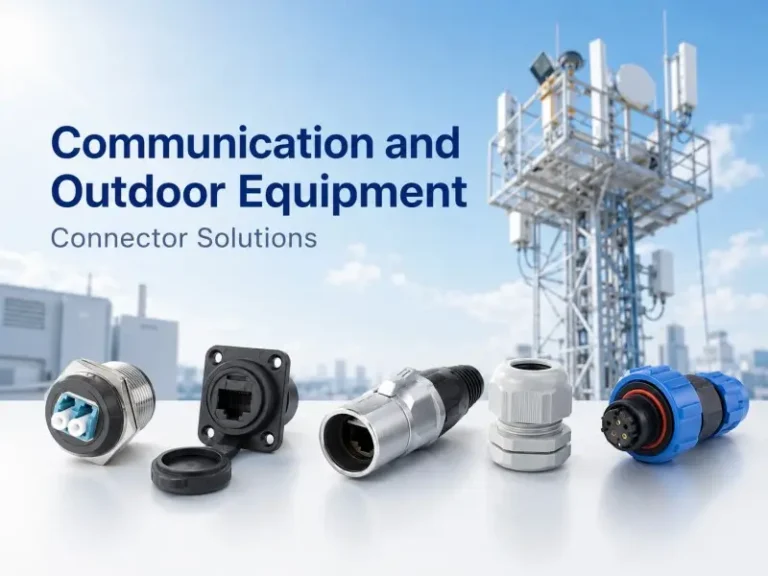
Communication and Outdoor Equipment Connector Solutions
Modern communication infrastructure - from 5G base stations, surveillance networks, to outdoor WiFi access points and roadside cabinets - imposes stringent requirements on connectors: they must be able to consistently maintain reliable performance in rain erosion, UV exposure, extreme temperature differences, and years of uninterrupted field operation. Even if only one connection point fails, the entire network segment may be completely paralyzed.
Verchil is committed to providing a full range of connector solutions for outdoor communication equipment, covering key links such as power supply, data transmission, signal distribution, and cable introduction sealing. Its full range of products have reached the IP67 / IP68 protection level, specially designed to cope with the worst deployment environment.
- 5G / 4G Base Stations
- CCTV & Surveillance
- Outdoor WiFi / AP
- Roadside Cabinets
- Outdoor Broadcasting
The Challenge
Why does outdoor communication equipment demand specialized connectors?
The outdoor environment is different from the indoor environment. The outdoor communication node is under the continuous attack of the composite environmental stress for a long time, and the civil grade connector can not withstand such tests. The consequences caused by the failure of the connector in the network node are not only the shutdown of the equipment; it also means that all downstream devices, cameras or users that rely on this node will completely lose network connectivity.
Moisture & Rain Intrusion
Repeated dry-wet cycles can lead to corrosion of unprotected terminals. In flood-prone areas, ground junction boxes may remain soaked for 12 to 48 hours - therefore, such junction boxes need to reach the IP68 protection level, not just IP67.
UV Radiation & Thermal Cycling
Long-term exposure to solar ultraviolet light will lead to aging and deterioration of plastic shell and insulation layer. The drastic daily temperature difference change will cause repeated thermal expansion and contraction at the connection point, which will lead to contact relaxation and signal attenuation.
Electromagnetic Interference (EMI)
Base stations, distribution units and adjacent high-voltage infrastructures can generate strong electromagnetic noise, which can interfere with video streaming, reduce network throughput, or cause false positives of sensor systems.
Salt Spray & Corrosion
The coastal deployment environment exposes the connector to salt-rich air, thereby accelerating the oxidation of the terminal. Telecommunications connectors located in coastal areas typically require 720 hours of salt spray test certification (ISO 9227).
Long Service Life Requirement
Communication infrastructure must operate for 10 to 25 years with minimal maintenance. Each connection point must maintain its mechanical and electrical integrity throughout the deployment life cycle.
Signal Integrity at High Data Rates
4G / 5G and Gigabit network data transmission require all connector interfaces to have high frequency shielding capabilities. In the actual field environment, if the connector lacks 360° EMI shielding, it will become the root cause of packet loss and throughput decline.
System Architecture
Connection system architecture for outdoor communication nodes
Modern outdoor communication network is a hierarchical system. Understanding the data and power flow between levels is the basis for selecting the correct connector for each interface point.
- Layer 01 - Core / Backbone: Fiber from a central data center or ISP junction. The long-distance optical cable enters the outdoor cabinet through the waterproof cable joint.
- Layer 02 - Outdoor distribution cabinet: including power input, photoelectric conversion, PoE switch and power surge protection function. All connectors on the cabinet panel must meet the protection level of IP65 and above.
- Layer 03 - Field equipment: 5G RRU / AAU, CCTV camera, outdoor AP, smart sensor, electronic signage and IoT node. Each type of equipment needs to have a sealed power supply and data connection capability.
- Layer 04 - Cable introduction and enclosure sealing: Each cable perforation into the windproof enclosure is a potential intrusion point. Selecting the appropriate cable sealing joint can ensure that the system IP protection level of each introduction point is maintained.
Communication & Outdoor Equipment Connector Products

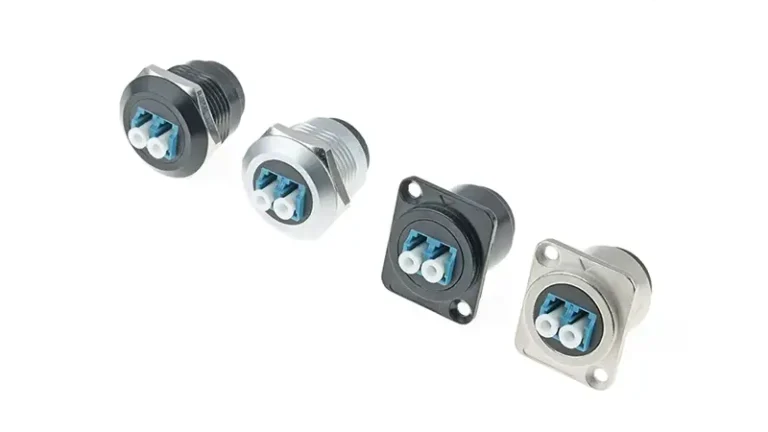
LC Panel Mount Connector
LC panel-mount connectors bring fiber through the wall of an outdoor enclosure or antenna housing, terminating a long backhaul run at the node without exposing a bare fiber end to weather. They suit FTTA (fiber to the antenna) and any node where signal has to travel farther than copper allows, with dust caps and a sealed bulkhead keeping the ferrule clean between service visits.
Insertion-loss figures and fiber-type options are on the LC panel mount page; selection and installation sit in the LC panel mount connector guide.

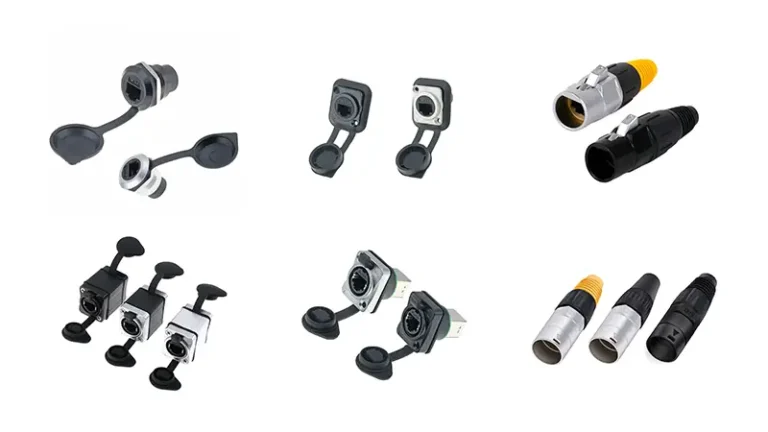
RJ45 Waterproof Connector
A sealed, shielded RJ45 carries Ethernet and PoE into outdoor cameras, access points, and radios where an indoor patch lead would corrode in a season. The 360-degree shield holds signal integrity next to radios and power lines, and the locking, weather-rated shell keeps water off the contacts through wind and temperature swings.
Cat ratings and PoE support sit on the waterproof RJ45 page; selection is in the waterproof Ethernet connector guide.

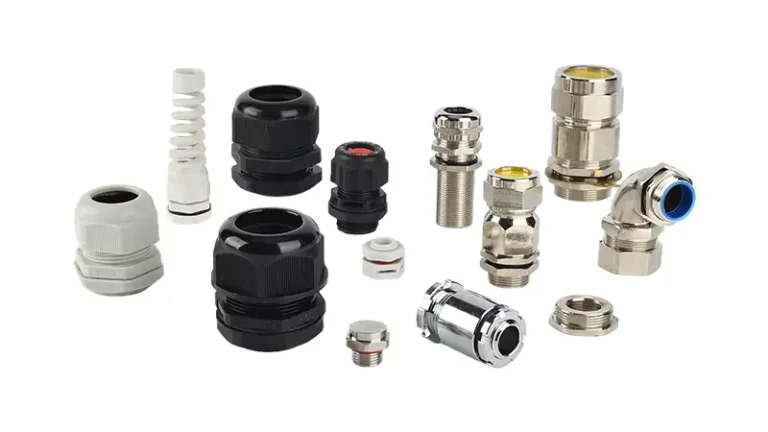
Waterproof Cable Gland
A cable gland seals every cable entry into an outdoor cabinet, camera housing, or junction box, holding the enclosure's IP rating while blocking the capillary water that creeps along a cable jacket. On a pole or a coastal site it is the difference between a dry node and a slow corrosion failure months later.
Thread sizes and cable-diameter ranges are on the cable gland page; matching a gland to the rating it must hold is covered in the cable gland IP rating guide.

Waterproof Aviation Connector
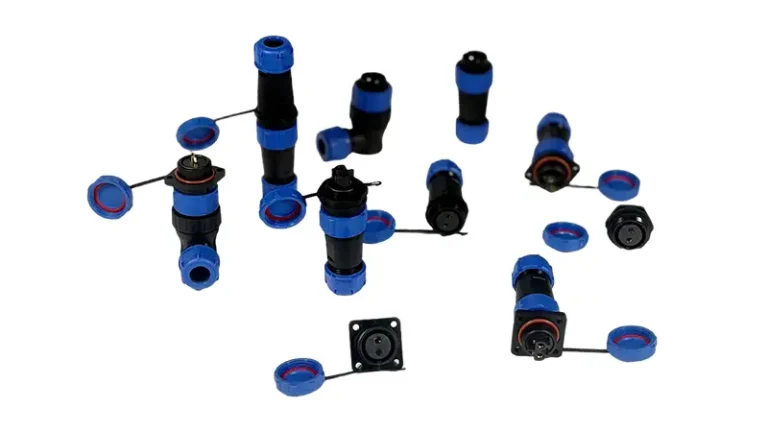
Threaded circular connectors carry power and signal to outdoor equipment on one sealed, vibration-proof interface, with blind-mate keying that makes field service on a pole or inside a cabinet quick. They fit cameras, sensors, and radios where a multi-pin link has to survive years of weather.
Pin configurations and shell sizes are on the waterproof aviation connector page; the waterproof aviation connector guide covers sealing and selection.
Selection Guide
Selecting the right IP protection level for your deployment
In outdoor installation environments, more than 50% of equipment failures are caused by non-electrical factors – including moisture, dust, temperature changes, and ultraviolet radiation. Specifying the correct IP protection level for each installation scenario is the most critical decision in the outdoor connector selection process.
| Application Scenario | Mounting Height / Environment | Recommended IP | Reason |
| Pole-mounted CCTV camera | 3–6 m above ground, rain & wind exposure | IP67 | Rain and spray exposure; no risk of submersion at height |
| Ground-level junction box | Pavement / kerbside, flood-risk regions | IP68 | May be submerged 12–48 h during heavy rain events |
| Outdoor cabinet panel port | Roadside enclosure, direct rain possible | IP67 | Water spray on panel face during servicing; sealed when mated |
| 5G RRU / AAU interface | Tower or rooftop, all weather | IP67 | Industry standard for base station antenna interfaces |
| Outdoor WiFi access point | Building fascia or pole, sheltered or exposed | IP67 | Rain-only exposure; submersion not anticipated |
| Underground sensor / loop detector | In-ground, potential long-term submersion | IP68 | Direct contact with soil moisture and standing water |
| Coastal or marine environment | Near sea, salt-spray exposure | IP68 | Salt spray + humidity accelerates corrosion; higher sealing required |
Installation Best Practice
How to implement a reliable outdoor communication connector system
Verchil recommends following a structured technical process in the planning and installation of connectors to avoid the most common on-site failure modes in outdoor communication systems.
System-level IP planning
Each installation location is classified according to the immersion risk. For the environment above the ground and only subject to splashing, the IP67 protection level should be specified; for ground level or vulnerable to flooding sites, IP68 protection level should be specified. The connector with the lowest protection level in the whole connection chain determines the actual protection level of the system.
Cable gland sizing verification
Before ordering a cable connector, be sure to confirm the exact outer diameter of each cable entering the chassis. The seal of the joint must be tightly clamped on the cable sheath-the joint with too small size cannot achieve effective compression, while the joint with too large size will leave a gap. These two cases will lead to the failure to achieve the expected IP protection level.
EMI shielding continuity
For RJ45 and network connectors installed near the base station or distribution equipment, it is important to ensure that the shielding layer of the cable is connected to the metal housing of the connector, and the correct grounding treatment is performed at the cabinet end. The shielding layer in a suspended state (ungrounded) will have no shielding effect, which is equivalent to no shielding.
Seal cap management
For any unconnected connector port - especially on the panel during on-site construction - be sure to install a dust cover and sealing cover with IP protection level immediately. Contact pollution caused by construction dust is one of the main reasons for the deterioration of photoelectric interface performance, and such problems are often not discovered until months after the equipment is put into operation.
Power and signal separation
AC power lines and low-voltage signal / data lines should be laid in separate ducts or slots, respectively. If the two must be crossed, they should be crossed at an angle of 90 degrees, rather than laid in parallel. This rule applies to the entire routing path from the cabinet to the field device, as well as to each connection panel interface.
Mating cycle planning for serviceable nodes
For connections that need to be plugged repeatedly (such as maintaining access ports, modular node replacement), make sure that the plug-in life rating of the connector matches the expected frequency of use over a 10-15 year deployment cycle. The rated life of aviation and industrial grade connectors is 500 to 1000 times; the standard RJ45 connector is more than 750 times.
Frequently asked questions
What IP rating do outdoor communication connectors need?
It depends on exposure, not on a single number. A connector mounted high and shielded from direct spray can use a lower rating than one at ground level or in driving rain, while anything that can sit in pooling water needs IP67 or IP68. The IP-selection table above maps common node positions to a recommended rating.
Can I use indoor RJ45 patch cables for outdoor equipment?
No. Standard patch leads have no UV resistance and no seal, so the jacket cracks and water reaches the contacts within a season. An outdoor node needs a sealed, shielded RJ45 in a weather-rated shell, terminated so the seal is unbroken at the entry.
Fiber or copper for an outdoor node?
Copper Ethernet is simplest within about 100 metres and carries PoE on the same cable. Beyond that distance, or where electrical noise and lightning risk are high, fiber on an LC panel-mount is the more reliable run because it carries no current and no induced noise.
How do I stop water creeping into a sealed connector?
Most leaks are not through the connector face but along the cable or through an unused port. Match the gland to the exact cable diameter, cap every unused connector, and keep mating faces clean — sealing is a system task, not the job of one part.