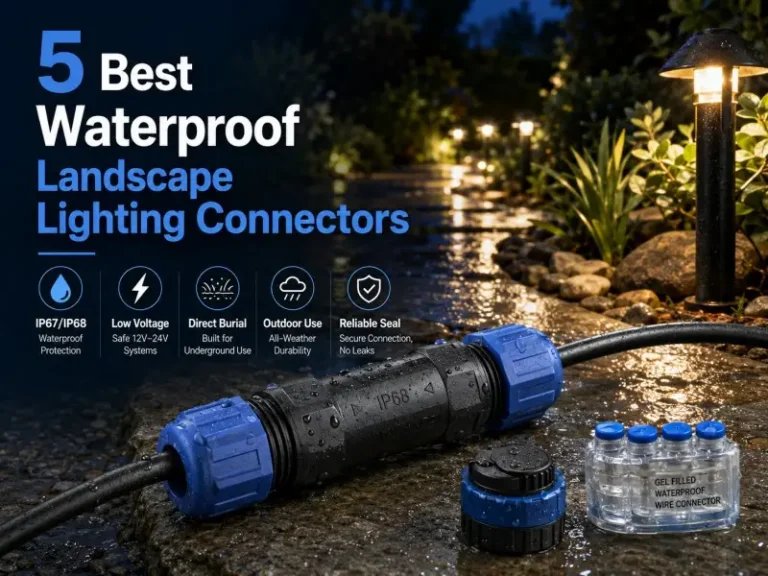
Waterproof landscape lighting connectors are usually gel-filled, silicone-filled, heat-shrink, or enclosed splice products used to protect low-voltage fixture leads, path-light branches, and buried garden-lighting runs. The right choice depends on wire gauge, cable outer diameter, direct-burial marking, IP rating, serviceability, and whether the connector is listed for the intended wet-location use.
Have you replaced the same path light twice in two rainy seasons? The culprit is rarely the fixture — it’s the connector. The cable splice is the most vulnerable point in any outdoor lighting system, so the right waterproof landscape lighting connector stops water at the source. The catch is that it only works when the IP rating, wire gauge, and install method all match the job.
This page is limited to landscape-lighting splices and fixture-lead connections. For general outdoor wire connectors, see the outdoor waterproof wire connectors guide. For broader 12V / 24V DC connector selection outside garden lighting, see the waterproof 12V connector guide. For IP68 enclosed repair splices, see the waterproof splice connectors IP68 guide.
For landscape lighting, connector failure usually comes from moisture inside the splice, cable movement, undersized wire joints, poor gel sealing, direct soil contact, irrigation spray, or repeated maintenance. The right connector should match the cable gauge, fixture lead size, burial condition, serviceability requirement, and expected exposure.
What Is a Waterproof Landscape Lighting Connector?
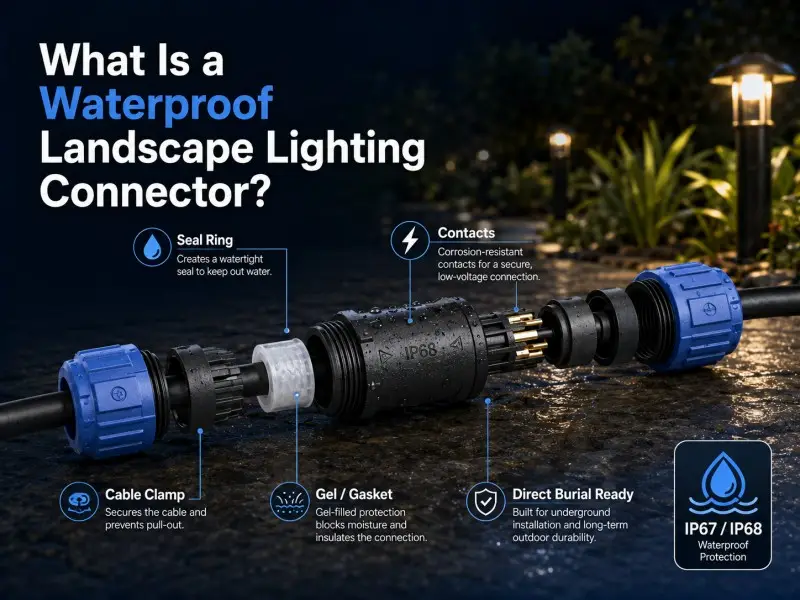
A waterproof landscape lighting connector is a sealed splice device built to keep moisture, dirt, and corrosion out of a low-voltage outdoor circuit. Most use a silicone gel fill, a nylon body, and nickel-plated brass conductors, and carry a stated IP rating. The two grades that matter here, defined by IEC 60529, are:
- IP67 — dust-tight and protected against immersion to 1 m for 30 minutes (a fixed test condition).
- IP68 — continuous immersion beyond 1 m, at a depth and time the manufacturer states.
For buried splices in damp turf or near sprinkler zones, choose a connector whose datasheet supports the actual burial or wet-location condition. For broader sealed electrical connector families outside landscape lighting, see the waterproof electrical connectors guide.
Landscape Lighting Connector Selection Map
Use this map before choosing a connector type. Landscape lighting connectors should be selected by the actual wiring point: transformer output, main cable run, branch tap, fixture lead, buried splice, or serviceable maintenance joint.
| Landscape lighting need | Best connector direction | Where to go deeper |
|---|---|---|
| Fixture lead to main low-voltage cable | Gel-filled wire connector or sealed tap connector | This landscape lighting guide |
| Buried garden or path light splice | Direct-burial rated outdoor wire connector | Outdoor waterproof wire connectors guide |
| Enclosed IP68-style repair joint | Waterproof splice connector | Waterproof splice connectors IP68 guide |
| Wire gauge, sheath, conductor, or cable OD uncertainty | Waterproof wire connector selection | Waterproof wire connectors guide |
| General 12V / 24V low-voltage DC connector selection | Low-voltage DC connector hub | Waterproof 12V connector guide |
| Removable plug-and-socket lighting module | Waterproof plug connector | Waterproof plug connector guide |
5 Best Connector Types for Low-Voltage Landscape Lighting
Not every waterproof landscape lighting connector suits every job. These are the five types professional installers reach for most:
- Silicone gel-filled twist connector — UL 486D listed, rated 600 V, pre-filled with dielectric grease. The default for permanent buried splices, and the type most low-voltage manufacturers recommend.
- Pierce / clamp (insulation-displacement) connector — no stripping; metal teeth bite through 12–18 AWG insulation for fast taps, though it suits temporary or accessible joints better than deep burial.
- IP68 screwless quick-connect — an M20 nylon shell with a rubber gasket, typically rated 250 V / 16 A and −40 °C to +95 °C. Verchil’s IP68 through-cable connector is this type, and its tool-free lock speeds up field work.
- Heat-shrink crimp connector — adhesive-lined tubing forms an air-tight seal; a 4:1 shrink ratio resists pull-out and water entry on exposed runs.
- Hub connector — several cables enter one sealed housing, which suits fixture clusters and reduces voltage drop versus long daisy-chains.
A widely repeated installer warning: the quick-clip connectors bundled with many fixtures are not waterproof and corrode out, so swap them for a sealed type. For other formats beyond landscape, our waterproof aviation connector range covers circular options.

How to Choose: Wire Gauge, IP Rating and Certifications
Last project’s connector won’t always fit the next one. Run this five-point check before ordering:
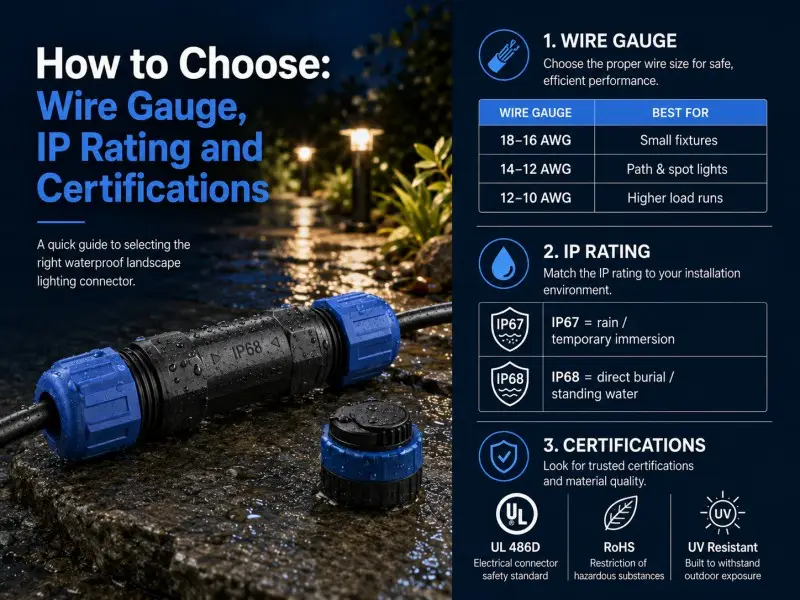
| Spec | What to look for |
|---|---|
| Wire gauge | Match the cable: 12 AWG main runs need 12–14 AWG connectors; fixture leads use 16–18 AWG |
| IP rating | IP67 minimum above grade; IP68 for direct burial or sprinkler zones |
| Voltage | Low-voltage lighting is governed by NEC Article 411 (≤30 V class); a 600 V-rated connector gives ample margin |
| Temperature | −40 °C to +105 °C covers four-season climates |
| Certifications | UL 486D (sealed wire connectors) and UL 1838 (low-voltage landscape), plus TÜV, CE, or RoHS |
Because a mismatched wire gauge opens a gap the gel can’t seal, measuring the cable first is the single most important step here. For the full IP-grade breakdown, our waterproof connector types and IP ratings guide is the pillar reference.
Why Landscape Lighting Connectors Fail Outdoors
Most landscape lighting connector failures are not caused by the light fixture itself. They usually come from the wire joint area, especially where moisture, soil pressure, irrigation spray, fertilizer, cable movement, or poor strain relief affects the splice.
| Failure cause | What happens | How to reduce the risk |
|---|---|---|
| Poor gel fill or incomplete seal | Moisture reaches the copper conductor and causes oxidation or intermittent lighting. | Use a connector designed for the cable size and confirm the seal closes fully. |
| Wrong wire gauge combination | The connector may feel tight but fail to hold both the main cable and fixture lead correctly. | Check wire gauge, conductor count, and fixture lead size before installation. |
| Buried splice without proper rating | Soil moisture and irrigation water can enter the joint over time. | Use a connector suitable for buried or wet outdoor conditions, or route to the outdoor wire guide. |
| No strain relief | Ground movement, maintenance pulling, or fixture adjustment can loosen the joint. | Leave service loop, avoid cable tension, and select a connector with secure cable retention. |
| Wrong maintenance expectation | Some sealed connectors are difficult to reopen without damaging the seal. | Use a serviceable connector if the lighting layout may be changed later. |
How to Install a Waterproof Landscape Lighting Connector (5 Steps)
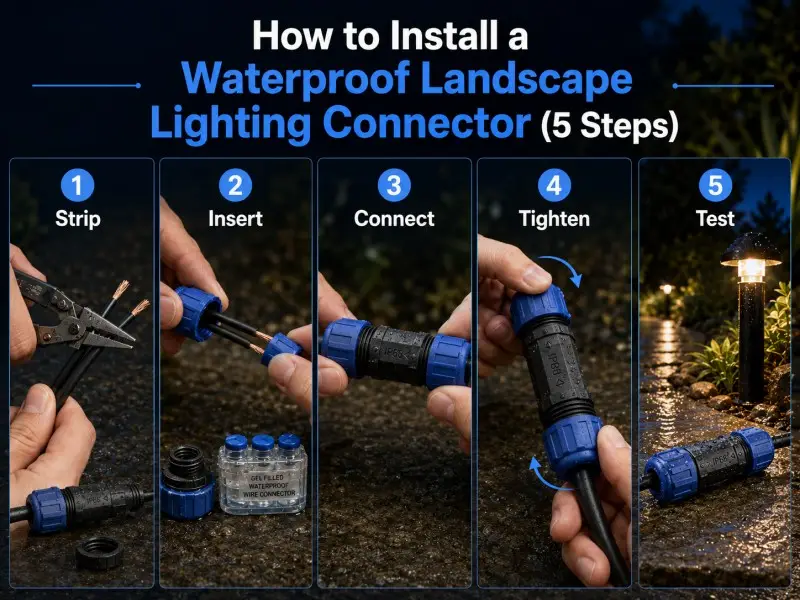
Even the best waterproof landscape lighting connector fails if installed wrong. Industry groups note that most outdoor wiring faults come from four mistakes: not stripping the insulation, not twisting the conductors tight, burying the joint facing up so it pools water, and using electrical tape as “waterproofing.” Follow this process instead:
- Cut the power — switch off the transformer at the breaker before you touch any wire.
- Strip ½ inch (12 mm) — twist the bare conductors together tightly, clockwise. Low-voltage runs have no polarity, so either conductor pairs to either.
- Insert and seal — screw or clamp the connector until silicone visibly extrudes; that overflow confirms the seal has formed.
- Wipe and pull-test — remove excess silicone with a cloth and tug each lead to confirm it’s locked.
- Bury facing down — at least 6 inches (15 cm) deep, with the connector opening pointing down so water can’t collect inside.
For wire gauge, conductor material, cable OD, jacket compatibility, wicking, and corrosion diagnosis, see the waterproof wire connectors guide.
Conclusion
Choosing a waterproof landscape lighting connector comes down to four specs: IP rating (favor IP68 for burial), wire-gauge compatibility (12–18 AWG covers most systems), certifications (UL 486D plus TÜV or CE), and install quality. Silicone-filled twist caps, pierce connectors, and IP68 through-connectors each have their place — match the type to the conditions, follow NEC Article 411, and your fixtures will outlast their warranty. Did this help with your install? Share it with anyone still taping their outdoor splices.
FAQ: Waterproof Landscape Lighting Connectors
How do I waterproof a landscape lighting connection?
Use a factory gel-filled or silicone-filled connector that is marked for wet-location or direct-burial use. The compound helps displace air, reduce moisture entry, and slow corrosion around the splice. Do not rely on electrical tape alone for buried landscape-lighting joints.
Can landscape lighting connectors be buried directly in soil?
Yes, but only models explicitly marked direct burial — usually IP67/IP68 and UL 486D listed. Ordinary indoor wire nuts corrode within a single wet season. When burying, always point the connector opening down so water can’t pool inside, and bury at least 6 inches deep.
Can wire nuts be used outdoors?
Only silicone gel-filled, UL 486D-listed wire nuts are safe outdoors. Standard dry wire nuts trap moisture and fail within months, and industry groups specifically warn against using them to splice direct-buried wire because the leak path lets current escape to ground and overheats the transformer.
How long do waterproof landscape lighting connectors last?
A correctly installed silicone-filled or IP68 connector typically lasts 10–20 years, matching the life of LED fixtures. Actual lifespan depends on burial depth, soil chemistry, and whether the connector’s rated wire gauge matches the cable — a mismatch shortens it considerably.
IP67 or IP68 — which do I need for landscape lighting?
Use IP67 for above-grade joints exposed to rain and spray, and IP68 for direct burial, low spots that pool water, or splices near sprinkler heads. Since IP68 depth and time are manufacturer-defined, confirm the exact rating on the datasheet before relying on it underwater.
Should I use a hub connector or daisy-chain my fixtures?
A hub connector brings several fixture leads into one sealed housing, which cuts voltage drop and gives more even brightness across a cluster than a long daisy-chain. Daisy-chaining is simpler for short runs, but on larger layouts a hub (or a home-run from the transformer) keeps end fixtures from dimming.