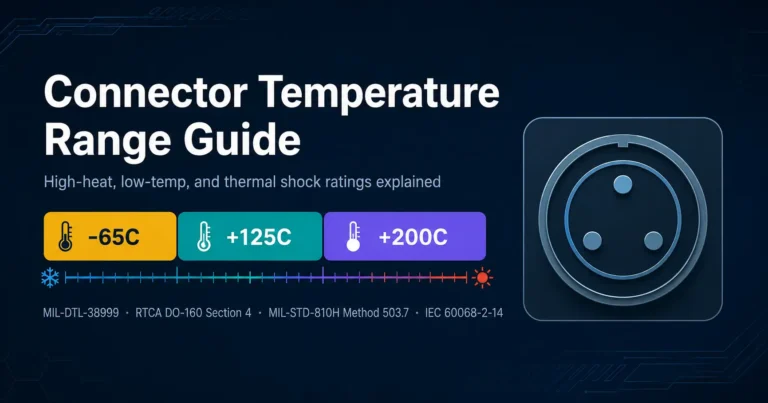
A connector’s “temperature range” is usually shorthand for three separate numbers, not one: the operating range it can carry current in continuously, the storage range it survives while idle and unpowered, and a processing peak — such as a solder reflow spike — it only has to withstand briefly during assembly. A datasheet that lists a single figure without saying which of the three it means is easy to misread, and mixing them up is the single most common mistake buyers make when speccing connectors for hot, cold, or thermally cyclic environments.
This guide breaks down what each of those numbers actually measures, how high-temperature and low-temperature ratings differ from thermal shock testing, what temperature does to a connector’s real-world performance, and how extreme-cold and aviation equipment get their own separate temperature category system entirely.
What “temperature range” actually measures
| Temperature type | What it covers | Typical use | Why it matters |
|---|---|---|---|
| Operating (working) temperature | The range the connector carries current and stays mated reliably, continuously, while in service | The number engineers actually design around | Exceeding it degrades contact resistance, seal integrity, or both — see how temperature affects performance below |
| Storage (non-operating) temperature | The range the connector survives while unpowered and unmated, in a warehouse, shipping container, or idle installation | Usually wider than the operating range, since no current-carrying heat is added | A connector rated for a wide storage range can still fail if operated anywhere near those extremes under load |
| Processing temperature | A brief peak the connector must survive during manufacturing — most commonly a solder reflow profile | Relevant mainly to PCB-mount and panel-mount connectors that go through a reflow oven | A short 250°C+ reflow spike is a completely different stress than a continuous 85°C operating environment; a part rated for one is not automatically rated for the other |
What counts as a “high temperature” connector rating
There is no single number for “high temperature” — the ceiling depends entirely on the connector class and its intended duty:
| Connector class | Typical operating ceiling | Source |
|---|---|---|
| Standard commercial-grade connectors | +70°C to +85°C | Common commercial spec convention |
| Industrial-grade connectors (e.g., Verchil’s HDC HE-series heavy duty connector) | −40°C to +125°C | Verchil published product specification, raw-HTTP verified 2026-07-09 |
| Military/aerospace circular connectors (MIL-DTL-38999 Series III/IV) | −65°C to +200°C | NASA NEPP (nepp.nasa.gov), raw-HTTP verified 2026-07-09 |
Even within that military-spec family, the exact ceiling shifts with series and finish — some manufacturer product lines of the same MIL-DTL-38999 family are rated to +175°C rather than +200°C, so the specific datasheet for the specific finish is what governs, not the family name alone. At the extreme end of the industry, specialty hyperboloid-contact connectors from third-party manufacturers such as IEH Corp are rated for sustained operation up to 260°C (500°F) — roughly double the standard MIL-SPEC ceiling — for applications like measurement-while-drilling tools and engine-mounted avionics. That figure describes a specific contact technology from a specific manufacturer, not a generic connector capability, so treat it as an industry extreme-case reference rather than a baseline expectation.
What counts as a “low temperature” / cold-weather connector rating
Low-temperature failure in connectors is rarely about the metal contacts themselves — metal stays conductive at low temperatures. The failure mode is almost always the non-metallic parts: PVC and standard rubber jackets and seals stiffen and lose flexibility as temperature drops, and a jacket that’s gone brittle can crack during handling or vibration long before the connector’s rated operating floor is reached. Verchil’s waterproof wire connector range addresses this by specifying jacket and seal materials rated for the target cold-weather environment rather than assuming any generic PVC jacket performs the same at −10°C and −40°C.
Common lower-limit conventions by connector class:
- −40°C — the standard floor for most industrial-grade connectors, including Verchil’s HDC HE-series
- −55°C — the common floor for aviation and military-grade circular connectors, matching the RTCA DO-160 ground survival floor described below
- −65°C — the extreme floor for military-spec circular connectors rated to MIL-DTL-38999
A connector’s low-temperature rating should specify whether it’s the operating floor (must stay functional and flexible while carrying current) or the storage floor (must survive without cracking while idle) — the two are not interchangeable, for the same reason the operating and storage columns in the table above differ.
Thermal shock vs. steady-state temperature range
A steady-state temperature rating tells you whether a connector survives sitting at a fixed hot or cold extreme. Thermal shock tests something different: whether the connector survives a rapid transition between two temperature extremes, since sudden expansion and contraction stresses seals, solder joints, and dissimilar-metal interfaces in ways a slow, steady exposure never does. Two standards define this precisely:
| Standard | What counts as “shock” | Test pattern |
|---|---|---|
| MIL-STD-810H, Method 503.7 (Temperature Shock) | A “sudden change” is defined as a temperature change greater than 10°C within one minute | Specimen is cycled between hot and cold chambers or zones with minimal transfer time |
| IEC 60068-2-14, Test Na (Rapid Change of Temperature, Air-to-Air) | Two fixed hot and cold chambers or zones; transfer time is minimized, typically under one minute, to create the shock | Specimen is moved between chambers with a defined dwell time at each temperature for full thermal stabilization before the next transfer |
| IEC 60068-2-14, Test Nb | A specified rate of temperature change, rather than a sudden step — a distinct sub-test from Na | Used when the application calls for a controlled ramp rate rather than an abrupt transition |
The practical distinction for buyers: a connector’s steady-state operating range (e.g., −40°C to +125°C) tells you what it can sit at. A thermal shock rating tells you whether it survives moving quickly between those extremes without a seal or solder joint failing — and a part can pass one test and fail the other, since they stress completely different failure mechanisms.
How temperature actually affects connector performance
Temperature degrades a connector through three distinct mechanisms, and confusing them leads to the wrong fix:
- Electrical — At elevated temperature, contact resistance tends to rise and spring-contact material can lose mechanical tension over time, reducing normal force at the mating interface. This is a materials effect distinct from current derating, which is the separate, well-documented practice of reducing a connector’s rated current as more contacts in a housing are loaded simultaneously and their combined self-heating adds to ambient temperature — see the multi-contact current derating guidance already published on Verchil’s site for the IEC 60512-5-2 derating curve and the ~0.8 derating factor commonly applied under full loading. Temperature range and current derating are related but answer different questions: temperature range asks “can the materials survive this environment,” derating asks “how much current can I actually run once every contact is loaded.”
- Mechanical — Thermal expansion and contraction change the mating force between plastic housings and metal contacts, which can loosen a previously snug fit over repeated cycles, and repeated flexing from expansion/contraction accelerates seal and gasket aging.
- Environmental — Repeated temperature cycling is a common cause of internal condensation: warm, humid air enters a housing during a hot cycle, then condenses as moisture when the temperature drops. This is why a connector’s environmental durability in a cycling climate depends on both its temperature rating and its ingress protection (IP) rating working together — see the IP rating chart for how sealing against that moisture is tested and rated as a separate specification.
Extreme-cold and aviation connector temperature requirements
Civil aviation equipment doesn’t use the same temperature framework as industrial or military-ground hardware — it uses RTCA DO-160, Section 4 (Temperature and Altitude), which assigns equipment a Category based on where it’s installed on the aircraft, whether that location is pressurized or temperature-controlled, and the aircraft’s maximum operating altitude. The category system runs from A1 through E2 depending on those variables. As one worked example, Category D3 (unpressurized, extreme) specifies a range of −55°C to +85°C at up to 21,300 meters altitude — a combination of cold floor and altitude that a generic industrial temperature rating never has to address, since altitude changes convective cooling and material outgassing behavior in ways sea-level testing doesn’t capture. Ground survival temperature under DO-160 can run as low as −55°C even for equipment with a much milder operating range once airborne, since the aircraft may sit on a cold tarmac for hours before takeoff.
For comparison, a competing aviation-style circular connector series (GX16) on the market is commonly rated −55°C to +120°C — useful context for buyers evaluating 16mm aviation connector options against military or DO-160-referenced parts. Verchil’s own waterproof aviation connector range (screw type and solder type) is published at −25°C to +85°C, a narrower window suited to general industrial and outdoor aviation-style panel applications rather than DO-160 Category D3 or MIL-DTL-38999 extreme-cold service — buyers with a genuine −55°C ground-survival or high-altitude requirement should confirm the exact DO-160 category their installation location calls for and talk to Verchil’s engineering team before assuming a standard industrial-rated connector covers it.
Verchil product temperature quick-reference
| Product | Operating temperature | Verified source |
|---|---|---|
| HDC HE-series heavy duty connector | −40°C to +125°C | Verchil product page, raw-HTTP verified 2026-07-09 |
| Waterproof aviation connector (screw & solder type) | −25°C to +85°C | Verchil product page, raw-HTTP verified 2026-07-09 |
| USB panel mount socket — industrial grade | −40°C to +85°C (commercial grade: 0°C to +70°C) | Verchil product guide, raw-HTTP verified 2026-07-09 |
| Cable gland — nickel-plated brass body | Material temperature ceiling ~+120°C | Verchil published FAQ |
| Cable gland — SS316 stainless steel body | Material temperature ceiling ~+200°C | Verchil published FAQ |
These are Verchil’s own published specifications, not a claim that every Verchil connector meets military or DO-160 extreme-cold figures — check the specific product page or request a quote against your exact environmental spec.
Three specs that get confused with “temperature range” — and aren’t the same thing
- Temperature range ≠ IP rating. A connector’s temperature rating describes whether its materials survive a given heat or cold environment. Its IP rating describes whether water and dust can get past its seals. A connector can be rated for −40°C to +125°C and still fail an IP68 immersion test if its gasket is degraded — the two specifications are tested independently and must both be checked.
- Temperature range ≠ salt spray / corrosion resistance. A salt-spray rating measures how long a material or plating survives standardized corrosion exposure before visible rust — a completely different failure mode from thermal survival. A stainless-steel housing with an excellent salt-spray rating and a plastic housing with an excellent temperature rating are solving two different problems, not the same one.
- Temperature range ≠ current derating. As covered above, temperature range asks whether the connector’s materials physically survive an environment; current derating asks how much current you can actually run once self-heating from loaded contacts is factored in. A connector rated to +125°C can still need its current reduced well below the catalogue number in a fully populated, high-current housing.
Need help matching a temperature spec, thermal shock standard, or DO-160 category to your actual installation environment? WhatsApp Verchil’s engineering team with your application details, or request a quote referencing the exact temperature range your project spec calls for.
FAQ
What temperature range can connectors withstand?
It depends on the connector class, and on which of three separate numbers you mean: operating, storage, or processing temperature. Standard commercial connectors typically run +70°C to +85°C. Industrial-grade connectors commonly extend to −40°C to +125°C. Military and aerospace circular connectors built to MIL-DTL-38999 are rated −65°C to +200°C (verified against NASA’s NEPP reliability documentation). Always confirm which of the three temperature types — operating, storage, or processing — a published figure refers to before comparing two connectors against each other.
Does IP68 mean a connector can handle high temperature?
No. IP68 under IEC 60529 tests whether water gets past a connector’s seals during immersion — it says nothing about whether the connector’s materials survive a given heat or cold environment. Temperature range and IP rating are tested by completely separate standards and can vary independently: a connector can be fully IP68-sealed and still fail outside its rated temperature window, or be rated for extreme heat with a seal that has degraded and no longer holds its IP68 rating. Check both specifications separately.
What is thermal shock testing for connectors, and how is it different from a steady-state temperature rating?
A steady-state temperature rating tells you whether a connector survives sitting at a fixed hot or cold extreme continuously. Thermal shock testing measures whether it survives a rapid transition between two extremes, since sudden expansion and contraction stresses seals and solder joints differently than steady exposure does. MIL-STD-810H Method 503.7 defines a “sudden change” as a temperature shift greater than 10°C within one minute. IEC 60068-2-14 Test Na (Rapid Change of Temperature, Air-to-Air) uses a similar under-one-minute transfer between two chambers, while its related Test Nb instead specifies a controlled rate of change rather than an abrupt step. A connector can pass a steady-state rating and still fail a thermal shock test, because the two tests stress different failure mechanisms.
Can connectors work in extreme cold, and what temperature can aviation connectors withstand?
Yes, but the applicable standard depends on the industry. Industrial connectors commonly extend down to −40°C, aviation and military-grade circular connectors commonly reach −55°C, and MIL-DTL-38999 extreme-spec parts reach −65°C. Civil aviation equipment uses RTCA DO-160 Section 4, which assigns a Category (A1 through E2) based on installation location, pressurization, and altitude — as one example, Category D3 (unpressurized, extreme) specifies −55°C to +85°C at up to 21,300 meters, and ground survival temperature under DO-160 can be as low as −55°C even for equipment with a milder in-flight operating range. Always confirm the exact DO-160 category or MIL-spec figure that applies to your installation location rather than assuming a single “aviation temperature.”
Why does temperature affect connector current rating?
Temperature range and current derating are related but not the same question. Temperature range asks whether a connector’s materials survive a given ambient environment. Current derating is the separate practice, defined under IEC 60512-5-2, of reducing a connector’s rated current as more contacts in a housing are loaded simultaneously, because the combined self-heating from every loaded contact raises the local temperature inside the housing above ambient. A connector rated to a high ambient temperature can still need a lower operating current than its catalogue figure once every contact in a fully populated housing is carrying load.
What’s the difference between operating, storage, and processing temperature for a connector?
Operating temperature is the range the connector carries current and stays reliably mated while in continuous service — the number that governs day-to-day use. Storage (non-operating) temperature is the range it survives while unpowered and unmated, such as in a warehouse or shipping container, and is usually wider than the operating range since no current-carrying heat is added. Processing temperature is a brief peak — most commonly a solder reflow spike — that the connector only has to survive for seconds to minutes during manufacturing, not continuously. A connector rated for a wide storage range or a high processing peak is not automatically rated for the same numbers under continuous operating load.