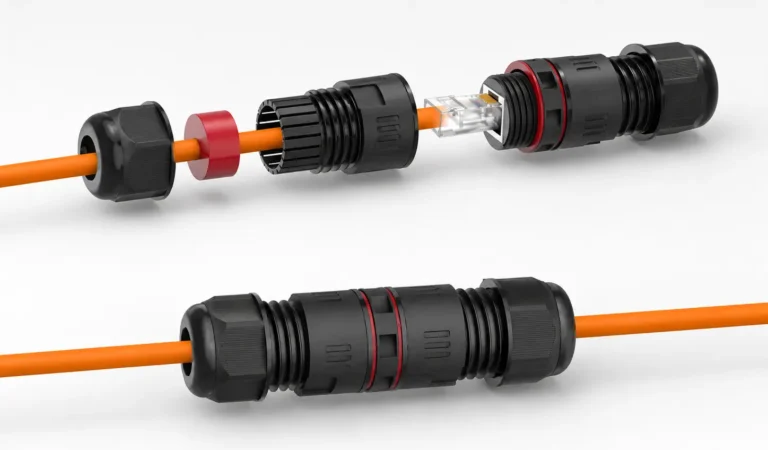
A waterproof Ethernet connector has to survive two environments at once — the weather outside and the high-frequency signal inside. Sealing it to IP67 (1 m / 30 min, IEC 60529) is the easy half; the hard half is keeping a Cat6A channel at 500 MHz, an unbroken shield, and up to 90 W of PoE heat (IEEE 802.3bt) all working inside that seal. This guide is the signal-and-power side of outdoor Ethernet: matching the connector’s Category to the cable, keeping shielding continuous, stopping PoE from cooking the contacts, and choosing between sealed RJ45 and M12. If you just need to pick and install the connector hardware, start with our [RJ45 waterproof connector guide] — then come back here for the link-engineering details.
Spec the cable to the right megahertz but grab any “IP67 RJ45” enclosure, and you’ve just throttled a Cat6A link to Cat5e — sealed, but slow. Because a waterproof Ethernet connector is an RF part first and a seal second, the Category rating matters as much as the IP number. So this guide covers what makes Ethernet different, the connector types, cable matching, shielding, PoE heat, and how to diagnose wet-weather link failures.
Why an Ethernet Connector Isn’t Just a Power Connector
You can’t borrow power-connector logic here. Ethernet moves data over differential pairs from 100 MHz (Cat5e) up to 2,000 MHz (Cat8), so at those frequencies the waterproof Ethernet connector behaves as an RF component, not a simple contact. A millimeter of unshielded conductor, an impedance step at the mating face, or a cable-to-connector geometry mismatch each adds insertion and return loss that eats link margin.
Where a waterproof power connector only has to hold low-resistance contact and seal out moisture, a waterproof Ethernet connector must also hold the differential impedance (nominally 100 Ω ±15 %) and keep near-end crosstalk inside the ANSI/TIA-568 channel limit. That’s why you can’t pair any IP67 shell with any RJ45 insert and call it sealed Ethernet — the internal coupler must reach the same Category rating as the terminated cable.
Types of Waterproof Ethernet Connectors
Two formats cover most outdoor and industrial work:
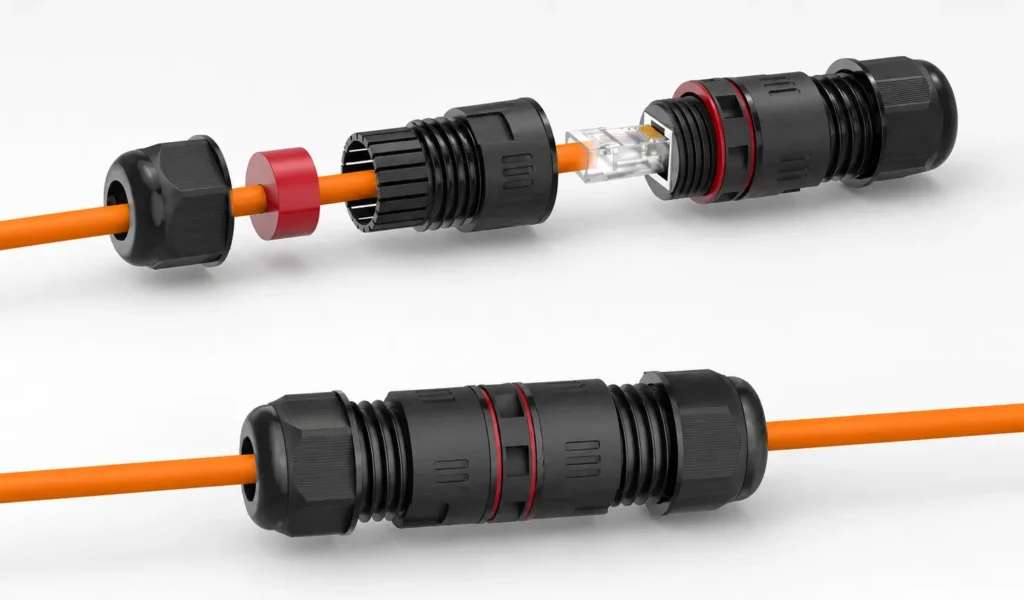
- IP67 RJ45 inline coupler — a straight-through coupler in a sealed shell (compression nut plus gasket) that joins two RJ45 plugs, extending a link with no switch or media converter. Best for CCTV runs, outdoor Wi-Fi AP feeders, lighting controllers, and BMS edge nodes.
- IP65 RJ45 panel-mount jack — threads into an enclosure wall and mates to a standard RJ45 inside; an unused port is capped or fitted with a waterproof plug. Best for outdoor switch cabinets, HMIs, and meter boxes. Note the rating is typically valid only when mated — open, most reach only IP20–IP54.
For marine and immersion use, an IP68 RJ45 or M12 D-coded connector with gold contacts is the step up. Browse sealed options on our RJ45 waterproof connector page, and for the basics of the IP65 variant see our IP65 RJ45 waterproof connector guide.

For touring, live-sound, and stage rigs where a locking (not just sealed) RJ45 is required, see our guide to Neutrik EtherCon and its alternatives.
Match the Cat Rating to the Cable
Cable category and connector category must match, because the lower of the two caps the channel. Pair a Cat8 cable with a Cat6-rated IP67 coupler and the link runs at Cat6 (250 MHz) no matter what the cable can do:
| Cable | Bandwidth | Max Channel Speed | Common Outdoor Use |
|---|---|---|---|
| Cat5e | 100 MHz | 1 Gbps (to 100 m) | Legacy CCTV, basic IoT |
| Cat6 | 250 MHz | 1 Gbps / 10 Gbps (≤55 m) | Outdoor WiFi APs, IP cameras |
| Cat6A | 500 MHz | 10 Gbps (to 100 m) | High-density surveillance, edge nodes |
| Cat8 | 2,000 MHz | 25 / 40 Gbps (to 30 m) | Data-center inter-rack, short industrial |
A practical rule: a product labeled only “IP65 waterproof RJ45” with no Category stated should be treated as Cat5e until the datasheet says otherwise. Verifying a waterproof Ethernet connector’s Cat rating is as important as verifying its IP rating.
Keep the Shielding Continuous Outdoors
Shielded cable (STP, F/UTP, SF/UTP) is common outdoors to resist EMI from power lines, drives, and radios, but the shield only helps if the waterproof Ethernet connector preserves it. A correct shielded connector provides 360° contact to the cable’s foil/drain, a continuous metal path through to the chassis ground, and single-ended grounding (one end only) to avoid a ground loop.
Signs the shield path has broken include CRC errors and packet loss that spike near motors, VFDs, or HVAC gear; errors that worsen at set times when heavy loads switch; abnormal TDR reflection at the coupler; and a cable that passes a continuity test but fails Fluke DSX channel certification. Where the shielded cable enters an enclosure, pair the connector with a sealed waterproof cable gland so the entry doesn’t become the weak point.
PoE Heat Inside a Sealed Connector
PoE adds a thermal problem a sealed waterproof Ethernet connector makes worse. Under IEEE 802.3bt, PoE++ delivers up to ~90 W, and that current generates resistive heat with nowhere to escape inside a watertight housing. So for PoE camera and AP runs, choose Cat6/Cat6A-rated shielded RJ45 connectors with low contact resistance, and treat any temperature rise over ~15 °C above ambient after 30 minutes at full load as a warning sign. A connector that passes a cold continuity test can still fail under sustained PoE heat.
Applications by Environment
The best waterproof Ethernet connector shifts with the environment:
| Application | Environment | Recommended Type | Min IP | Shielded | PoE |
|---|---|---|---|---|---|
| Outdoor IP camera | Rain, UV, dust | IP65 RJ45 coupler or panel jack | IP65 | Optional | Yes (PoE+/++) |
| Outdoor Wi-Fi AP | Rain, UV, wind | IP65 panel jack, metal housing | IP65 | Recommended | Yes (PoE+) |
| Marine chartplotter/AIS | Salt spray, immersion | IP68 RJ45 or M12 D-coded, gold contacts | IP68 | Required | Optional |
| Smart-building BMS node | Dust, light moisture | IP65 panel jack | IP65 | Optional | No |
| Direct-burial junction | Soil moisture, pressure | IP68 inline coupler, gel-seal boot | IP68 | Optional | No |
For the wider picture, see Verchil’s outdoor equipment connector system.
How to Troubleshoot Wet-Weather Link Failures
When an outdoor link drops packets after rain or in humidity, work through four checks rather than rewiring:
- Locate the fault. A TDR-capable tester pinpoints the reflection distance; if it lands at a connector, that’s your culprit. No TDR? Swap the suspect connector for a known-good short patch — if the link stabilizes, you’ve found it.
- Check for water ingress. Disconnect PoE first, then open the shell and look for droplets or condensation, white/green oxide on the pins, a swollen or cracked O-ring, or corrosion at the nut threads. Water inside means the seal failed — usually under-torqued, a seal-to-cable size mismatch, or an O-ring damaged on assembly.
- Verify shield continuity. Measure resistance from the cable shield to the chassis ground; under ~1 Ω is good, over ~10 Ω or open means a broken shield path, usually at the connector.
- Test under load. A PoE link that passes cold can fail hot — run it at full load for 30 minutes and check the shell with an IR thermometer; a >15 °C rise signals thermal stress.
Conclusion
In short, a waterproof Ethernet connector has to be right twice: sealed for the environment and rated for the data. Match the Category to the cable, keep the shield continuous and single-end grounded, plan for PoE heat inside the housing, and confirm the IP rating holds when mated. When a wet-weather link degrades, diagnose with a TDR and a load test instead of rewiring. Get both the RF and the seal right, and an outdoor Ethernet link stays stable for years.
FAQ: Waterproof Ethernet Connectors
Is IP65 enough for an outdoor Ethernet connector?
For sheltered outdoor spots — rain, dust, and spray — a waterproof Ethernet connector rated IP65 is adequate. Where water can pool or the connector sits near the ground, step up to IP67; for immersion, burial, or marine use, choose IP68. Remember the rating only holds when the connector is mated and locked.
What’s the difference between a coupler and a panel-mount jack?
An inline coupler joins two RJ45 cables in a sealed shell to extend a run; a panel-mount jack threads into an enclosure wall to create a sealed port. Use a coupler to lengthen a cable outdoors, and a panel jack to bring Ethernet through a cabinet or device housing.
Does PoE overheat a sealed Ethernet connector?
It can. PoE++ pushes up to ~90 W under IEEE 802.3bt, and resistive heat can’t easily escape a watertight shell. Use Cat6/Cat6A shielded connectors with low contact resistance, and treat a temperature rise over ~15 °C above ambient at full load as a sign of thermal stress.
Do I need a shielded waterproof Ethernet connector?
Use one near motors, drives, VFDs, or radios, where EMI would corrupt the signal — but only if your cable is shielded and you maintain 360° shield contact with single-ended grounding. In clean environments, a quality unshielded (UTP) connector is fine and avoids ground-loop risk.
Can I use a Cat8 cable with any waterproof RJ45 coupler?
No. The channel runs at the lower of the cable and connector ratings, so a Cat6 coupler caps a Cat8 cable at Cat6 speed. Match the coupler’s Category to the cable, and treat any sealed RJ45 without a stated Category as Cat5e until the datasheet proves otherwise.
How do I test an outdoor Ethernet link for water damage?
Run a channel certification test (e.g., Fluke DSX), not just a continuity check — a wet connector often passes continuity but fails certification. Add a TDR scan to locate reflections at connectors, and a 30-minute PoE load test with an IR thermometer to catch heat-related faults.