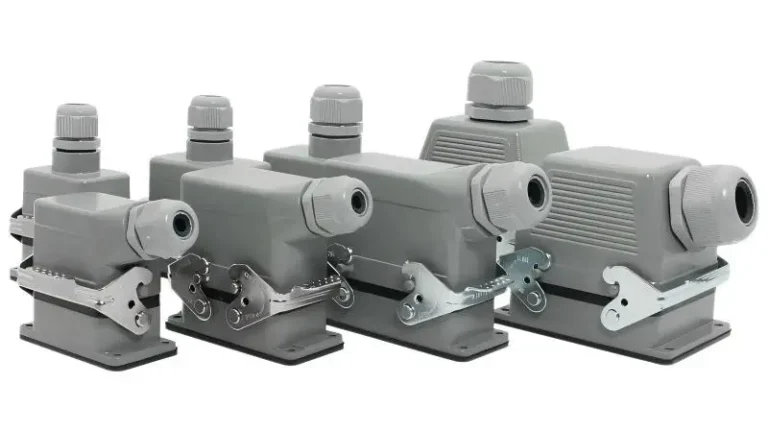
A heavy duty connector (HDC) is a rugged industrial connector assembly used to transmit power, signal, data, or mixed media in harsh environments. The right selection depends on five checks: electrical rating, IP protection, insert layout, termination method, and locking structure. For high-current models, always confirm the exact ampere and voltage rating from the manufacturer datasheet.
Is your production line one failed connector away from hours of expensive downtime? Most wiring failures in industrial machinery trace back to one root cause: the wrong connector for the environment. Heavy duty connectors solve this—but only when you choose the right housing, IP rating, and termination method from the start. This guide walks through 7 critical selection tips that engineers most often overlook, backed by IEC standards and real industrial data.
Heavy Duty Connector Selection Checklist
| Decision Point | What to Check | Common Mistake | Next Step |
|---|---|---|---|
| Electrical load | Rated current, voltage, peak load, derating curve | Using average load instead of peak load | Check the insert datasheet before choosing the housing size |
| Environment | Dust, water jets, washdown, outdoor exposure, corrosion | Assuming IP65 is enough for all wet areas | Match the assembled connector to the required IP rating |
| Signal mix | Power, signal, Ethernet, pneumatic or hybrid modules | Using separate connectors when one modular frame would reduce panel openings | Compare standard inserts with modular inserts |
| Termination | Screw, crimp, spring clamp or cage clamp | Choosing a termination method that does not match the assembly process | Review wire termination requirements before ordering contacts |
| Mechanical stress | Vibration, cable bending, locking force, cable gland fit | Ignoring cable strain relief at the gland | Confirm hood entry direction and locking style |
What Is a Heavy Duty Connector—and Why Does It Outperform Standard Options?
A heavy duty connector (HDC) is a rectangular, ruggedized electrical connector engineered to transmit power, data, and signals simultaneously under extreme environmental conditions. Unlike standard round plastic connectors—adequate only for clean, controlled spaces—HDCs are designed for factory floors, outdoor installations, and mobile equipment where dust, moisture, vibration, and temperature extremes are continuous.
The key differentiator is not just durability—it’s modularity. A single HDC housing can carry a 40 A power module alongside a Gigabit Ethernet data module and multiple signal pins, eliminating the need for three separate cable runs and dramatically reducing panel wiring complexity.
According to TE Connectivity’s HDC FAQ, the operating temperature range for industrial HDCs spans −45 °C to +125 °C, with contact ratings from 5 A (for sensor signals) up to 650 A for high-current power applications.
| Feature | Heavy Duty Connector (HDC) | Standard Connector |
|---|---|---|
| Housing Material | Die-cast aluminum or high-grade thermoplastic | Standard plastic |
| IP Rating | IP65 / IP67 / IP68 / IP69K | IP20–IP40 |
| Current Capacity | 10 A – 650 A | Typically ≤16 A |
| Modularity | Power + signal + data in one housing | Fixed pin count |
| Locking System | Lever, latch, or screw lock | Push-pull or light screw |
| Mating Cycles (IEC 61984) | 500+ cycles | 50–100 (typical) |
👉 Browse Verchil’s complete range of HDC connector series to identify the right housing size and pole count for your application.
The 3-Part Anatomy of a Heavy Duty Connector
Before ordering, you need to understand the three components that must be specified together—selecting them independently is how engineers end up with assemblies that fail their IP rating on day one.
1. Hoods and Housings
The hood (cable-side half) and housing (panel-mount base) form the outer shell. Die-cast aluminum is the standard choice for mechanical protection and EMC shielding in high-vibration environments. Impact-resistant thermoplastic performs better in wet, corrosive, or non-grounded applications where metal housings could create ground loops.
2. Modular Inserts
This is where HDCs deliver their core value. A modular frame accepts individual insert blocks—power contacts, signal pins, RJ45 data modules, fiber optic modules, and even pneumatic fittings—within the same housing. Molex HDC documentation confirms voltage capacities up to 1,000 V and current capacities up to 200 A, with configurations supporting up to 216 contacts in a single housing.
3. Cable Glands
The cable gland seals the cable entry point and is what actually maintains the IP rating under field conditions. Using the wrong gland diameter—or leaving it undertightened—is the most common cause of IP rating failure in the field, creating a path for moisture ingress that voids the connector’s environmental certification.
Need a compliant sealing solution? See Verchil’s waterproof cable glands for options compatible with our HDC housing range.
How a modular insert system is built
A modular heavy duty connector is a frame that holds swappable modules, not one fixed insert. You drop a hinged module frame into the hood, snap in the modules the job needs — power, signal, data, even pneumatic or fibre — and exchange any one of them later without reterminating the rest. A standard frame takes 1 to 12 modules depending on housing size, and the Han-Modular ecosystem alone lists more than 100 module types, per HARTING module data published through Mouser and DigiKey (2026).
That building-block approach earns its place for two reasons. Maintenance gets faster, because a worn data module pulls out on its own instead of forcing a full reterminate. And one connector can carry media that would otherwise need three separate interfaces, which frees panel space on a crowded cabinet.
Three rules keep a modular build clean:
- Frame size first. The hood and housing cap how many modules fit. Size the frame to the module count, plus one spare bay if the design may grow.
- Place power and signal deliberately. Group high-current modules away from sensitive signal modules to hold down heat and crosstalk.
- Code the frame. Coded module frames stop two same-size connectors on one machine from cross-mating.
Verchil’s HK series uses this modular, mixed-insert layout (the HDC product range, linked above, lists which frames accept which modules).
Phoenix Contact – “HEAVYCON Heavy-Duty Connectors: Tool-Free Assembly”(Published: January 21, 2026)— demonstrates modular insert assembly and click-in latching.

Choose the Right Heavy Duty Connector Path
Not every heavy duty connector problem should be solved on one page. Use this guide as the main selection hub, then go deeper by connector type, wiring method, form factor, or sealing requirement:
- Heavy duty connector types — compare rectangular, circular, high-current, BESS, IP-rated and rail-oriented connector families.
- Industrial rectangular connectors — use this when the project is specifically about Han-style rectangular HDC housings, inserts and frame sizes.
- Heavy duty wire connectors — use this when the main question is screw, crimp, spring or cage-clamp termination.
- Heavy duty waterproof connectors — use this when sealing, outdoor exposure, washdown or IP protection is the deciding factor.
7 Critical Tips for Selecting the Right Heavy Duty Connector
Follow this sequence before finalizing any HDC specification. Skipping a single step is how projects end up with connectors that fail within 18 months of installation.
Tip 1 — Calculate Peak Load, Not Average Load
Start with amperage and voltage. Industrial motors generate inrush currents at startup that can reach 6–10× the steady-state value. Always specify a connector rated at least 25% above your maximum expected current—a system running 80 A continuous should use a connector rated for no less than 100 A. For mixed-load systems combining power and data, calculate each circuit independently before selecting the modular insert configuration.
See the detailed load-calculation methodology in Verchil’s heavy duty power connector guide.
Tip 2 — Match the IP Rating to Your Actual Environment
Three IP levels cover the majority of industrial scenarios:
- IP65 — Dust-tight; protected against low-pressure water jets from any direction. Baseline for most indoor factory automation.
- IP67 — Dust-tight; withstands temporary immersion to 1 m for 30 minutes. Suitable for outdoor equipment and general wash-down areas.
- IP69K — Resists high-pressure steam cleaning at up to 100 bar and 80 °C. Required in food and beverage processing and pharmaceutical environments.
Critical: Confirm that the IP rating applies to the fully assembled connector—housing, insert, cable gland, and gasket together—not to the housing shell in isolation.
For the full IP54–IP69K test breakdown, see our IP ratings guide.
Tip 3 — Prioritize Modular Design for Future Changes
A modular HDC lets you reconfigure or add inserts without replacing the housing or re-running cable. For OEMs building multiple product variants, or facilities planning phased capacity expansion, this flexibility reduces lifecycle costs significantly. Select connector families with standardized frame sizes (e.g., IEC standard 6B, 10B, 16B, 24B) that accept a broad range of inserts from a consistent supplier ecosystem.
Tip 4 — Choose the Termination Method Around Your Assembly Process
Termination is not only an electrical decision; it also affects labor time, rework risk and field maintenance. Crimp contacts are usually preferred for repeatable production because the crimp height and pull-out force can be controlled with the right tooling. Screw terminals are easier for small batches and field repair, but they depend more heavily on installer consistency. Spring and cage-clamp options are useful where vibration resistance and faster wiring matter.
For a deeper comparison of screw, crimp, spring and cage-clamp wiring methods, read the heavy duty wire connector guide.
Tip 5 — Verify the Locking Mechanism for Your Vibration Level
- Lever latch (single or double): One-handed operation; suitable for most industrial applications.
- Screw lock: For extreme vibration (rail, press machinery) and IP68 applications where continuous sealing integrity is required.
- Cam lock / quarter-turn: Fast tool-free disconnect; ideal for frequent toolchangeovers in automated manufacturing cells.
Tip 6 — Specify Cable Entry Direction Before Ordering
Top entry (cable exits vertically) and side entry (cable exits at 90°) hoods must be specified at time of order—they are not interchangeable after purchase. Ordering the wrong hood forces a sharp bend at the cable entry point, accelerating insulation fatigue and creating micro-fractures in conductors within 12–18 months of continuous vibration exposure.
Tip 7 — Verify Compliance with Applicable Standards
Confirm that any HDC meets the standards required for your target market and application:
| Standard | Scope |
|---|---|
| IEC 61984 | General requirements and testing for industrial connectors |
| IEC 60309 | Industrial plugs and socket-outlets (up to 1,000 V / 800 A) |
| UL 2237 | North American standard; no upper current limit |
| EN 45545 | Fire and smoke performance for rail applications |
| RoHS / REACH | EU market environmental compliance requirements |
Need Help Matching Housing Size, Insert Type and Cable Entry?
Verchil can help review the required current rating, pole count, cable gland size, hood entry direction and sealing level before quotation. Share the application environment, wiring diagram or existing connector model, and the technical team can recommend a compatible heavy duty connector configuration.
Request a heavy duty connector quote or message Verchil on WhatsApp.
Industrial Applications Where Heavy Duty Connectors Are Non-Negotiable
HDCs are standard wherever a single wiring failure halts production or creates a safety risk.
Factory Automation & Robotics: A single robot arm simultaneously transmits 400 V drive power, encoder data, and safety signals. A modular HDC consolidates all three into one interface at the robot base, reducing both cable count and assembly time. Modular connectors are now the standard interface for robot base connections in ISO 10218-compliant cells.
Rail & Mass Transit: Rolling stock connectors must meet EN 45545 fire-and-smoke standards and withstand constant vibration at 5–500 Hz. Screw-locked HDCs with crimp terminations are the required specification on most European rail programs.
Renewable Energy: Offshore wind turbines operate in salt-spray environments requiring IP67 minimum—many OEMs specify IP68. Each turbine nacelle contains dozens of HDC connection points for generator output, pitch control systems, and power converter interfaces.
Food & Beverage: High-pressure steam cleaning at 80–120 °C eliminates most connector categories from contention. IP69K is the minimum specification. Housing materials must additionally comply with FDA or EHEDG hygiene design principles.
| Application | Connector Requirement | Recommended Verchil Route |
|---|---|---|
| Industrial automation and machine tools | Modular power + signal transmission, vibration-resistant locking, fast maintenance | Industrial automation connector solutions |
| Outdoor communication equipment | IP-rated sealing, corrosion resistance, stable signal transmission | Communication and outdoor equipment connector solutions |
| Stage lighting and LED display systems | Repeated mating, cable strain relief, weather-resistant connection points | Stage lighting connector solutions |
Installation Mistakes That Reduce Heavy Duty Connector Reliability
A connector rated IP69K provides zero protection if incorrectly assembled. Follow these three steps.
Step 1 – Strip and Terminate Correctly
Strip conductors to the exact length specified for the contact insert (typically 8–12 mm). Use a calibrated crimp tool with the correct die for the contact size and wire gauge. Over-stripped conductors expose bare copper beyond the contact barrel, creating a corrosion initiation point that IP gaskets cannot protect.
Step 2 – Verify Gasket Seating Before Closing
Before fully closing the connector halves, confirm that the sealing gasket lies flat in its groove with no pinching or folding. Tighten the cable gland to the manufacturer’s specified torque (typically 2–5 N·m for M20–M32 glands). A torque value outside this range—either way—compromises the IP seal.
Step 3 – Inspect on a Defined Schedule
Even a correctly selected heavy duty connector can fail early if the cable gland, gasket or contact termination is installed incorrectly. Before closing the housing, confirm three points: the conductor is terminated with the correct tool, the gasket is seated without twisting or compression damage, and the cable jacket is clamped by the gland rather than by the conductor itself.
For detailed wiring and termination choices, use the heavy duty wire connector guide. For waterproof sealing details, use the heavy duty waterproof connector guide.
For complex installation requirements or custom wiring assemblies, contact Verchil’s technical team for specification support.
What drives the cost of a heavy duty connector
Price tracks five variables, not a single catalogue figure: contact count and current class, housing material (die-cast aluminium versus thermoplastic), contact plating (silver and gold cost more than tin, but cut resistance and corrosion), sealing and certification overhead (IP69K and Ex-rated parts carry test cost), and order volume. A brand premium sits on top of all five — and that is the layer you can often remove.
A China-built HDC made to the same Han B dimensions mounts in the same cutout with the same pinout; Verchil positions its range at 40–50% below the equivalent European-brand part. Send the frame size, insert type, pole count, and target IP rating, and a quote against your real spec will beat a catalogue number.
Conclusion
A heavy duty connector is not a commodity purchase—it is a reliability decision that determines whether your production line runs or stops. The right combination of IP rating, current capacity, termination method, and locking mechanism keeps industrial systems running under conditions that would destroy standard connectors within months. Follow the 7 tips in this guide to specify HDCs that precisely match your environment, electrical load, and maintenance schedule. When facing uncertainty, size up: a connector rated slightly above your requirements costs far less than a single hour of unplanned downtime.
Frequently Asked Questions
What is the difference between IP65, IP67, and IP69K for heavy duty connectors?
IP65 protects against dust and low-pressure water jets from any direction—sufficient for most indoor factory automation environments. IP67 adds protection against temporary water immersion to 1 m for 30 minutes, covering outdoor equipment and general wash-down applications. IP69K is a separate designation covering resistance to high-pressure steam jets at up to 100 bar and 80 °C, which is mandatory in food processing and pharmaceutical facilities. Always verify that the rating applies to the fully assembled connector, not just the housing.
Can I mix different brands of heavy duty connectors?
Inserts conforming to IEC standard sizes (6B, 10B, 16B, 24B, etc.) are generally interchangeable across brands. However, hoods and housings from different manufacturers may not maintain their full IP rating when mated together because gasket geometry and compression tolerances differ between suppliers. For any IP-rated application, source hoods, housings, and inserts from the same manufacturer to guarantee the declared protection level under field conditions.
Is it safe to disconnect a heavy duty connector while the circuit is live?
No. Standard HDCs are not rated as switchgear and are not designed to break a live circuit. Disconnecting under load causes electrical arcing that damages contact surfaces, increases contact resistance on future connections, and creates a fire risk. Always isolate the circuit before mating or unmating—unless the specific connector is explicitly rated with an arc-breaking capacity and marked accordingly by the manufacturer.
How many mating cycles does a heavy duty connector last?
IEC 61984 requires industrial connectors to maintain electrical and mechanical performance for a minimum of 500 mating cycles under standard test conditions. Quality HDCs from established manufacturers frequently exceed this, with some rated for 1,000 or more cycles. Actual service life depends on contact material, alignment accuracy at each mating, and whether the IP gasket is replaced at recommended service intervals—gaskets are the life-limiting component, not the contacts.
What causes heavy duty connector failure in the field?
The most common causes are incorrect crimping, poor gasket seating, underspecified IP protection, cable strain at the gland and mismatched hood / housing combinations. In IP-rated applications, always verify the complete mated assembly rather than checking the housing alone.
What is a hybrid heavy duty connector?
A hybrid HDC uses a modular insert frame to combine power, signal, and data contacts within a single housing. For example, one 24B-size housing might contain a 40 A power module, four signal pins, and an RJ45 Gigabit Ethernet module. This approach reduces cable penetrations through machine panels, simplifies maintenance to a single connection point, and meets IEC 61984 requirements for combined-media industrial connectors—making it the standard solution in robotics, CNC machining, and decentralized automation architectures.
What standards must a heavy duty connector meet for the EU market?
For the EU market, the minimum requirements are conformity with IEC 61984 (general performance and testing for industrial connectors), the RoHS Directive (restriction of hazardous substances in electrical equipment), and the REACH Regulation (chemical substance compliance). For rail and transit applications, EN 45545 fire-behavior compliance is mandatory. Products sold in North America additionally require UL 2237 or UL 508A listing for industrial panel and control cabinet applications.
How do I choose between rectangular and circular heavy duty connectors?
Use rectangular heavy duty connectors when modular inserts, mixed power / signal layouts and panel-mounted machine interfaces are the priority. Use circular connectors when compact cable-to-cable routing or rotating equipment space is more important. For rectangular HDC details, see the industrial rectangular connector guide.
Is a heavy duty connector the same as a heavy duty wire connector?
No. A heavy duty connector usually refers to the complete hood, housing, insert and contact assembly. A heavy duty wire connector focuses more narrowly on how conductors are terminated, such as screw, crimp, spring or cage-clamp wiring. For termination details, see the heavy duty wire connector guide.
What does “HDC” stand for?
HDC stands for heavy duty connector—the rectangular, modular industrial connector that combines power, signal, and data contacts in one housing, built to the IEC 61984 safety standard. To compare live series, sizes, and inserts, see our HDC connector range.
Are heavy duty connectors flame retardant?
Yes—the insulating insert of a quality heavy duty connector is molded from a flame-retardant thermoplastic, typically rated UL 94 V-0, the class that self-extinguishes within 10 seconds and does not drip flaming particles. As of 2026, connector-relevant flammability is also assessed by the glow-wire test under IEC 60695-2-12 (glow-wire flammability index), while the connector as a whole is governed by the IEC 61984 safety standard. The metal hood and frame are non-combustible, so the plastic insert grade is the figure to confirm on the data sheet.
Are heavy duty connectors suitable for outdoor and UV exposure?
Yes, when specified for it. A heavy duty connector’s hood and base are die-cast aluminium with a powder-coat or electroplated finish that is inherently UV-stable and does not chalk or embrittle in sunlight the way unprotected plastic can. Sealing gaskets and any plastic hoods should be a UV-stabilized grade for long outdoor runs. Confirm the IP rating separately—IP65 or IP66 for rain and washdown, IP68 where standing water or burial is possible—because UV resistance and water sealing are independent requirements.
Are heavy duty connectors resistant to acids and alkalis?
Resistance depends on the housing material, not the connector type. The polyamide insert resists weak acids and alkalis, and a powder-coated aluminium hood tolerates general industrial atmospheres; for strong chemicals, salt, or hygiene washdown, a stainless-steel or specially coated housing is the durable choice. Match the material to the specific chemical and concentration rather than assuming “industrial grade” covers it—an aluminium hood that is fine on a factory floor can corrode in a chlorine or acid-mist room. State the chemical exposure when you request a quote so the housing and seal are matched to it.