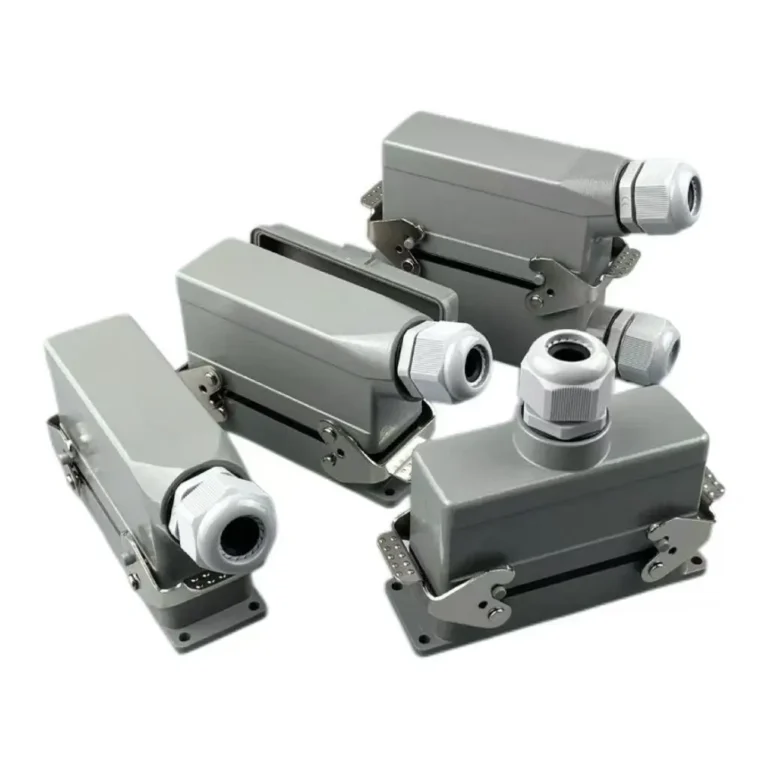
The main heavy duty connector types are rectangular modular connectors, circular Mil-Spec connectors, single-pole high-current connectors, IP69K washdown connectors, Ex-rated connectors, BESS connectors, and rail connectors. Rectangular HDCs fit most factory automation panels; high-current and BESS types fit power distribution; IP69K and Ex-rated types are selected only when washdown or hazardous-area compliance is required.
Confused by the dozens of “heavy duty connector” categories on supplier catalogs? Rectangular HDC, circular Mil-Spec, IP69K washdown, single-pole high-current—each type exists because no single connector survives every environment. This guide breaks down the 7 most common types of heavy duty electrical connectors, the exact applications each one is built for, and the IP ratings, current capacities, and standards that define them. Backed by IEC 61984 and IEC 60529 testing data.
Heavy Duty Connector Types at a Glance
| Type | Best Use | Main Advantage | Go Deeper |
|---|---|---|---|
| Rectangular modular HDC | Machine panels, robotics, automation cabinets | Combines power, signal and data in one housing | Industrial rectangular connectors |
| Circular Mil-Spec connector | Defense, aerospace, mobile equipment, harsh outdoor equipment | Compact round shell with rugged coupling | Use when circular form factor is required |
| Single-pole high-current connector | Battery, inverter, busbar and power distribution systems | Handles high current in a dedicated power path | Heavy duty power connectors |
| IP69K washdown connector | Food, beverage, pharmaceutical and cleaning-intensive equipment | Built for high-pressure washdown environments | Heavy duty waterproof connectors |
| Ex-rated connector | Oil, gas, chemical processing and dust-risk zones | Designed around hazardous-area certification requirements | Confirm ATEX / IECEx rating before specification |
| BESS connector | Battery energy storage containers and rack systems | Optimized for high-voltage energy storage wiring | High-current / BESS connector detail |
| Rail connector | Rolling stock, transit equipment and trackside cabinets | Prioritizes vibration, fire-smoke-toxicity and maintenance access | Use when rail standards drive the specification |
What Are Heavy Duty Electrical Connectors?
Heavy duty electrical connectors are industrial connector assemblies used where ordinary plugs cannot provide enough mechanical strength, sealing protection, current capacity or serviceability. In this article, the term is used as a type index: it compares the main industrial connector families and shows which page to read next for detailed selection.
For full selection criteria such as IP rating, insert layout, termination method and locking structure, use the heavy duty connector selection guide.
7 Types of Heavy Duty Electrical Connectors and Their Best Industrial Uses
The seven types below cover roughly 95% of industrial applications. Each was developed for a specific failure mode that commercial plugs cannot handle—match your environment to the right type before requesting quotes.
Type 1 — Rectangular Modular Connectors (HDC)
The industry standard for factory automation, robotics, and CNC machinery. A rectangular HDC housing accepts modular inserts that combine 200 A power contacts, signal pins, RJ45 Ethernet, and fiber optics within a single panel-mount interface. Per Molex’s HDC documentation, housings conform to standard IEC sizes (6B / 10B / 16B / 24B / 32B / 48B) to ensure intermateability across manufacturers.
Best for: Robot base connections, CNC tool changers, modular production cells, control cabinet pass-throughs. Typical IP rating: IP65–IP69K.
Full housing sizes, Han-style frame logic and insert selection belong in the dedicated industrial rectangular connector guide.
Type 2 — Circular Mil-Spec Connectors
Cylindrical connectors originally specified under MIL-DTL-5015 and MIL-DTL-38999 for military and aerospace use. The threaded coupling delivers superior vibration resistance and shock survival compared to lever-locked rectangular alternatives. Cable-to-cable, panel-mount, and free-hanging configurations are available with 2–66 contacts per shell.
Best for: Aerospace, military vehicles, heavy construction equipment, EV charging, mobile machinery. Typical IP rating: IP67–IP68.
Type 3 — Single-Pole High-Current Connectors
Single-contact connectors rated from 150 A to 800 A for transmitting large electrical loads where modular pin density is not required. Finger-proof IP2X-rated contacts prevent accidental shock during mating and unmating, even at full voltage. Common applications use color-coded keyed shells (black, red, blue, green) to prevent miswiring on multi-phase systems.
Best for: Mobile generators, battery charging stations, mining trailers, welding equipment, EV fast charging. Typical current rating: 150 A / 350 A / 500 A / 800 A.
For high-current sizing, power distribution, BESS and EV-related connector selection, continue with the heavy duty power connector guide.
Type 4 — IP69K Washdown Connectors
Engineered to survive the high-pressure steam cleaning protocols required in food, beverage, dairy, and pharmaceutical processing. Per the IP69K test (DIN 40050-9), these connectors withstand water jets at 80–100 bar and 80 °C from multiple angles—conditions that would penetrate any IP67- or IP68-rated connector within seconds. Housing materials typically use stainless steel (304/316) or FDA-compliant thermoplastics.
Best for: Food and beverage processing, pharmaceutical manufacturing, dairy production, automated bottling lines. Compliance: FDA / EHEDG / 3-A Sanitary Standards.
For sealing structure, cable gland fit and IP-rated field failures, read the heavy duty waterproof connector guide. For a full IP code breakdown, use the IP ratings guide.
Type 5 — Hazardous Area / Ex-Rated Connectors
Ex-rated connectors should not be selected by connector shape alone. The decisive factor is whether the equipment is certified for the hazardous zone, gas or dust group, and temperature class required by the site. In the EU, ATEX Directive 2014/34/EU covers equipment and protective systems intended for use in potentially explosive atmospheres; for international projects, IECEx certification is often used as the parallel compliance route.
Best for: Oil and gas refineries, offshore drilling platforms, chemical processing, grain handling, paint booths. Certifications required: ATEX Directive 2014/34/EU, IECEx, UL 1203.
Type 6 — Battery Energy Storage System (BESS) Connectors
A rapidly growing category driven by utility-scale battery storage and EV infrastructure deployment. BESS connectors are specified for DC voltages up to 1,500 V and currents from 200 A to 600 A, with positive-locking mechanisms designed to prevent live disconnection (a serious hazard at DC bus voltages). Built-in HVIL (High Voltage Interlock Loop) circuits are now standard.
Best for: Grid-scale battery storage, EV fast-charging stations, solar inverter DC links, hybrid energy systems. Voltage range: 600 V to 1,500 V DC.
BESS connectors should be evaluated with the high-current connector family, not with general-purpose signal connectors. For current path, locking, cable assembly and service isolation questions, continue with the heavy duty power connector guide.
Type 7 — Rail and Rolling Stock Connectors
Connectors certified to EN 45545-2 fire-and-smoke standards (mandatory for European rail) and IEC 61373 shock-and-vibration standards. These connectors survive 25+ years of service under continuous vibration at 5–500 Hz, with screw-locked threaded mating systems and crimp terminations as the required specification on most European rail programs.
Best for: Passenger rail cars, metro and light rail, locomotives, signaling cabinets, traction power. Standards required: EN 45545-2, IEC 61373, EN 50155.
For industry-specific connector selection, explore Verchil’s industrial solutions.
How to Choose the Right Heavy Duty Connector Type
Start with the application driver, not the connector catalog. If the project needs mixed power and signal in a machine panel, start with rectangular modular HDCs. If the project is mainly about current carrying capacity, start with high-current or BESS connectors. If cleaning, rain or dust is the risk, start with waterproof / IP-rated connectors. If the installation is in a hazardous area, start with Ex certification before comparing shapes or pin counts.
| Primary Requirement | Start With This Type | Do Not Start With |
|---|---|---|
| Mixed power, signal and data in one panel interface | Rectangular modular HDC | Single-pole power connector |
| High current or battery rack wiring | Single-pole / BESS connector | General rectangular insert |
| Washdown, outdoor exposure or dust sealing | IP-rated waterproof connector | Unsealed circular connector |
| Explosive gas or dust environment | Ex-rated connector | Standard HDC without certification |
| Rail or rolling stock equipment | Rail connector family | Generic industrial connector without rail compliance review |
After choosing the connector family, use the heavy duty connector selection guide for rating, insert, termination and locking checks.
Installation Notes for Different Heavy Duty Connector Types
Installation details should be handled after the connector type is selected. Rectangular HDCs require correct insert orientation and hood / housing pairing; waterproof connectors require cable gland and gasket verification; high-current connectors require torque, conductor size and insulation checks based on the manufacturer datasheet. For screw, crimp, spring and cage-clamp wiring choices, use the heavy duty wire connector guide.
Conclusion
The best heavy duty connector type depends on the first constraint in the application. Use rectangular modular HDCs for machine panels and mixed-media wiring, circular connectors for compact harsh-environment cable routing, high-current or BESS connectors for power distribution, IP69K connectors for washdown equipment, Ex-rated connectors for hazardous areas, and rail connectors for rolling stock or transit systems.
If the connector family is still unclear, start with Verchil’s heavy duty connector selection guide. If the type is already clear, contact Verchil with the current rating, cable size, pole count, installation environment and target certification, and the technical team can recommend a matching configuration.
Frequently Asked Questions
What current ratings are available for heavy duty electrical connectors?
Heavy duty electrical connectors are rated from 5 A for signal contacts up to 800 A for single-pole high-current applications. Standard rectangular modular HDCs typically handle 10 A to 200 A per insert. For higher currents, specify single-pole connectors (150 A / 350 A / 500 A / 800 A) or busbar systems. Always specify at least 25% headroom above your expected peak current to handle inrush and degradation over time.
What standards apply to heavy duty electrical connectors?
Key standards include IEC 61984 (general industrial connector requirements), IEC 60529 (IP rating tests), IEC 60068-2-27 (shock testing), EN 45545-2 (rail fire-and-smoke), ATEX 2014/34/EU (explosive atmospheres in EU), IECEx (international Ex zones), and UL 2237 (North American industrial power connectors). Application-specific standards add additional requirements—e.g., FDA and EHEDG for food processing.
Can heavy duty electrical connectors carry both power and data?
Yes. Hybrid modular HDCs are the standard solution for this requirement. A single 24B-size housing can carry a 40 A power module, multiple signal pins, an RJ45 Gigabit Ethernet module, and even pneumatic fittings—simultaneously. This consolidates 3–5 separate cable runs into one connection, reducing panel penetrations and simplifying maintenance. Most major manufacturers offer cross-compatible modular insert systems.
What is the most common heavy duty connector type?
Rectangular modular HDCs are the most common type in factory automation because one housing can combine power, signal and data inserts. They are usually the first type to evaluate for machine panels, robotics and control cabinets.
When should I choose a circular heavy duty connector instead of a rectangular HDC?
Choose a circular connector when the equipment needs a compact cable-to-cable connection, threaded or bayonet coupling, or a round shell for mobile equipment. Choose rectangular HDCs when panel interfaces, modular inserts and mixed-media layouts matter more.
Are BESS connectors the same as standard heavy duty electrical connectors?
No. BESS connectors are a high-current / high-voltage subset used in battery energy storage systems. They should be evaluated by current path, insulation, locking, service isolation and cable assembly requirements rather than by general HDC housing size alone.
Which heavy duty connector type is best for washdown equipment?
Use IP-rated waterproof or IP69K washdown connectors when the equipment faces high-pressure cleaning, detergent exposure or frequent moisture. Confirm the rating on the fully assembled connector, including cable gland and gasket, not only the shell.