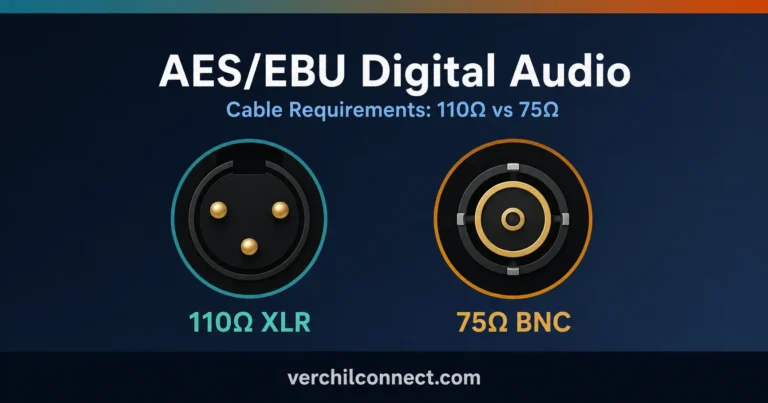
AES/EBU (AES3) requires 110-ohm balanced twisted-pair cable over 3-pin XLR — not the 40–75-ohm cable used for analog microphone runs. AES3 also defines a 75-ohm unbalanced coaxial path (AES-3id) over BNC. Balanced XLR tops out around 100–150 meters; 75-ohm coax reaches roughly 1,000 meters with equalization.
Wiring an AES/EBU digital audio run and wondering whether your existing XLR microphone cable will actually work? It might carry the signal over a short patch, but “might work over a few meters” and “meets spec” are two different claims, and the gap between them gets expensive on a long broadcast run. This guide breaks down what AES/EBU (AES3) actually requires from a cable, the two legitimate physical interfaces the standard defines, and — the part most buying guides skip — why the unbalanced version, not the balanced one, wins on long-distance runs.
AES/EBU Cable Requirements: Why 110Ω Impedance Isn’t Optional
AES/EBU digital audio (formally AES3) is specified to run over 110-ohm balanced twisted-pair cable — a spec that has nothing in common with the roughly 40–75-ohm cable most XLR microphone leads use, per Wikipedia’s AES3 reference documenting the IEC 60958-derived standard (page last edited June 2026), a figure independently corroborated by av-info.eu’s professional AES-3 technical reference. The two figures look close enough on paper to seem interchangeable; electrically, they are not. Impedance mismatch between the cable and the transmitter/receiver reflects part of the digital signal back down the line instead of letting it pass cleanly, and at AES3’s data rates that reflection shows up as jitter, bit errors, or outright dropouts — problems that don’t exist in the same way on an analog microphone signal, where a cable’s exact impedance is far less critical to a usable result.
That’s also why an AES/EBU connection can look deceptively normal and still fail intermittently: the connector is the same familiar 3-pin XLR covered in our XLR input connector guide, so nothing about the plug tells you whether the cable inside meets the 110-ohm spec. Cable that’s marketed specifically for AES/EBU or digital audio use is built to the impedance figure; generic “balanced audio cable” pulled from a mic-cable spool usually is not, even though it will physically plug in and often pass a short-run signal without obvious trouble.
Two Legitimate AES3 Wiring Types: Balanced XLR vs Unbalanced Coax
AES3 defines two separate physical interfaces, not one primary format with a fallback — a 110-ohm balanced XLR connection (IEC 60958 Type I) and a 75-ohm unbalanced BNC coaxial connection under the AES-3id variant, according to Wikipedia’s AES3 documentation. Type I over XLR is the default choice for most studio and live-sound installations: it’s the connector engineers already have on hand, it carries phantom-power-style familiarity from analog wiring, and it’s what nearly all consumer-facing AES/EBU-equipped gear ships with. AES-3id over 75-ohm coax and BNC is the format broadcast and permanent-install engineers reach for when a run needs to go farther than a balanced twisted pair comfortably supports — the next section covers exactly why that trade-off exists.
Because the physical XLR connector is identical to the one used for analog microphone and line-level signals, the 3-pin XLR3 connector itself is the shared hardware element across both worlds. Verchil manufactures XLR3 connectors built to the mechanical and electrical baseline that balanced AES3 (Type I) wiring runs through, available for OEM and custom XLR connector sourcing — the connector supplies the physical interface; the cable’s own impedance spec is what determines whether the finished assembly actually meets AES3.
Why Coax Outperforms Twisted Pair at Long Range
Balanced 110-ohm AES3 over XLR tops out at roughly 100–150 meters, while the unbalanced 75-ohm AES-3id coaxial variant can run up to about 1,000 meters with cable equalization — a nearly tenfold gap that runs opposite to what analog balanced-audio wiring teaches, per av-info.eu’s AES-3 technical reference and Rane Corporation’s 2014 engineering note on interfacing AES3 and S/PDIF. (Sources differ slightly on the exact balanced-cable ceiling — Wikipedia cites 150 meters, av-info.eu cites roughly 100 meters — so treat “100–150 m” as the honest range rather than a single precise figure; both agree on the order-of-magnitude gap versus coax.)
The reason is counterintuitive if your instinct comes from analog audio, where a balanced XLR line is the standard answer for rejecting noise over long cable runs. Digital transmission plays by different rules. Rane’s technical note explains that for long-distance, high-frequency signal transmission, unbalanced coaxial cable outperforms balanced twisted-pair cable because shielded twisted-pair construction carries substantially higher capacitance — and higher capacitance attenuates the high-frequency edges that a digital bitstream depends on to stay readable at the receiving end. Coax’s construction keeps that capacitance lower across a longer run, which is why broadcast facilities running permanent digital audio infrastructure over long distances typically standardize on 75-ohm coax and BNC rather than balanced XLR, even though XLR remains the default for shorter studio and live-sound connections. It’s the same distance threshold covered from the analog side in our XLR-to-TRS cable guide, which flags runs over 30 meters as the point to switch from snake cable to a digital path like AES/EBU in the first place.
Converting Between 110Ω and 75Ω: The Impedance-Matching Math
Converting between AES3’s 110-ohm balanced interface and its 75-ohm unbalanced counterpart requires a transformer wound to a 1.21:1 turns ratio — the square root of the 110:75 impedance ratio — per Rane Corporation’s 2014 technical note on interfacing AES3 and S/PDIF. This isn’t a theoretical detail: it comes up in practice whenever a facility needs to interface AES3-equipped broadcast gear with legacy or consumer-adjacent equipment built around the 75-ohm S/PDIF-style interface, or when a long coax run on the distribution side needs to hand off to balanced XLR gear at the receiving end. A plain resistive pad can shift signal level, but only a correctly wound transformer — or an off-the-shelf impedance-matching adapter built around one — actually resolves the impedance mismatch itself; using the wrong direction of adapter, per Rane’s note, risks attenuating the signal below what the receiving equipment can reliably read. For background on the XLR side of that interface, including the digital-audio protocols the connector also carries, see our XLR connector guide.
The AES3 Impedance-Distance Matrix
| Scenario | Recommended interface | Why |
|---|---|---|
| Studio or short indoor run | 110Ω balanced XLR (Type I) | Standard connector; native support on nearly all AES3-equipped gear |
| Broadcast or long-distance permanent install | 75Ω unbalanced coax (AES-3id, BNC) | ~1,000 m vs. ~100–150 m; lower capacitance at high frequency |
| Interfacing balanced and unbalanced equipment | 1.21:1 impedance-matching transformer | Rane’s engineering note specifies the exact turns ratio |
Nothing about a 3-pin XLR tells you which cable is behind it, and that is the whole problem. Verchil’s live event hub names it the identical-shell trap and shows what the impedance difference costs in meters of usable run.
Conclusion
AES/EBU cable requirements come down to two decisions most guides blur together: get the impedance right (110Ω balanced XLR, 75Ω unbalanced coax), and match the physical interface to your run length instead of defaulting to XLR out of habit. Balanced 110Ω XLR remains the practical standard for studio and live-sound distances; 75Ω coax is the format built for long broadcast or permanent-install runs. If your project needs XLR3 connector hardware for a balanced AES3 build — OEM, custom, or bulk supply — contact Verchil’s team or reach us on WhatsApp.
FAQ
What cable do I need for AES/EBU digital audio?
AES/EBU (AES3) over the standard balanced interface requires 110-ohm impedance twisted-pair cable with 3-pin XLR connectors — not generic microphone or line-level balanced cable, which typically runs closer to 40–75 ohms. For the unbalanced AES-3id variant, you need 75-ohm coaxial cable with BNC connectors instead. Using the wrong impedance cable can cause signal reflections that show up as jitter, bit errors, or intermittent dropouts, even though the connector will physically fit either way.
Can I use a regular XLR microphone cable for AES/EBU?
It may work over a very short run because the connector is physically identical, but it isn’t meeting spec. Standard microphone cable is built around roughly 40–75-ohm impedance, not the 110 ohms AES3 requires, so impedance mismatch and reflection risk increase with distance. For a reliable AES/EBU connection, use cable rated specifically for 110-ohm digital audio use rather than assuming any balanced XLR cable will do.
Why does 75-ohm coax carry AES/EBU farther than balanced XLR?
Because shielded twisted-pair cable — the construction balanced 110-ohm XLR wiring uses — carries higher capacitance than coaxial cable, and that capacitance attenuates the high-frequency signal edges a digital bitstream needs to stay readable. Coax’s lower capacitance lets the signal travel roughly 1,000 meters with equalization, versus about 100–150 meters for balanced XLR, which is why long broadcast runs typically use 75-ohm coax rather than XLR.
Is AES-3id the same as S/PDIF?
They share the same 75-ohm coaxial, BNC-connector electrical format, but they are not identical protocols — AES-3id carries the professional AES3 data format over a consumer-style physical interface, while S/PDIF is a related but separate consumer format. Interfacing between the two typically requires the same kind of impedance-matching and, in some directions, signal-level attention covered in the impedance-matching section above.
Do I need a transformer to connect balanced and unbalanced AES3 gear?
Yes, if you need a correct impedance match rather than just a mechanical adapter. Converting between the 110-ohm balanced and 75-ohm unbalanced AES3 interfaces requires a transformer wound to a 1.21:1 turns ratio; several manufacturers sell off-the-shelf impedance-matching adapters built around this ratio rather than requiring engineers to wind their own.
Does Verchil sell AES/EBU-certified cable assemblies?
No — Verchil’s product line is XLR3 connector hardware, not certified digital audio cable assemblies. The connector supplies the mechanical and electrical interface that balanced AES3 (Type I) wiring runs through; whether a finished cable assembly meets the 110-ohm AES3 spec depends on the cable itself, which is a separate sourcing decision from the connector. If your project needs XLR3 connector hardware for a balanced AES3 build — OEM, custom, or bulk — Verchil’s XLR connector line is built to the standard mechanical and electrical baseline that wiring requires.