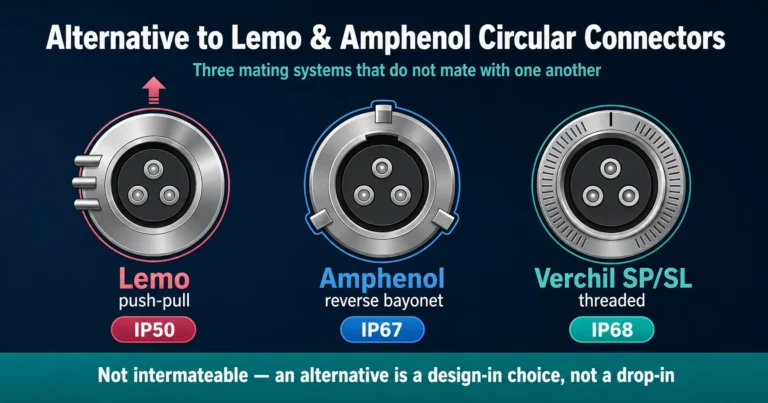
You can move a design off Lemo or Amphenol to cut cost and lead time, but only by choosing the connector for a new build or a both-ends changeover, not by plugging a substitute into an existing Lemo or Amphenol socket.
Lemo’s push-pull, Amphenol’s MIL-DTL-5015 bayonet, and a threaded SP/SL aviation connector are three different, non-intermateable mating systems.
This guide maps where a threaded IP68 connector genuinely covers the same job, and where staying with the original is the right call.
Lemo / Amphenol family → functional alternative (quick table)
| You are using | Its mating system | Closest functional alternative (design-in) | Hard boundary |
|---|---|---|---|
| Lemo B-series (0B–2B, signal/instrument) | Push-pull, keyed | Verchil SP13 / SP17 threaded, IP68 | Not intermateable; ~500 vs 5,000 cycles |
| Lemo watertight (S / T series) | Push-pull, sealed | Verchil SP/SL, IP68 threaded | Different mate; no push-pull speed |
| Amphenol GT / 62GB (MIL-DTL-5015) | Reverse bayonet / thread | Verchil SP21 / SP28, or GX for metal shell | No MIL-5015 qualification or insert match |
| Amphenol industrial signal circular | Thread | Verchil SP/GX, IP68 | Different insert keying |
The table pairs by job, not by part number, because none of these plugs mate with one another.
Are these legitimate alternatives, or am I giving something up?
Both things are true. Lemo and Amphenol are premium branded systems that earn their price: Lemo’s push-pull latch mates in a straight pull with a 5,000-cycle service life and full 360° EMC screening, and Amphenol’s MIL-DTL-5015 hardware carries formal military and VG95234 qualification with metal shells rated to IP67. Neither is a connector you replace to save a few cents without knowing what the money bought.
What you are not doing, when you spec a threaded SP/SL connector instead, is buying a counterfeit. A round, threaded, IP-sealed aviation connector built to a 13, 17, or 21 mm panel cutout is a different product to a shared industrial pattern, the same way an M12 sensor connector or an XLR audio shell is made independently by many factories. The honest question is never “is the alternative fake,” it is “does my application actually need what Lemo or Amphenol charge for.” For a sealed outdoor sensor that gets mated twice a year, the answer is often no. For a medical probe unplugged forty times a day, the answer is usually yes, keep the Lemo.
The baselines, scored against each other
Lemo B-series — precision push-pull, indoor
The B-series mates and releases with a straight push-pull motion, holds 5,000-plus mating cycles, and screens 360° for EMC across 2 to 64 contacts. The trade to know is sealing: the standard B-series is rated IP50, an indoor and protected-environment part. Lemo does seal, but in its separate watertight S and T families, not the plain B. So “a sealed Lemo” already means moving up Lemo’s own range, not just buying the cheapest B.
Amphenol GT / 62GB — MIL-grade, rugged, sealed
Amphenol’s GT and 62GB circulars follow MIL-DTL-5015 and VG95234, couple by reverse bayonet, and seal to IP67 when mated with aluminium or stainless shells across shell sizes 10SL to 40 and up to 128 contacts. Minimum mating life is 2,000 cycles. This is heavy-industrial and defence hardware: you pay for the metal shell, the qualification paperwork, and contact counts a small aviation connector cannot reach.
Verchil SP / SL — the sealed, threaded, cost-led match
Verchil’s SP (solder) and SL (screw-terminal) aviation connectors couple by a threaded ring, seal to IP68 when mated, run from −25 °C to +85 °C, and use gold-plated copper contacts rated from roughly 3 A to 30 A per contact depending on pin count and shell size. Mating life is specified at 500-plus cycles. Against Lemo, it seals far better (IP68 versus IP50) at a fraction of the cost, but it will not push-pull and will not reach 5,000 cycles. Against Amphenol GT, it is lighter and cheaper but carries no MIL-DTL-5015 qualification and tops out at far fewer contacts.
GX series — the metal-shell adjacent option
Where a design wants a threaded metal shell closer to the Amphenol feel but not the MIL paperwork, the GX16/GX20 family sits alongside SP as a heavier-built threaded circular. It shares the “design-in, not drop-in” rule with everything else here.
Full comparison
| Spec | Verchil SP/SL | Lemo B-series | Amphenol GT / 62GB |
|---|---|---|---|
| Coupling | Threaded ring | Push-pull, keyed | Reverse bayonet / thread |
| Sealing (mated) | IP68 | IP50 (sealed = Lemo S/T) | IP67 |
| Mating cycles | ≥ 500 | 5,000+ | ≥ 2,000 |
| Contacts | 2–9 (SP13) upward by size | 2–64 | up to 128 |
| Shell | Metal, compact | Metal, EMC 360° | Aluminium / stainless |
| Qualification | Commercial, IP68 tested | Precision instrument grade | MIL-DTL-5015 / VG95234 |
| Typical home | Outdoor sensor, moderate power | Medical, T&M, instrument | Defence, heavy industrial |
| Relative cost | Lowest | Highest | High |
Matching more than the spec sheet: the mating system is the wall
A spec table can make two connectors look swappable when they physically are not. Before treating any of these as an alternative, three things have to line up, and the first one is usually the deal-breaker.
The coupling. Push-pull, reverse bayonet, and threaded rings are three incompatible ways to hold a connector shut. A threaded SP plug cannot enter a Lemo push-pull receptacle or an Amphenol bayonet shell, and the reverse is equally true. This is why every recommendation here is design-in: you replace both halves, panel socket and cable plug, or you replace nothing.
The insert and keying. Even within threaded circulars, the contact arrangement and the anti-mismating key differ between makers. A 5-pin Verchil insert is not pin-compatible with a 5-pin Amphenol 5015 insert, so a harness built for one will not land correctly in the other. Match the pin count and the intended keying to your own drawing, not to the brand you are leaving.
The cable and the cycles. Each shell size seals over a band of cable outer diameter, and that has to match your jacket before IP68 means anything. Just as important is how often the connector is mated: a 500-cycle threaded connector is right for gear that is installed and left, and wrong for a bench instrument plugged in dozens of times a day, where Lemo’s 5,000-cycle push-pull earns its price.
When the alternative wins — and when to stay
Move to a threaded SP/SL/GX when: you control both ends of a new or refreshed design, the connector is sealed outdoor or washdown, it is mated occasionally rather than constantly, contact counts are modest, and unit cost or lead time is the pressure. This is the large middle of industrial, outdoor, UAV, and equipment wiring where a full Lemo or MIL-5015 build is more connector than the job needs.
Stay with Lemo when: the connector is unplugged many times a day, needs the fast blind push-pull mate, carries EMC-sensitive instrument or medical signals, or has to fit an existing Lemo panel. Stay with Amphenol GT / 5015 when: you need formal MIL-DTL-5015 or VG95234 qualification, a metal shell for severe mechanical duty, very high contact counts, or interoperability with existing 5015 hardware.
Because the alternative is always a both-ends change, the cost case only works on a new design or a planned changeover, where a matched cable-and-panel pair with traceable material and a shorter lead time can replace a long-lead branded order without ever needing to mate with the old parts.
Need a fast spec check before committing to a design? WhatsApp Verchil’s engineering team directly with your pin count, IP requirement, and cable OD, or request a quote through the contact page.
FAQ
Is there an alternative to Lemo connectors?
Yes, for a new design or a both-ends changeover. A threaded IP68 aviation connector such as the SP or SL series covers many sealed industrial and outdoor jobs at a fraction of Lemo’s cost. What it will not do is mate with an existing Lemo socket or match Lemo’s 5,000-cycle push-pull life, so it fits gear that is installed and left rather than plugged in constantly.
Can I replace a Lemo push-pull connector with a threaded one?
Only by changing both halves. Lemo’s push-pull and a threaded coupling are incompatible mating systems, so a threaded plug cannot enter a Lemo receptacle. You would replace the panel socket and the cable plug together as a pair, which is practical on a redesign but not as a field swap into existing Lemo hardware.
What is an alternative to Amphenol circular connectors?
It depends on which Amphenol. For MIL-DTL-5015 GT or 62GB hardware, a threaded SP21/SP28 or a metal-shell GX connector covers the sealed, rugged role at lower cost, but carries no MIL-5015 qualification and uses a different insert, so it suits commercial and industrial builds rather than defence programmes that require the qualified part.
Will a third-party connector mate with my existing Lemo or Amphenol?
No. Different coupling systems and different insert keying mean an alternative is never a drop-in into an existing branded socket. Treat every alternative here as a design-in choice where you fit both the panel connector and the cable connector from the same family.
Are non-branded circular connectors safe or legitimate?
A connector built to a shared threaded pattern and tested to its stated IP and current ratings is a legitimate product, not a counterfeit of a brand. The thing to verify is the actual data: IP rating, current per contact at your pin count, cable OD range, and mating-cycle life, rather than assuming the brand name is the only safe choice.
How do I choose between staying branded and switching?
Count the mating cycles and check the mating face. If the connector is unplugged constantly, needs push-pull, or must fit existing Lemo or Amphenol hardware, stay branded. If it is a sealed connection on a new design that is mated occasionally and cost or lead time matters, a threaded SP/SL/GX pair is usually the better economics.