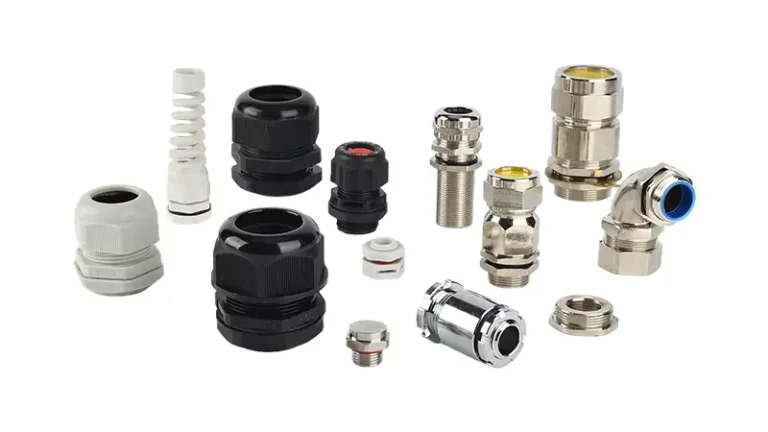
If you need one safe default, a nickel-plated brass waterproof cable gland is the Best Overall pick for most outdoor and industrial jobs, because it balances strength, corrosion resistance and a metal earth path in a single part. That said, the “best” gland is the one matched to your environment. These parts are governed by two standards worth knowing up front: IEC 62444 covers a cable gland’s mechanical and sealing performance, while IEC 60529 defines the IP rating, so any honest comparison starts there rather than with marketing claims.
I remember pulling a crumbling plastic gland off a coastal pump housing after barely a year — the wrong material in salt air had quietly cost more than the whole enclosure. This guide compares the five waterproof cable gland families you’ll meet on a real spec sheet so you avoid that mistake.
The 5 Best Waterproof Cable Gland Types
How we compared them. Five waterproof cable gland families were assessed — nylon, nickel-plated brass, stainless steel, EMC and spring/flexible — across the same dimensions: base material, maximum achievable IP rating, typical temperature range, EMI shielding, relative cost and best use. The basis is field experience plus the IEC 62444 and IEC 60529 standards above. Price tiers run from budget (nylon) to premium (SS316); figures are typical and vary by manufacturer, so always confirm the data sheet.
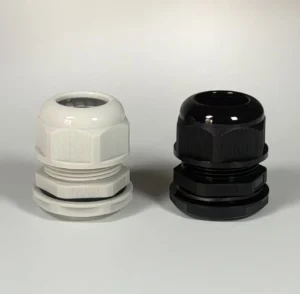
Nylon (PA66) — Best Value
Rating: ★★★★ 4.4/5
Nylon is the most common and cost-effective waterproof cable gland, and for ordinary outdoor wiring it is often all you need. Because PA66 resists weak acids and alkalis, it suits solar inverters, junction boxes and DIY runs — provided you pick a UV-stabilized grade for sun exposure.
- Material: PA66 polyamide; Max IP: IP68; typical range −40°C to +100°C
- EMI shielding: none; relative cost: low
- Best for: general outdoor use, unarmored cable, budget projects
- Another useful feature is its light weight, which can help you cut shipping and handling cost on large installs.
- Authority basis: sealing/strain-relief per IEC 62444
Nickel-Plated Brass — Best Overall
Rating: ★★★★½ 4.7/5
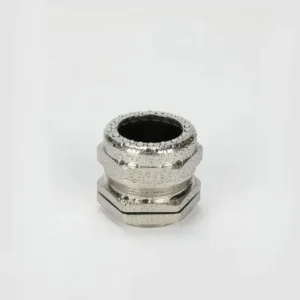
Brass is the all-rounder, which is why it appears daily on industrial machinery, control panels and automation cabinets. It is stronger than plastic yet cheaper than stainless steel, and the nickel plating adds corrosion resistance.
- Material: nickel-plated brass; Max IP: IP68; typical range −40°C to +120°C
- EMI shielding: good (metal body); relative cost: medium
- Best for: general outdoor and industrial wiring, armored cable
- Brass glands provide a metal earth path, which is great because it carries fault current to ground on armored runs.
- Authority basis: construction and sealing per IEC 62444
Stainless Steel (SS316) — Most Durable
Rating: ★★★★½ 4.6/5
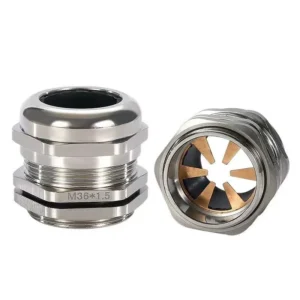
When the environment turns hostile, SS316 is the durable answer. Since it resists salt water and aggressive chemicals, it dominates food processing, pharmaceutical and offshore work where lesser materials pit and fail.
- Material: SS304/SS316; Max IP: IP68/IP69K; typical range −60°C to +200°C
- EMI shielding: good; relative cost: high
- Best for: marine, washdown, chemical and hygienic environments
- Authority basis: corrosion grade per AISI/EN 316 stainless specification

EMC Gland — Best for Signal Integrity
Rating: ★★★★ 4.3/5
An EMC cable gland is a specialized metal gland that maintains electromagnetic shielding at the cable entry. It seals against water while preserving the cable screen’s 360° contact, so it is the pick wherever electromagnetic interference would corrupt sensitive signals.
- Material: brass/steel with spring-finger contact; Max IP: IP68; typical range −40°C to +120°C
- EMI shielding: excellent (360° screen bond); relative cost: high
- Best for: drives, instrumentation and shielded data cable
- Authority basis: screen-bonding under IEC 62444; EMC context per IEC 61000 family
Spring (Flexible) Gland — Best for Moving Cables
Rating: ★★★★ 4.1/5
If your cable flexes constantly, the spiral “tail” of a spring gland prevents over-bending at the entry point. Consequently, it extends cable life on robots, handheld tools and any joint that moves through its duty cycle.
- Material: nylon or metal body with spiral spring; Max IP: IP66/IP68; typical range −40°C to +100°C
- EMI shielding: varies by body; relative cost: medium
- Best for: robotics, drag chains, frequently moved cables
- Authority basis: bend/strain relief per IEC 62444

Comparison Table
| Type | Positioning | Max IP | Typical temp | EMI shielding | Cost | Best for |
|---|---|---|---|---|---|---|
| Nylon (PA66) | Best Value | IP68 | −40 to +100°C | None | Low | Budget outdoor, unarmored |
| Nickel-plated brass | Best Overall | IP68 | −40 to +120°C | Good | Medium | General industrial/outdoor |
| Stainless steel (SS316) | Most Durable | IP68/IP69K | −60 to +200°C | Good | High | Marine, washdown, chemical |
| EMC gland | Best for EMI | IP68 | −40 to +120°C | Excellent | High | Shielded data/drives |
| Spring/flexible | Best for movement | IP66/IP68 | −40 to +100°C | Varies | Medium | Robotics, moving cable |
You can see the full sealed range on our waterproof cable gland page.
Value Editorial & Buying Guide
How to Choose the Best Waterproof Cable Gland
Start from the environment, not the catalogue. First, fix the IP rating you need: IP67 for rain and washdown, IP68 for burial or submersion — our companion guide to the cable gland IP rating breaks down each digit. Next, choose material by hazard: nylon for ordinary outdoor runs, brass for mechanical strength and earthing, stainless steel for salt and chemicals. Then match the thread (M, PG or NPT) to your enclosure and confirm the cable’s outer diameter falls inside the gland’s sealing range. Because a top-rated waterproof cable gland leaks if any one of these is wrong, treat them as a checklist rather than a menu, and the choice usually narrows to a single sensible option.
Key Features That Differentiate Cable Glands
Beyond material, a handful of features separate a reliable waterproof cable gland from a leak waiting to happen. The sealing element matters most: single-compression glands seal the outer sheath, whereas double-compression versions also clamp armor for earthing and pull-out resistance. The O-ring on the entry thread is what seals the gland to the enclosure wall, so a quality elastomer is not optional. Look, too, at the cable range printed on the body, since a wider range is convenient but a tighter range seals more reliably. Finally, certified parts state compliance with IEC 62444, which tells you the strain relief and sealing were actually tested rather than assumed.
Common Mistakes When Buying Cable Glands
Most waterproof cable gland failures trace back to a few avoidable errors. The biggest is a size mismatch — fitting a 10–14 mm gland on an 8 mm cable means the seal never fully compresses, so water tracks straight in. A close second is skipping the thread O-ring, which leaves a leak path even on an IP68 part. I remember a site where three “waterproof” junction boxes wept after one storm, and every one had the same crushed gasket from someone torquing the dome nut with pliers. Two more traps: choosing plain nylon for chemical or high-UV exposure, and assuming “waterproof” alone is a spec — without an IP number and a matched cable range, the word means little.
Who Should Actually Buy Each Type
Not everyone needs the premium option, so filter your waterproof cable gland choice honestly. If you are wiring a rooftop solar array or a garden junction box, a UV-rated nylon gland is enough and the cheapest safe choice. If the cable carries vibration, mechanical load or armor, step up to brass for strength and earthing. Only reach for stainless steel if salt, chemicals or hygiene rules demand it, since you are paying for corrosion resistance you otherwise won’t use. Choose an EMC gland strictly when shielded signal integrity is on the line, and a spring gland only where the cable physically moves. Matching the type to the duty is what keeps both the cost and the failure rate down.
Conclusion
For a single all-round recommendation, nickel-plated brass wins as Best Overall: it covers most outdoor and industrial duties with strength, corrosion resistance and earthing that nylon can’t match and stainless steel charges a premium for. The two runners-up earn their place by specializing — nylon (PA66) is the Best Value pick for ordinary outdoor and DIY runs, while SS316 stainless is the Most Durable choice for marine and chemical sites. As the buying guide stressed, confirm the IP rating, match the cable diameter and seat the O-ring; get those right and any of these waterproof cable glands will keep your connection dry for years. The same sealing logic applies to network entries too — see our outdoor RJ45 connector guide for the data-cable version.
Frequently Asked Questions
Are cable glands waterproof?
Only when correctly rated and installed. A waterproof cable gland seals to its stated IP level — IP67 for temporary immersion, IP68 for continuous submersion — and only when the cable size matches and the O-ring is seated. “Waterproof” without an IP number and a matched cable range is a marketing word, not a specification.
Which waterproof cable gland is best for marine or outdoor use?
For marine and salt exposure, SS316 stainless steel is best because it resists corrosion the longest. For general outdoor wiring, a UV-rated nylon gland is usually sufficient and far cheaper. The deciding factor is chemistry and mechanical load, not simply whether the site is outdoors.
Nylon or brass — which should I choose?
Choose nylon for cost, light weight and ordinary outdoor runs; choose brass when you need mechanical strength, higher temperature tolerance, or an earth path for armored cable. Both can reach IP68, so on day one they seal equally — the difference shows up in durability under stress and heat.
What is an EMC cable gland?
An EMC gland is a metal gland with internal spring fingers that bond the cable’s screen 360° around its entry, blocking electromagnetic interference while keeping a watertight seal. It is used on drives, instrumentation and shielded data cable, where a standard gland would break the screen continuity and let noise through.
How do I choose the right cable gland size?
Measure the cable’s outer diameter with calipers, then pick a gland whose sealing range includes that figure — for example, an M20 gland often covers roughly 6–12 mm. Avoid oversizing or undersizing, since either breaks the seal regardless of the printed IP rating. Match the thread (M, PG or NPT) to your enclosure separately.
Metric, PG or NPT — what thread should I use?
Metric (e.g. M20) is the modern international standard and the safest default. PG is an older German thread still found on legacy equipment, and NPT is common in North America. Pick whichever matches your enclosure’s tapped hole; the thread choice does not affect waterproofing as long as the O-ring seals.