An IP65 RJ45 waterproof connector is a sealed, fully dust-tight Ethernet connector that resists water jets from any direction (about 12.5 L/min at 30 kPa) but is not rated for immersion. It fits outdoor enclosures, factory floors, and washdown areas, and most models support Cat5e–Cat6A plus PoE. Where water can pool, flood, or submerge the link, step up to IP67 or IP68 instead.
Is IP65 actually enough for your outdoor run, or are you about to under-spec a connection that fails in the first storm? Because the right rating depends entirely on exposure, that one question decides everything. So this guide explains what IP65 really protects against, how it compares with IP67 and IP68, the specs that matter for PoE and data speed, and how to install an IP65 RJ45 connector that lasts.
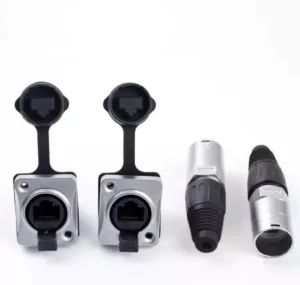
What Is an IP65 RJ45 Waterproof Connector?
An IP65 RJ45 connector is a shielded Ethernet connector built to block dust completely and resist low-pressure water jets, while staying fully compatible with standard Cat5e, Cat6, and Cat6A cable. It combines two ideas: the universal 8P8C RJ45 interface, and the IP65 sealing grade defined by IEC 60529.
| IP65 digit | Protects against | Meaning |
|---|---|---|
| First digit — 6 | Solids | Fully dust-tight, zero ingress |
| Second digit — 5 | Liquids | Water jets from any direction, no harmful entry |
In plain terms, the 6 means no dust gets in, and the 5 means the housing shrugs off a sustained 12.5 L/min jet at 30 kPa for at least three minutes from any angle. It does not, however, mean the connector can be submerged. You can see sealed options on our RJ45 waterproof connector page.
How the IP65 Sealing Mechanism Works
An IP65 RJ45 connector reaches its rating through layered seals, and skipping any one of them breaks the protection:
- Cable entry gland — a rubber or silicone compression seal grips the cable sheath so water can’t track along the jacket. The same principle drives a standalone waterproof cable gland.
- Plug-to-socket gasket — when mated, a gasket forms the watertight face between plug and socket.
- Dust cap — on unused or unmated sockets, a screw-on cap preserves the seal.
- Shell — UV-stabilized PVC, polycarbonate, or die-cast zinc alloy resists sunlight and impact outdoors.
Because the rating only holds when every layer is intact and the connector is mated, an unmated panel socket left open is no longer IP65.
IP65 vs IP66 vs IP67 vs IP68: Which Do You Need?
This is where most buyers over- or under-spec. The honest answer: IP65 covers dust and jets, but many integrators treat IP67 as the practical outdoor minimum wherever water can pool or the connector sits near the ground.
| Rating | Water protection | Best use |
|---|---|---|
| IP65 | Jets from any direction | Sheltered outdoor enclosures, factory floors, washdown panels |
| IP66 | Powerful high-pressure jets | Car washes, food processing, heavy wash-down |
| IP67 | Immersion to 1 m for 30 min | Exposed outdoor, flood-prone, dockside |
| IP68 | Continuous immersion | Buried runs, submersible and marine gear |
| IP69K | High-Pressure/High-Temp Jets | Food processing plants, sanitation |
So choose IP65 for protected outdoor and industrial spots where cost and product choice matter; move to IP67/IP68 for flooding, burial, or immersion. For the full selection and install workflow across IP67/IP68, shielding, locking and housing, see our complete RJ45 waterproof connector guide.

Specs That Matter: Material, Cat6, PoE and Temperature
Beyond the IP grade, five specs decide whether an IP65 RJ45 connector performs over years of service:
- Shell and seal — UV-stabilized PVC or polycarbonate for light outdoor use; zinc alloy or stainless steel for impact-heavy industrial sites. Use silicone or EPDM gaskets, not ordinary rubber, for heat and UV resistance.
- Contacts — gold-plated copper alloy (around 50 µin) keeps contact resistance low and resists oxidation.
- Cable category — Cat5e (1 Gbps), Cat6 (10 Gbps to 55 m), or Cat6A (10 Gbps to 100 m). Match the connector to the cable under the TIA-568 / ISO-IEC 11801 cabling standards, or the weakest link caps your speed.
- PoE capacity — for PoE++ up to ~90 W (IEEE 802.3bt), choose Cat6/Cat6A-rated shielded connectors to handle the extra heat.
- Temperature and durability — industrial parts run roughly −40 °C to +85 °C, resist UV for 5+ years, and should meet IEC 60068-2 vibration tests for transport or machinery.
How to Choose and Install an IP65 RJ45 Connector
Everything below is the IP65-specific angle — where IP65 changes the decision. The universal 5-spec selection and 6-step install workflow that applies to every waterproof RJ45 rating lives in the main guide linked above; here we stay on what’s unique to IP65.
When buying, weigh four things: pick a shielded version near motors, drives, or power cables (ground the shield at one end); verify the PoE current rating if powering cameras or access points; choose a thread or bayonet locking collar for vibration; and confirm IEC 60529, RoHS, and CE marks.
For a comparison of Neutrik’s own locking EtherCon RJ45 against alternative locking connector options for touring and stage use, see our Neutrik EtherCon alternative guide.
Installation, in short:
- Thread the cable through the silicone seal first.
- Strip the jacket to the maker’s spec (usually 30–50 mm) and sort wires to T568A/B, both ends identical.
- Terminate, seat the plug in the body, and lock it.
- Hand-tighten the seal, then a quarter-turn with a wrench — no more.
- Test continuity and PoE before sealing the cabinet, and cap every unused port.
For permanent, hard-to-reach outdoor spots, add a ring of silicone sealant around the cable entry as a secondary seal.
Conclusion
In short, an IP65 RJ45 waterproof connector is the right call for sheltered outdoor and industrial Ethernet — fully dust-tight, jet-resistant, PoE-capable, and cheaper with wider choice than higher grades. Just remember its limit: IP65 is not for immersion, so flood-prone, buried, or submerged links need IP67 or IP68. Match the IP grade, cable category, and shielding to your environment, seat every seal correctly, and the connection will run reliably for years outdoors.
FAQ: IP65 RJ45 Waterproof Connectors
Is IP65 enough for outdoor use?
For sheltered outdoor spots — rain, dust, sprinkler spray, and pressure washing — IP65 is enough. However, where water can pool, flood, or briefly submerge the connector, IP67 is the safer outdoor minimum. Match the rating to the wettest condition the link will actually face, not just “outdoors.”
Can an IP65 RJ45 connector be submerged?
No. IP65 protects against water jets, not immersion. Submerging an IP65 part lets water past the seal over time. For temporary immersion choose IP67, and for continuous or deep submersion choose IP68, which is rated for those exact conditions.
Can I use an IP65 RJ45 connector with a standard Cat6 patch cable?
A standard plug fits the IP65 socket and passes data, but the waterproof seal only works with the matching IP65 plug and gland. The whole assembly’s protection equals its weakest part, so a bare patch cord at the entry breaks the IP65 rating.
How many watts of PoE can an IP65 RJ45 connector support?
It depends on the model, but quality industrial IP65 connectors handle PoE++ up to about 90 W under IEEE 802.3bt. Always confirm the current rating on the datasheet, and use Cat6/Cat6A shielded parts so resistive heat from PoE current doesn’t degrade the contacts.
What is the difference between IP65 and IP67 for RJ45?
Both are fully dust-tight; the gap is water. IP65 withstands jets from any direction, while IP67 adds immersion to 1 m for 30 minutes. IP65 suits sheltered outdoor and washdown use; IP67 is for exposed, flood-prone, or dockside installs where standing water is likely.
How long does an IP65 RJ45 connector last outdoors?
With a UV-stabilized shell, silicone gasket, correct installation, and periodic inspection, an IP65 RJ45 connector typically lasts 5+ years outdoors. Service life drops fast with poor sealing, ordinary rubber gaskets, or an oversized cable that prevents the gland from compressing.