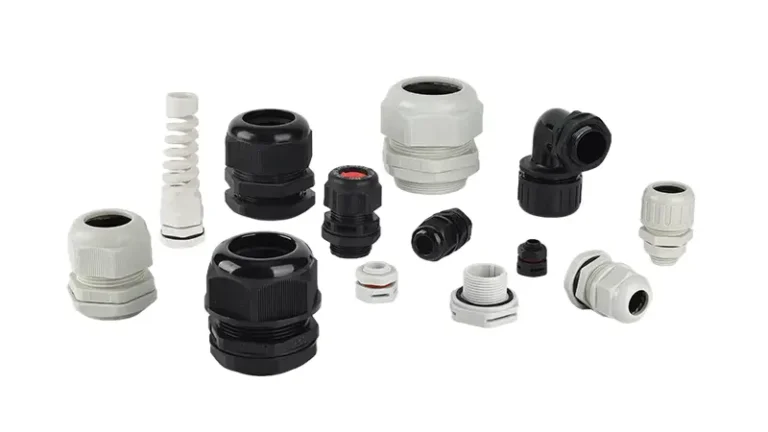
A waterproof cable gland needs an IP code where the first digit is 6 (dust-tight) and the second digit covers water at the level you face. For rain and washdown, choose IP66 or IP67 (IP67 = immersion to 1 m for 30 minutes). For burial, marine, or continuous submersion, choose IP68. The correct rating is set by the wettest condition the gland will ever meet — not by the biggest number on the box.
Is your enclosure sitting in the rain, or could it end up underwater? That single question decides which waterproof cable gland you should buy. Because picking too low an IP rating lets moisture creep in, while defaulting to the highest rating makes you overpay for protection you may never use, the goal with any waterproof cable gland is to match — not maximize. Here is how to read the code and apply it to your site.
What the IP Rating on a Waterproof Cable Gland Means
The IP (Ingress Protection) code is defined by the international standard IEC 60529, and it always uses two digits, as in IP68. The first digit grades solids, the second grades water:
| Digit | Position | What it protects against |
|---|---|---|
| 5 | First (solids) | Dust-protected — limited ingress, no harmful deposit |
| 6 | First (solids) | Dust-tight — no ingress at all |
| 5 | Second (water) | Low-pressure water jets from any direction |
| 6 | Second (water) | Powerful water jets and heavy seas |
| 7 | Second (water) | Temporary immersion, 1 m for 30 minutes |
| 8 | Second (water) | Continuous immersion beyond 1 m (manufacturer-defined) |
For outdoor or industrial wiring, the first digit should be 5 or 6. Since cable glands are also load-bearing parts, they are additionally governed by IEC 62444, which covers their mechanical strength, sealing, and strain-relief performance — a detail many spec sheets omit. For the full test method behind each grade, see Wikipedia’s reference on the IP code. You can compare rated options on our waterproof cable gland range.
Watch — a cable gland fitting demo

IP67 vs IP68 Cable Glands: What’s the Real Difference?
The two ratings share the same dust performance but diverge on water. Under IEC 60529 test conditions, IP67 means dust-tight plus immersion to 1 m for 30 minutes, whereas IP68 means dust-tight plus continuous immersion beyond 1 m, at a depth and duration the manufacturer specifies. Because IP68 is manufacturer-defined, always confirm the exact depth rating rather than assuming “deeper is automatic.”
od and beverage processing, pharmaceutical factories and offshore drilling platforms.
| Feature | IP67 cable gland | IP68 cable gland |
|---|---|---|
| Dust protection | Dust-tight | Dust-tight |
| Water resistance | Immersion to 1 m, 30 min | Continuous immersion beyond 1 m |
| Best use case | Outdoor rain, washdowns | Burial, pumps, marine, submersion |
| Relative cost | Lower | Higher |
If your run only sees rain, IP67 is plenty; if it will sit underwater or be buried, step up to IP68. For specific models matched to each tier, see our roundup of the 5 best waterproof cable gland types.
How to Match the IP Rating to Your Environment
Rather than chasing the highest number, work backward from the harshest condition the waterproof cable gland will face. As industry selection guidance built on IEC 60529 makes clear, the best rating is the lowest one that still covers your worst-case exposure:
- IP65 — protected indoor or light outdoor areas with occasional spray.
- IP66 — exposed outdoor panels, sea spray, and pressure washdowns.
- IP67 — sites prone to flooding or temporary water pooling.
- IP68 — offshore platforms, underground cabling, and permanent submersion.
When the same cable run also carries network or signal lines outdoors, apply the identical logic to every entry point; our guide to sealing an outdoor RJ45 connection walks through that companion case.
Choosing the rating is half the job; placing the gland in the wider seal plan is the other half — see IP planning for outdoor enclosures.
Does Material and Installation Affect the IP Rating?
Material does not change the IP digits, but it decides whether the waterproof cable gland keeps that rating over years of exposure. Nylon suits UV-exposed outdoor wiring and solar setups (choose an anti-UV grade); nickel-plated brass adds mechanical strength and EMC shielding for industrial use; and SS316 stainless steel resists salt and chemicals on marine or offshore sites — the same corrosion logic behind our waterproof aviation connector range.
Installation matters just as much, because a top-rated gland leaks if fitted wrong. Following the strain-relief and sealing principles in IEC 62444, keep the thread O-ring in place, match the cable’s outer diameter to the gland’s sealing range, and tighten by hand without crushing the seal. A gland only holds its IP rating when it is correctly seated and sealed.
Is IP69K Better Than IP68?
Not better — different. IP69K, defined under ISO 20653 (originally DIN 40050-9), certifies resistance to close-range high-pressure, high-temperature steam jets, which is a surface-cleaning test, not a depth test. Because a part can pass IP68 yet fail IP69K (and the reverse), IP69K is not a strict upgrade. Choose it for food, pharma, or vehicle washdown lines; choose IP68 for submersion. For other sealed entry options across these environments, browse our full waterproof connector category.
For the complete first-digit and second-digit matrix — plus why IP69 (no K) is actually part of IEC 60529 while IP69K is a separate ISO 20653 standard — see our IP rating chart: IEC 60529 digit-by-digit reference.
Conclusion
In short, a waterproof cable gland is only as reliable as the IP rating you match to its environment. Read the two digits, confirm the manufacturer-defined depth on any IP68 part, pick the lowest rating that still covers your worst-case exposure, and back it with the right material and a correctly seated seal. Get those four things right and the gland will protect your cable entry for the full life of the equipment.
Frequently Asked Questions
What IP rating do I need for an outdoor cable gland?
For general outdoor panels exposed to rain, a waterproof cable gland rated IP66 or IP67 is sufficient, since IP67 already seals against immersion to 1 m for 30 minutes. Move up to IP68 only where the gland may be buried, submerged, or sit in standing water, as that is the condition IP67 cannot guarantee.
Is IP68 always better than IP67?
No. IP68 costs more and demands stricter installation, so it is only worth it when the gland faces continuous immersion. For rain or washdown duty, IP67 delivers the same dust-tight sealing at lower cost. The right choice is the lowest rating that still covers your worst-case water exposure.
Do cable glands need an O-ring to be waterproof?
Yes. The O-ring on the mounting thread seals the gap between the gland body and the enclosure wall. Without it, water tracks through the thread even on an IP68 part, which is why a missing or pinched washer is one of the most common causes of failed sealing.
Are nylon cable glands as waterproof as brass?
They can reach the same IP rating, so on day one a nylon IP68 gland and a brass IP68 gland seal equally. The difference is durability: brass and stainless steel handle higher temperatures, impact, and corrosion, while UV-rated nylon is lighter and cheaper for ordinary outdoor use.
Is IP69K better than IP68?
No — it is a different test. IP69K (ISO 20653) certifies high-pressure, high-temperature steam-jet cleaning, not deep submersion. A gland can pass one and fail the other, so pick IP69K for washdown environments and IP68 for underwater or buried runs.
Does the IP rating depend on cable size?
Yes. A gland only seals within its specified cable-diameter range, so an oversized or undersized cable breaks the rating regardless of the printed IP code. Always measure the cable’s outer diameter and match it to the gland’s sealing range before installing—our metric (M) and PG size chart lists the common sizes against their sealing ranges.