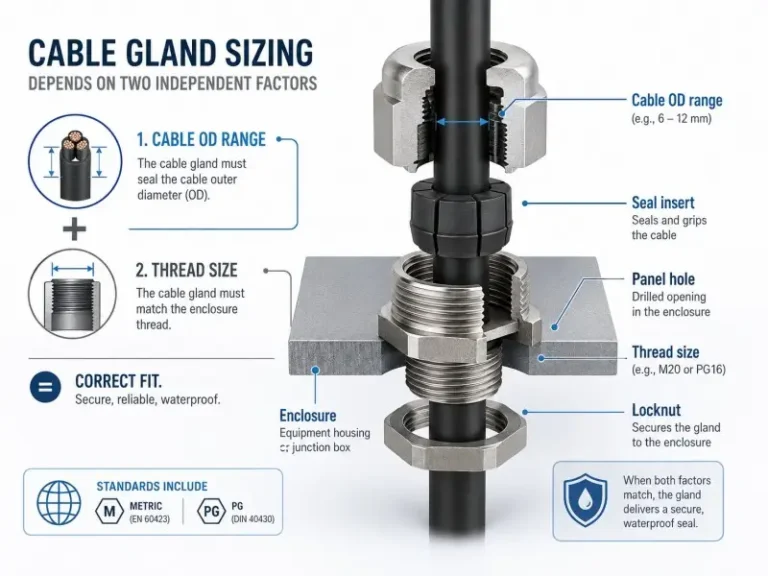
A cable gland is sized by the cable’s outer diameter (OD), not the wire gauge. The size code (M20, PG11, etc.) sets both the enclosure thread and the cable OD it seals. As a rule, an M20 gland fits 6–12 mm cable, M25 fits 10–14 mm, and PG11 fits 5–10 mm. Pick the size where your cable OD lands near the middle of the clamping range.
Choosing the wrong cable gland size is the most common reason a “waterproof” entry still leaks. Too large and the seal never compresses; too small and the cable won’t pass. This chart gives the exact Metric (M) and PG cable OD ranges, the thread each size uses, and how to convert between standards—so you order the right size once. Every range below is taken from a real, lot-traceable Verchil cable gland datasheet, not a generic table.
How Cable Gland Sizes Actually Work
A cable gland size code defines two independent things: the thread that screws into your enclosure and the cable outer-diameter (OD) range it can seal. The international product standard for cable glands is IEC 62444, and thread forms follow ISO 965 (Metric) or DIN 40430 (PG)—so the same “M20” means the same thread everywhere, but the sealed cable range can vary by gland design.
Three numbers decide every fit: the cable OD clamping range (the min–max cable the rubber insert seals), the thread size (M20×1.5, PG11, etc.), and the panel hole you drill for that thread. Measure your cable OD first with calipers; the gland’s thread is chosen separately to match the enclosure. If you’re still deciding which gland type (nylon, brass, stainless) suits the job, see our 5 best cable gland types compared before locking a size.
Metric (M) Cable Gland Size Chart
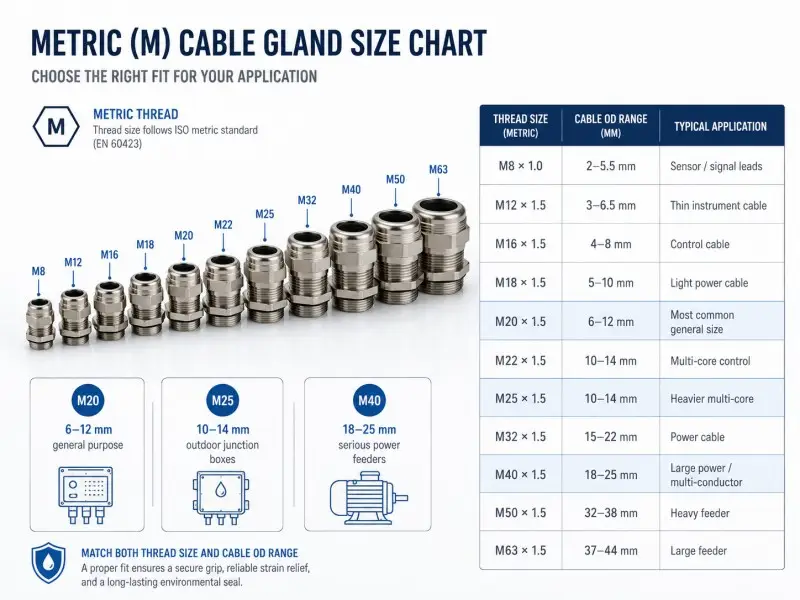
Metric cable glands use an ISO thread written as M + diameter × pitch (e.g., M20×1.5). The table below lists Verchil’s standard metal-gland ranges; flexible and wide-range variants exist for the same thread (noted after the table).
| Metric thread | Cable OD range | Typical use |
|---|---|---|
| M8 × 1.0 | 2–5.5 mm | Sensor / signal leads |
| M12 × 1.5 | 3–6.5 mm | Thin instrument cable |
| M16 × 1.5 | 4–8 mm | Control cable |
| M18 × 1.5 | 5–10 mm | Light power cable |
| M20 × 1.5 | 6–12 mm | Most common general size |
| M22 × 1.5 | 10–14 mm | Multi-core control |
| M25 × 1.5 | 10–14 mm | Heavier multi-core |
| M32 × 1.5 | 15–22 mm | Power cable |
| M40 × 1.5 | 18–25 mm | Large power / multi-conductor |
| M50 × 1.5 | 32–38 mm | Heavy feeder |
| M63 × 1.5 | 37–44 mm | Large feeder |
M20 cable gland size
An M20 cable gland fits cables 6–12 mm in OD and uses an M20×1.5 thread (≈20.2 mm panel hole). It’s the default “general purpose” size and covers most 3–5 core control and light power cables. For round cables near 11–12 mm, step up only if your conductor count makes the cable stiff. Verchil supplies M20 in nylon, brass, and SS304/SS316.
M25 cable gland size
An M25 cable gland seals 10–14 mm cable on a standard insert, with M25×1.5 thread. Wide-range flexible M25 variants extend to 8–16 mm. Use M25 when an M20 tops out below your cable OD but you don’t yet need M32. It’s the workhorse size for outdoor junction boxes and machine power entries.
M40 cable gland size
A standard M40 cable gland accepts 18–25 mm cable (M40×1.5 thread); wide-range and plastic versions reach up to ~30–32 mm. M40 is where you move into serious power feeders and thick multi-conductor cable. Because OD spread is wide at this size, confirm the exact insert range against the stainless steel M40 datasheet before ordering.
PG (Panzergewinde) Cable Gland Size Chart
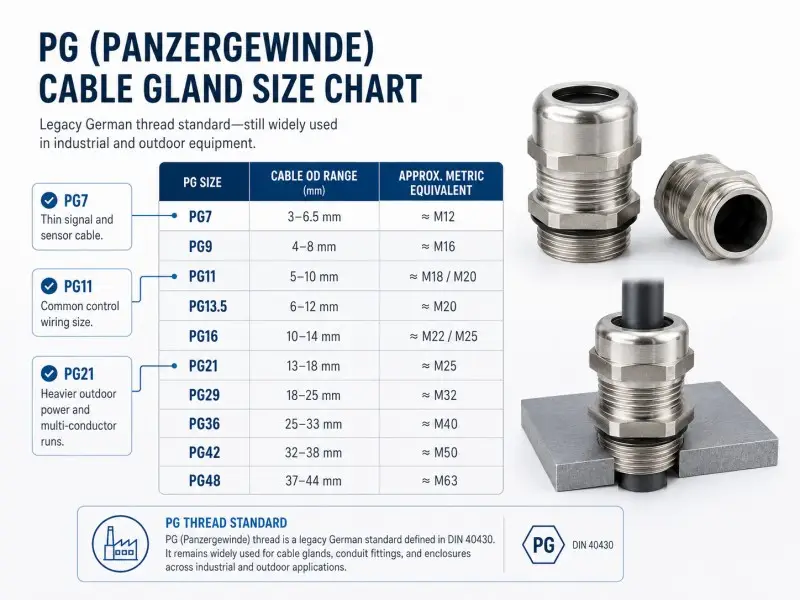
PG is a German thread standard still dominant in industrial and outdoor gear. PG sizes don’t map to a millimeter dimension the way Metric does, which is why a conversion chart matters.
| PG thread | Cable OD range | Metric equivalent (thread) |
|---|---|---|
| PG7 | 3–6.5 mm | ≈ M12 |
| PG9 | 4–8 mm | ≈ M16 |
| PG11 | 5–10 mm | ≈ M18 / M20 |
| PG13.5 | 6–12 mm | ≈ M20 |
| PG16 | 10–14 mm | ≈ M22 / M25 |
| PG21 | 13–18 mm | ≈ M25 |
| PG29 | 18–25 mm | ≈ M32 |
| PG36 | 25–33 mm | ≈ M40 |
| PG42 | 32–38 mm | ≈ M50 |
| PG48 | 37–44 mm | ≈ M63 |
PG7 cable gland size
A PG7 cable gland is the smallest common size, sealing 3–6.5 mm cable. It’s the right pick for thin signal, sensor, and instrument leads—including small multicore made of fine 22 AWG conductors (see the AWG note in the FAQ). If your cable is thinner than 3 mm, you need a reducing seal insert rather than a smaller thread.
PG11 cable gland size
A PG11 cable gland seals 5–10 mm cable and is the PG-world equivalent of an M20. In retrofits, a PG11 hole (≈18.6 mm) is often re-drilled to 20.2 mm to drop in an M20—handy when you standardize a panel on Metric. PG11 is one of the most stocked sizes for control wiring.
PG21 cable gland size
A PG21 cable gland fits 13–18 mm cable, roughly matching an M25 thread. It suits heavier outdoor power and multi-conductor runs—LED display trunk cable, stage power, and similar. Verchil stocks PG21 across nylon and metal bodies for outdoor LED installations.
Metric ↔ PG Conversion (and why threads aren’t interchangeable)
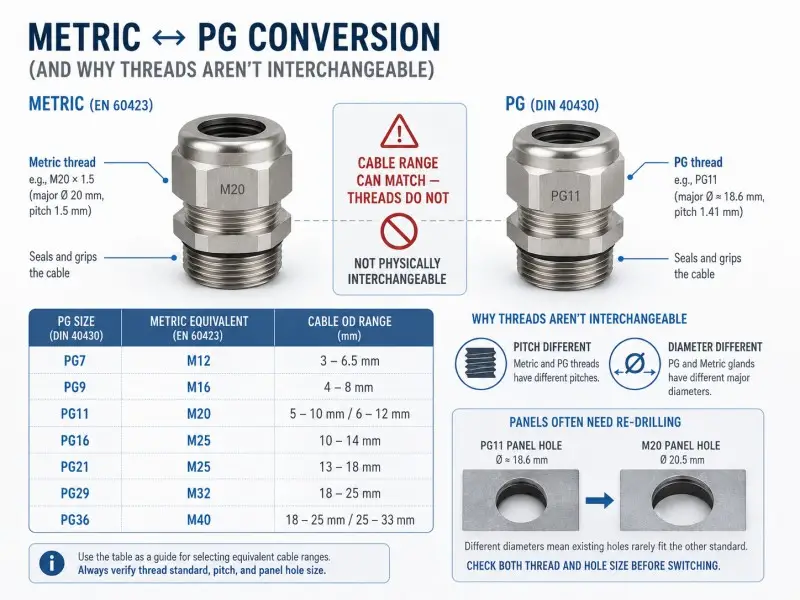
M and PG threads are not physically interchangeable—pitch and diameter differ, so an M20×1.5 will not thread into a PG16 hole. Conversion charts match sizes by cable range, not by swapping hardware. The table below pairs the closest equivalents; when you switch standards on an existing panel, plan to re-drill the hole.
| PG | Closest Metric | Shared cable OD band |
|---|---|---|
| PG7 | M12 | 3–6.5 mm |
| PG9 | M16 | 4–8 mm |
| PG11 | M20 | 5–10 / 6–12 mm |
| PG16 | M25 | 10–14 mm |
| PG21 | M25 | 13–18 mm* |
| PG29 | M32 | 18–25 mm |
| PG36 | M40 | 18–25 / 25–33 mm* |
*PG and Metric bands overlap rather than match exactly; verify the seal insert OD when the ranges differ. Verchil ships Metric, PG, G(PF), and NPT threads on the same body, so you can standardize a mixed panel—confirm the thread column on any product datasheet.
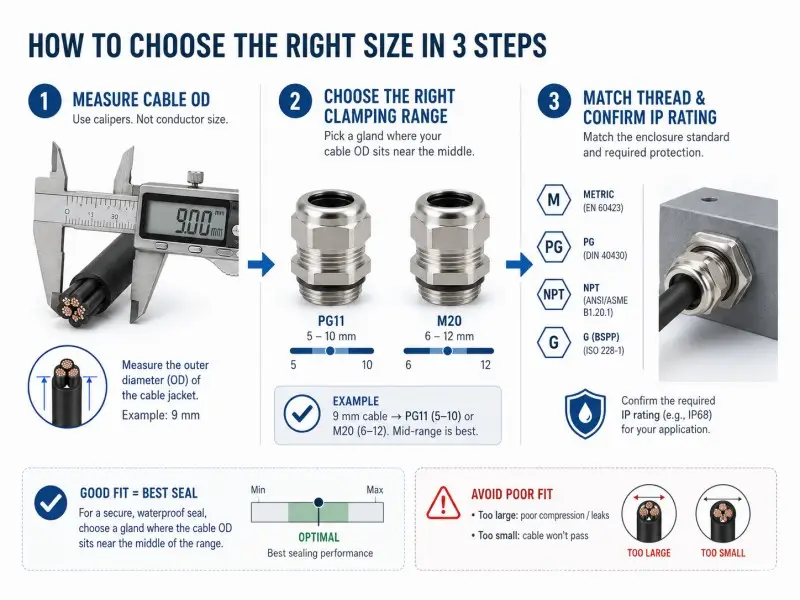
How to Choose the Right Size in 3 Steps
- Measure cable OD with calipers (not the conductor—the finished jacket).
- Find the gland whose clamping range centers on that OD. A 9 mm cable belongs in PG11 (5–10) or M20 (6–12), sitting mid-range for the best seal compression.
- Match the thread to your enclosure standard (Metric, PG, NPT, or G), and confirm IP needs. For full immersion or washdown, check our IP67 vs IP68 guide before finalizing.
Order at the wrong end of a range and the IP rating you paid for won’t hold. When two sizes both cover your OD, choose the one where the cable lands nearer the middle. Need help on a batch or a custom thread? Request a quote or datasheet or message our engineers on WhatsApp.
Conclusion
Cable gland sizing comes down to one measurement—cable OD—mapped to the clamping range of a Metric or PG size, then matched to your enclosure thread. Use M20 (6–12 mm) and PG11 (5–10 mm) as your mental anchors, convert by cable band rather than by swapping threads, and keep the cable near the middle of the range for a seal that actually meets its IP rating. Verchil stocks every size in this chart across nylon, brass, and stainless, IP68-rated and lot-traceable. Download the full size + spec sheet to size your next panel in minutes.
Frequently Asked Questions
What size cable gland do I need for a 10 mm cable?
Either PG11 (5–10 mm) or M20 (6–12 mm) works; M20 puts a 10 mm cable closer to mid-range, giving a slightly better seal.
Is PG11 the same as M20?
They cover a similar cable range and are common swaps, but the threads differ—PG11 needs ≈18.6 mm hole, M20 needs ≈20.2 mm, so a retrofit means re-drilling.
What cable gland fits a thin 22 AWG wire?
Cable glands are rated by cable OD, not wire gauge. A single 22 AWG conductor (~1.7 mm finished) is below most sealing ranges—use the smallest size (PG7, 3–6.5 mm) with a reducing insert, or bundle the wires so the jacket OD reaches the gland’s minimum.
Are Metric and PG threads interchangeable?
No. Pitch and diameter differ; you must drill the correct hole for the standard you choose. Conversion charts only match cable ranges, not hardware.
Does cable gland size affect the IP rating?
Yes—an oversized gland can’t compress the seal, dropping the effective rating. Size to mid-range and confirm the gland’s stated IP (most Verchil glands are IP68). Details in our IP rating guide.