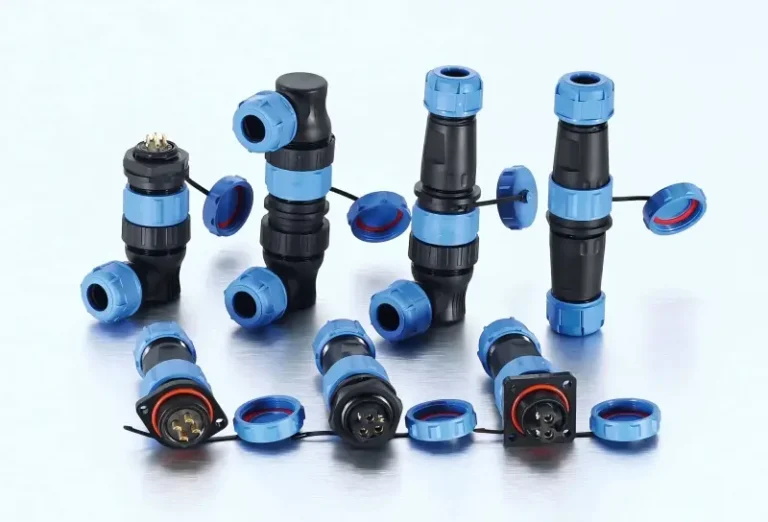
A waterproof aviation connector is a sealed circular (or rectangular) connector that keeps power and signal stable in wet, dusty, high-vibration conditions. Most are rated IP67 (immersion to 1 m for 30 minutes) or IP68 (continuous immersion), and they lock by thread, bayonet, or push-pull. The seal only holds when the connector is mated and locked, so a dust cap belongs on every unplugged port.
Designing avionics, an underwater robot, or outdoor infrastructure — and unsure which waterproof aviation connector seals well enough? Because a single failed seal can short a whole circuit, the IP grade and locking type are decisions you make first, not last. So this guide explains how these connectors seal, what IP67/IP68/IP69K actually mean, the main types, and how to choose the right one.
What Is a Waterproof Aviation Connector?
A waterproof aviation connector is a multi-pin circular or rectangular connector built to maintain reliable signal and power transmission in wet environments. The name is historical: the circular bayonet design was created for aviation, where mechanical shock, thermal cycling, and moisture resistance were mandatory. Today the format reaches far beyond aircraft — into defense, shipbuilding, industrial automation, and outdoor infrastructure.
Four traits separate it from an ordinary industrial connector:
- A multi-point environmental seal (mating face, contacts, and cable entry)
- A circular shell that compresses the gasket evenly
- A locking mechanism (bayonet, threaded, or push-pull) that holds mating pressure under vibration
- Compliance with an IP or MIL-spec protection standard
For the sealed SP/SL series Verchil manufactures, see our waterproof aviation connector range, and for the wider family our aviation connector ultimate guide is the pillar reference.
How Waterproof Aviation Connectors Seal
A waterproof aviation connector reaches its rating through layered seals, and skipping any one of them breaks the protection:
- Mating-face O-ring — a silicone or nitrile O-ring between plug and socket compresses axially when locked. This is the primary seal on IP67/IP68 parts.
- Cable-entry seal — a gland or grommet at the rear grips the cable so moisture can’t track in along the jacket. If the seal size doesn’t match the cable, the whole connector fails even with a perfect mating face — the same principle behind a standalone waterproof cable gland.
- Per-contact cavity seal — MIL-spec types like MIL-DTL-38999 Series III seal each pin cavity individually, so water can’t bridge contacts even if the main seal ages.
- Potting — for deep-sea or maintenance-free use, epoxy or polyurethane is injected behind the contacts to block ingress permanently.

IP67 vs IP68 vs IP69K: Which Rating Do You Need?
The IP code comes from IEC 60529: the first digit grades dust (0–6), the second grades water (0–9K). For a waterproof aviation connector, the water digit is what you weigh:
| IP rating | Water protection | Typical use |
|---|---|---|
| IP65 | Water jets from any direction | Outdoor enclosures, general industrial |
| IP67 | Immersion to 1 m for 30 min | Handheld and field instruments, outdoor gear |
| IP68 | Continuous immersion beyond 1 m (maker-defined) | Submersible equipment, marine sensors |
| IP69K | High-pressure, high-temp washdown (ISO 20653) | Food processing, vehicle wash systems |
So most rugged outdoor work needs IP67; marine, subsea, and ship power distribution call for IP68, and washdown lines for IP69K, all covered across our waterproof connector range. Because IP68 depth and time are manufacturer-defined, always confirm the exact tested conditions rather than assuming “deeper is automatic.”
Types of Waterproof Aviation Connectors
Match the locking type to how often you’ll mate it and how much it vibrates:
- Bayonet circular — a quarter-turn lock for fast, repeatable mating with solid vibration resistance; common on ground vehicles, test gear, and the civil GX format covered in our 4 pin aviation connector guide.
- Threaded circular — the most vibration-resistant lock, preferred for defense and aerospace; flight-grade power versions are detailed in our aviation power connector guide.
- Push-pull circular — one-handed connect/disconnect in seconds, common on medical, broadcast, and portable gear, often rated to IP68.
- Micro / high-density — 1.27 mm contact spacing fits 50+ contacts in a compact shell for refined aerospace and defense systems.
For the popular 16 mm shell size specifically, see our industrial 16mm aviation connector guide.
Key Specs and How to Choose
Work through these parameters and the candidate list narrows fast. The headline specs:
| Parameter | What to specify | Why it matters |
|---|---|---|
| Shell material | Aluminum, stainless steel, composite | Corrosion, weight, EMI shielding |
| Contact plating | Gold (signal), silver (power) | Signal integrity, oxidation resistance |
| Operating temp | up to −65 °C to +175 °C (MIL-spec) | Thermal cycling |
| Mating cycles | 500–5,000 | Field-serviceable vs. permanent |
| Current rating | Signal <1 A; power 7.5–23 A/contact | Match to circuit |
| Locking | Threaded / bayonet / push-pull | Vibration vs. mating speed |
Then choose in order:
- Set the IP target from the environment
- Count contacts and reserve ~20 % spares
- Separate signal and power runs to manage heat
- Pick shell material — aluminum for general/aviation, stainless for marine and chemicals, composite for light-and-corrosion balance
- Match the locking type to vibration and mating frequency
- Confirm compliance (MIL-spec for defense, IEC/IP for industrial)
- Check the supply chain so lead time won’t stall production
For non-flight industrial, outdoor, and marine work, Verchil’s SP/SL waterproof aviation connector series fits these criteria; flight-critical circuits should use qualified MIL-spec brands such as Amphenol or TE Connectivity, as documented in the MIL-DTL-38999 standard.
Installation and Maintenance
Even a correctly chosen waterproof aviation connector fails if it’s fitted poorly. Four habits protect the seal:
- Inspect the O-ring before every mating; a nicked, deformed, or chemically swollen O-ring downgrades an IP68 part to no protection at all.
- Torque to spec with a wrench — too little lets the coupling vibrate loose, too much crushes the O-ring past its elastic limit.
- Cap unplugged ports immediately, since bare pins begin corroding within hours in salt spray.
- Test before closing up — a basic check is to submerge the mated assembly at rated depth for 30 minutes, then verify continuity. Where the cable passes a panel, pair the connector with a sealed waterproof cable gland at the entry.
Conclusion
In short, a waterproof aviation connector is defined by three matched choices: the IP rating for your wettest condition, the locking type for your vibration and mating frequency, and the shell material for your corrosion environment. Set those, seat every seal correctly, and cap unused ports, and the connection holds through immersion, vibration, and years of outdoor service. Civil and industrial work suits SP/SL-style parts; flight-critical lines stay with qualified MIL-spec connectors.
On an outdoor node these circular connectors share the cabinet with fiber, sealed Ethernet, and glands — see how they fit together when wiring outdoor communication equipment.
FAQ: Waterproof Aviation Connectors
What is the difference between IP67 and IP68 in aviation connectors?
IP67 covers immersion to 1 m for 30 minutes, while IP68 covers continuous immersion at a depth and time the manufacturer defines — typically several meters. Both are fully dust-tight. For most marine and ship applications, IP68 is the recommended minimum; IP67 suits handheld and general outdoor gear.
Are waterproof aviation connectors waterproof when unplugged?
No. The IP rating only applies when the plug and socket are fully mated and locked, because the seal forms between the two halves. An unmated socket left open has no protection, so fit a screw-on dust cap whenever a port is disconnected, especially outdoors or in salt air.
What does MIL-DTL-38999 mean?
MIL-DTL-38999 is a U.S. Department of Defense detail specification for circular, environment-sealed connectors. Its Series III — threaded coupling, stainless shell, per-contact seals — is the most widely used standard in modern defense and aerospace. It represents flight-grade performance beyond typical civil waterproof connectors.
Can waterproof aviation connectors be reused?
Yes, within their rated mating cycles — usually 500 to 5,000 depending on design and contact type. Bayonet and push-pull versions suit frequent reconnection, while potted connectors are permanent and cannot be reused. Replace the O-ring at service intervals to keep the seal effective.
Which IP rating do I need for marine or subsea use?
Choose IP68 for continuous immersion such as ship hulls, buoys, and subsea sensors, and pair it with a stainless or composite shell to resist salt corrosion. IP67 is only adequate for splash and brief immersion, not sustained underwater service, so don’t substitute it for genuinely submerged links.
Do I need a shielded waterproof aviation connector?
Use a shielded, metal-shell version with 360° backshell screening near motors, drives, or radio equipment, where electromagnetic interference would corrupt signals. For clean low-noise environments, an unshielded housing is fine. Match the shield to the cable and ground it correctly for the screening to work.
How do you maintain the waterproof seal on an aviation plug?
A waterproof aviation connector only holds its IP rating while it is mated or capped, so the first maintenance rule is to fit the sealing cap whenever the plug is unmated instead of leaving the open shell exposed. Inspect the interfacial gasket and the coupling O-ring for cuts, flats, or hardening at each service, and replace a perished seal rather than reseating it, since a compressed or nicked O-ring is the usual reason a connector that once passed IP68 starts to leak. Keep the sealing faces clean of grit, avoid over-torquing the coupling in the belief that tighter is more watertight because that crushes the gasket and shortens its life, and a thin film of silicone grease on the O-ring keeps it supple and easier to mate.