
An aviation 16mm connector is a circular, thread-locking panel connector whose 16 mm shell thread fits a roughly 16 mm panel hole. It comes in the civil GX16 series and the more rugged waterproof SP16 / SL16 series, carries anywhere from 2 to 26 contacts, and is rated IP65–IP68 when mated and locked. Compact, vibration-resistant, and cheap, it has become the default for industrial, robotics, LED, and outdoor wiring.
Need a compact multi-core connector that survives vibration and weather on a panel — but unsure whether GX16 or SP16 is right? Because the two share a 16 mm thread yet differ in sealing and ruggedness, your aviation 16mm connector choice shapes reliability and cost. So this guide breaks down what “16 mm” means, the pin and current options, IP sealing, and how to pick between the GX and SP/SL families.
What Is an Aviation 16mm Connector?
Despite the name, an aviation connector is not for aircraft. The circular, thread-locking design borrowed the anti-vibration structure of early aviation instruments, then spread across industrial and civil use — automation, robots, LED stage lighting, audio-video gear, DIY electronics, and renewable energy. The full family is covered in our aviation connector ultimate guide.
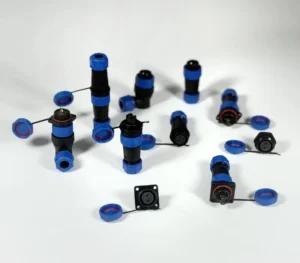
The “16 mm” refers to the shell thread diameter — that is, the panel opening size — and it is the most popular specification in the range. It appears as GX16 in the GX series and SP16 / SL16 in the industrial SP/SL series, and every aviation 16mm connector shares that 16 mm thread regardless of series. Core traits include:
- A round shell with a 16 mm locking thread
- A threaded lock with strong anti-vibration, anti-loosening performance
- A fixed panel-mount end plus a free cable end
- Contact counts from 2 to 26+ depending on series
- Optional IP65 / IP67 / IP68 sealed housings
For the sealed SP/SL hardware itself, see our waterproof aviation connector range.
Pin Configurations and Current Ratings
Contact count drives both capability and current per pin on an aviation 16mm connector, so match it to your circuit before anything else:
| Pins | Max current/pin | Typical applications |
|---|---|---|
| 2 | 10 A | Power supply, LED lighting |
| 3 | 10 A | DC motors, three-phase signals |
| 4 | 5 A | Servo drives, sensors, UART |
| 5 | 5 A | Stepper motors, RS-485 |
| 6 | 3 A | Encoders, multi-axis signals |
| 7 | 3 A | CAN bus, power-and-signal hybrid |
| 8–10 | 1–2 A | Data-acquisition instruments |
| 12–26 | 0.5–1 A | High-density signal (SP/SL series) |
In hybrid power-and-signal layouts, assign high-current loads to dedicated pins kept physically apart from signal contacts, and reserve about 20 % headroom below the rated current for continuous duty. For the most common low-pin layout, our 4 pin aviation connector guide details wiring and pinout.
IP Ratings and Sealing: GX16 vs SP16/SL16
Waterproofing on an aviation 16mm connector varies sharply by model, so confirm the IP grade before you buy. Under IEC 60529, the relevant tiers are:
- No rating (basic GX16) — unsealed; indoor, dry use only.
- IP65 — dust-tight plus water jets; light outdoor splash, via a mating-face O-ring.
- IP67 — immersion to 1 m for 30 minutes; needs O-rings on both plug and socket, for outdoor or occasional immersion.
- IP68 — continuous immersion; individually sealed contacts for submerged or constantly wet sites.
The SP series uses a welded tail that forms an integral seal, holding IP67+ reliably and suiting the harshest industrial jobs; the SL series uses a threaded, detachable tail that also reaches IP67 while staying easier to service. For the deeper sealing-mechanism breakdown, see our waterproof aviation connector guide.
Electrical and Mechanical Specs
Beyond pins and sealing, these ratings define an aviation 16mm connector:
- Rated voltage — 250 V AC / 300 V DC
- Dielectric withstand — 1,500 V AC for 1 minute (per the connector standard IEC 61984)
- Contact resistance — ≤5 mΩ gold-plated, ≤10 mΩ tin-plated
- Insulation resistance — ≥100 MΩ at 500 V DC
- Mating life — 500–1,000 cycles standard; 5,000+ on high-end industrial models
- Locking — threaded (GX/SL/SP, best vibration resistance), push-pull (one-handed), or bayonet (fastest)
For higher-current power circuits beyond what a 16 mm shell handles comfortably, our aviation power connector guide covers contact sizing.
Where Aviation 16mm Connectors Are Used
Because it is compact, multi-core, and sealable, the 16mm aviation connector is hard to beat on cost across many fields:
- Industrial automation and robots — a 5- or 6-pin GX16/SL16 carries encoder signal and 24 V power on one cable, simplifying the harness.
- LED and stage lighting — 4- and 7-pin GX16 link power and control on theater and architectural lighting, and the thread lock survives frequent re-rigging.
- Audio-video — 2- and 3-pin versions handle mic, amp, and AV-rack lines as a lower-cost stand-in for some XLR connector roles, with a smaller 16 mm footprint.
- Outdoor and renewable energy — sealed SP16/GX16 versions run solar, storage, and wind-instrument DC buses with IP68 dust-and-water protection.
- Medical and lab — push-pull 16 mm types give one-handed mating on portable diagnostic and lab instruments.
How to Choose — and 16mm vs XLR, M12, USB-C
Choosing the wrong aviation 16mm connector is easy and costly, so evaluate five things in order:
- Count pins for every signal, power, and ground line — never share a pin between power positive and ground
- Check current and voltage, reserving 20 % headroom for continuous duty
- Set the IP grade — GX16 indoors, IP67 outdoors, SP welded tail for immersion or high-pressure washdown
- Pick plating — gold/silver for signal and encoders, tin for pure power
- Match the panel — GX16 threads engage about 3–4 mm of panel, so above 5 mm use an extended-thread model, and pair panel entries with a sealed waterproof cable gland where needed
How it compares with other panel connectors:
| Feature | Aviation 16mm (GX16/SP16) | XLR 3-pin | M12 circular | USB-C |
|---|---|---|---|---|
| Pin range | 2–26+ | 3–7 | 3–12 | 24 (fixed) |
| Panel opening | 16 mm | 22 mm | 12 mm | 8.3 mm |
| Max current | 10 A (2-pin) | 15 A | 4 A | 5 A |
| IP protection | IP68 (SP series) | IP40 | up to IP68 | IP68 |
| Locking | Threaded / welded | Rotary lock | Threaded / push-pull | Friction |
| Unit cost | $0.50–$8 | $3–$20 | $5–$30 | $0.20–$3 |
| Certification | RoHS / REACH | IEC 61076-2-101 | USB-IF |
So GX16/SP16 wins on cost and configuration flexibility; M12 is the more standardized pick for formal fieldbus that requires IEC 61076-2-101 compliance.
Conclusion
In short, an aviation 16mm connector earns its place through a compact 16 mm shell, 2–26 contacts, and a vibration-proof thread lock — at a price other circular connectors can’t match. Choose GX16 for indoor and budget builds, SL16 for serviceable sealed runs, and SP16 for welded, immersion-grade reliability. Match pin count, current, IP grade, plating, and panel thickness, and the connector will hold signal and power steady for years.
FAQ: Aviation 16mm Connectors
What is the difference between the SP and SL series?
The difference is the cable tail. The SP series uses a welded tail that forms one integral, highly waterproof and vibration-resistant seal, best for permanent harsh-environment runs. The SL series uses a threaded, detachable tail that still reaches IP67 but is easier to install and service.
What panel opening does a GX16 connector need?
A standard GX16 panel socket needs a hole of about 15.5–16.0 mm. Tolerances vary slightly by manufacturer, so always check the specific datasheet before drilling. The thread typically engages 3–4 mm of panel; thicker panels need an extended-thread version.
Can GX16 and SP16/SL16 connectors mate with each other?
No. The GX series and the SP/SL series use different shell structures and thread specs, so they are not cross-compatible. Always pair plugs and sockets from the same series, since mixing them prevents proper locking and breaks the seal.
Is a waterproof aviation plug sealed when unplugged?
No. Every series only achieves its IP rating when fully mated and locked, because the seal forms between the two halves. An unmated or partly locked connector has no guaranteed protection, so fit a dust cap on exposed faces during storage, transport, or downtime.
GX12, GX16 or GX20 — which size should I pick?
The number is the thread diameter in millimeters. GX12 is the most compact for tight panels and low pin counts, GX16 is the common all-rounder, and GX20 gives more room for higher current and more contacts. Choose by panel space, current rating, and pin count.
What does “16 mm” actually refer to?
It refers to the connector’s shell thread diameter, which equals the panel mounting-hole size — not the cable diameter or contact count. So a 16 mm aviation connector always needs a ~16 mm panel hole, whether it carries 2 pins or 26.