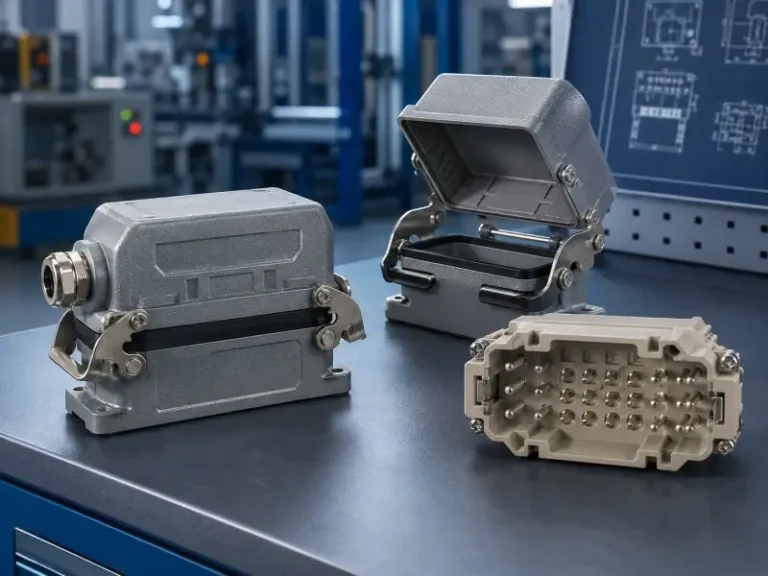
You speced a Harting Han or an ILME rectangular connector years ago, the machine has run on it ever since, and now the requote lands with a long lead time and a price you would rather not pay again. The good news: the Han B housing standard is open enough that a dimensionally matched insert and hood will bolt into the same panel cutout. The catch is knowing exactly where “fits the same hole” ends and “behaves identically at the contact” begins.
This page maps Harting Han B and ILME frames to the Verchil HE series part for part, then draws that line honestly. It is written for the maintenance engineer, the panel builder, and the buyer who already run industrial automation connector systems on Han-style hardware and want a second source without re-engineering the cabinet.
The short answer: drop-in at the housing, verify at the contact
Are Verchil, Harting, and ILME heavy duty connectors interchangeable? At the housing level, yes — Verchil HE frames follow the Han B standard, so an HE housing, hood, and panel cutout match the Han 6B through 48B footprint and a Han E insert’s pole pattern. At the contact level, treat it as a verification step, not an assumption: confirm the current, plating, and contact geometry against your load before you mix parts from two makers in one mated pair.
That distinction is the whole article. Han B is a published frame convention, which is why ILME, Weidmüller, and Verchil can all build to it. Contact internals are not standardized the same way, and that is exactly where a wrong swap bites.
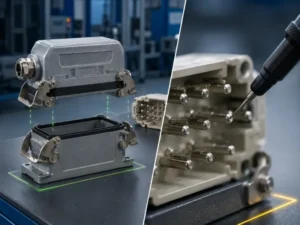
Harting Han B and ILME to Verchil HE cross-reference matrix
A Han B frame is named for the number of Han E power contacts it holds, plus one protective earth. A 16B frame carries 16 contacts and a PE; a 48B carries 48. As of 2026, a standard Han E insert is rated 16 A at 500 V per contact, per HARTING Han E datasheet figures published through distributors such as TME and RS. Verchil’s HE series is built to the same frame names and the same 16 A / 500 V Han E pattern, so the mapping below is frame-for-frame and pole-for-pole.
| Han B frame | Contacts (+PE) | Per-contact rating | Harting Han E insert | ILME CNE equivalent ‡ | Verchil HE part |
|---|---|---|---|---|---|
| Han 6B | 6 + PE | 16 A / 500 V | Han E 6-pole (09330062602) | CNEM06T | HDC-HE-006 |
| Han 10B | 10 + PE | 16 A / 500 V | Han E 10-pole (09330102602) | CNEM10T | HDC-HE-010 |
| Han 16B | 16 + PE | 16 A / 500 V | Han E 16-pole (09330162602) | CNEM16T | HDC-HE-016 |
| Han 24B | 24 + PE | 16 A / 500 V | Han E 24-pole (09330242602) | CNEM24T | HDC-HE-024 |
| Han 32B | 32 + PE | 16 A / 500 V | 2 × Han E 16-pole | 2 × CNE 16 (1–16 + 17–32) | HDC-HE-032 |
| Han 48B | 48 + PE | 16 A / 500 V | 2 × Han E 24-pole (09330242601 + 09330242611) | 2 × CNE 24 (1–24 + 25–48) | HDC-HE-048 |
A single Han E or ILME CNE insert tops out at 24 poles, so the Harting, ILME, and Verchil 32B and 48B frames are each populated with two inserts per half — not one 32- or 48-pole part. For 48 poles, Harting pairs a “1–24” insert (09330242601) with a “25–48” insert (09330242611), per the HARTING B2B catalog; ILME and Verchil split the frame the same way.
ILME CNE is the E-type, 16 A / 500 V line. The cells show the male screw-terminal insert (CNEM…T); use CNEF…T for the female half, per ILME listings on Newark and Mencom. Match the gender to the mating side.
Read the matrix in one direction: start from the frame size already stamped on your housing, then drop down to the Verchil HE part in the last column. The pole count and the 16 A / 500 V rating carry across every row, so a Han 24B housing on your machine accepts a 24-pole HE insert of the same pattern. The full list of HE part numbers and housing variants — including the SE, TE, BK, and SF hood codes — sits on the HE-series page.
A worked example, drawn from a community lookup rather than a single catalog: the ILME TCHI-16 C-type bulkhead base maps to Harting 09340100301, and an ILME CNEM16T insert (listed in some threads as CMEM-16) drops into the same 16-pole Han E position ProductsForAutomation. Treat any single pairing as a starting point and confirm it against the live datasheet before you order — suffixes shift with hood style and termination.
Reading the frame size off the connector you already have
Before any of this helps, you need the frame size of the part on the machine — and it is usually printed right there. Check three places, in order.
The housing comes first. Harting and ILME stamp the frame designation, 6B through 48B, into the metal of the hood or the bulkhead base, often beside the maker’s logo. That stamp is the fastest answer you will get.
The insert is the backup. If the shell marking is painted over or worn flat, pull the hood and read the part number molded into the insert itself; the pole count lives in that code, and the matrix above converts it to a frame size.
A contact count is the last resort. With no legible marking anywhere, count the power contacts in one insert and add the central protective earth — six power contacts plus a PE is a 6B, sixteen is a 16B. The frame name only restates that count, which is why even a worn, unbranded connector is identifiable on the bench in about a minute.
A Han connection is three parts, not one
When a quote says “Harting connector,” it usually means three separable pieces, and a cross-reference has to account for each. Mixing brands works cleanly when you swap a whole side, and gets risky when you mix internals across a single mated pair.
- The insert carries the contacts. This is the piece whose pole count and current rating must match — a 16-pole Han E insert and a 16-pole HE insert share the 16 A / 500 V pattern and the same cavity layout.
- The hood and housing are the metal shell: the bulkhead base that mounts through the panel and the hood that the cable enters. These are pure mechanical parts, keyed to the Han B frame, and the lowest-risk thing to second-source.
- The contacts and terminations. Verchil HE uses screw terminals on a silver-plated copper-alloy contact, per the Verchil HE-series datasheet. If your existing assembly is crimp, you are changing the termination method, not just the brand.
The practical rule that falls out of this: replacing a complete connector side — insert plus hood plus housing — from one maker is a clean swap. Dropping one maker’s insert into the other maker’s hood on the same machine is the case that needs a bench check first. For the frame-and-hood mechanics behind this, the industrial rectangular connector guide walks through cable entry, hood angle, and gland sizing.
Where “drop-in” stops: housing fit versus contact interchange
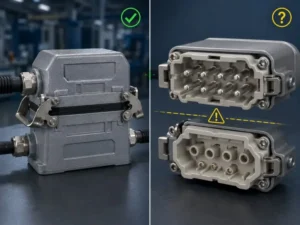
Plenty of supplier pages claim full interchangeability with Han. That claim is half true, and the honest half is the useful one. Frame dimensions are shared. Contact internals are not.
A community-reported example makes the point. The ILME HMK-003.1 socket looks like a Han part and is often listed near it, yet cross-reference threads repeatedly flag it as a look-alike that is not a Han drop-in. The underlying reason is general, not brand gossip: different makers use different female-contact geometries — a fork-type contact engages differently from a barrel-type one — so two parts can share an outline and still mate differently under load and vibration. Treat any look-alike as unverified until the contact pair is confirmed. That is why a cross-reference table is a starting point for sizing, not a guarantee that any two inserts will share a single contact pair.
Verchil’s position here is deliberately narrow. The HE series matches the Han B frame, the pole pattern, and the 16 A / 500 V Han E rating, so an HE side drops into a Han-built cabinet. Verchil does not claim a Verchil contact is mechanically identical to a Harting barrel contact — the published HE contact is a silver-plated screw-terminal type, and contact-level mixing should be verified for your current and cycle count. Honest framing protects the engineer who has to sign off on the change.
Two safety behaviors are shared across all three brands and are not optional:
- Protective earth mates first and breaks last. The central PE contact is longer than the power and signal pins, so earth is made before any live pin touches and is the last to part on withdrawal. This is built into the Han B geometry and into IEC 61984, the safety standard for connectors rated above 50 V.
- No mating under load. Han E and equivalent inserts are not rated to make or break current. Per HARTING and ILME insert datasheets, you de-energize the circuit before plugging or unplugging, whichever brand is on the cable.
A four-question drop-in decision
Before you commit a cross-reference to a purchase order, run the part through four checks. Pass all four and it is a housing-level drop-in; fail any and it moves to a bench verification.
- Frame match. Is the replacement the same Han B frame size (6B, 16B, 24B…) as the housing on the machine? If no, it will not seat.
- Pole and rating match. Same pole count, and at least the same 16 A / 500 V per-contact rating for your load? If no, resize.
- Whole-side swap. Are you replacing a complete insert-plus-hood-plus-housing side, rather than mixing one maker’s insert into another’s hood? A whole-side swap clears this; a mixed pair goes to step 4.
- Contact verification. For a mixed pair, has the contact geometry, plating, and current been checked against the duty? If not, bench-test before the line run.
Verchil HE series at a glance
These are the figures that decide whether an HE part covers your duty. All values are from the Verchil HE-series datasheet.
| Parameter | Verchil HE series |
|---|---|
| Frame sizes | H6B, H10B, H16B, H24B, H32B, H48B |
| Contacts per frame | 6 / 10 / 16 / 24 / 32 / 48 (+PE) |
| Rated current | 16 A per contact |
| Rated voltage | 500 V (UL/CSA 600 V) |
| Contact | Silver-plated copper alloy, ≤ 1 mΩ |
| Termination | Screw terminal |
| Wire range | 1.0–2.5 mm² (18–14 AWG) |
| Ingress protection | IP65 / IP67 (mated, correct gland) |
| Operating temperature | −40 °C to +125 °C |
| Flammability | UL 94 V-0 |
| Impulse voltage | 6 kV |
| Mechanical life | ≥ 500 mating cycles |
| Pollution degree | 3 |
If the duty fits inside that envelope and the frame size matches, the cross-reference holds. When you are ready to confirm a specific part and its hood code, the Verchil HDC heavy duty connectors range lists the full housing and insert combinations and the request-a-quote path. For the wider context of where HDC sits among connector families, the heavy duty connector guide covers selection from the ground up.
Prefabricated and modular data center power is one of the places this housing pattern earns its keep — a generator or UPS feed point, or a deliberate break in a run that has to open without cutting anything. Verchil covers module-to-module power tie-ins in prefabricated data center builds, including the point where a heavy-duty connector stops being a substitute for a certified PDU or CDU inlet.
Frequently asked questions
Are Harting and ILME heavy duty connectors interchangeable?
At the frame and housing level, largely yes — ILME builds to the Han B standard, so frames, hoods, and panel cutouts line up. At the contact level, not always: makers use different female-contact styles (fork-type versus barrel-type), and look-alikes such as the ILME HMK-003.1 are commonly flagged as not a Han drop-in. Match the frame freely; verify the contact before mixing inserts in one mated pair.
Can a Verchil HE connector replace a Harting Han B?
For a complete side — insert, hood, and housing — yes. The HE series uses the same Han B frame names and the same 16 A / 500 V Han E pole pattern, so an HE side seats in a Han-built cabinet. Confirm the per-contact current against your load and keep the swap to a whole side rather than mixing one maker’s insert into the other’s hood.
What does a Han 16B frame cross-reference to?
A Han 16B frame holds 16 contacts plus a protective earth. It maps to a Han E 16-pole insert (16 A / 500 V), the ILME CNEM16T, and the Verchil HDC-HE-016-M. Pole count and rating are shared across all three.
Do I have to de-energize before unplugging a heavy duty connector?
Yes. Han E and equivalent inserts are not rated to make or break under load, regardless of brand. De-energize the circuit first; the protective earth contact is designed to break last on withdrawal, but the power contacts must not be parted live.
Will a cheaper alternative still meet my IP rating?
The IP rating depends on the mated seal and the correct cable gland, not the brand badge. A Verchil HE pair reaches IP65/IP67 when mated with the right gland for the cable diameter, the same precondition that applies to a Han assembly.