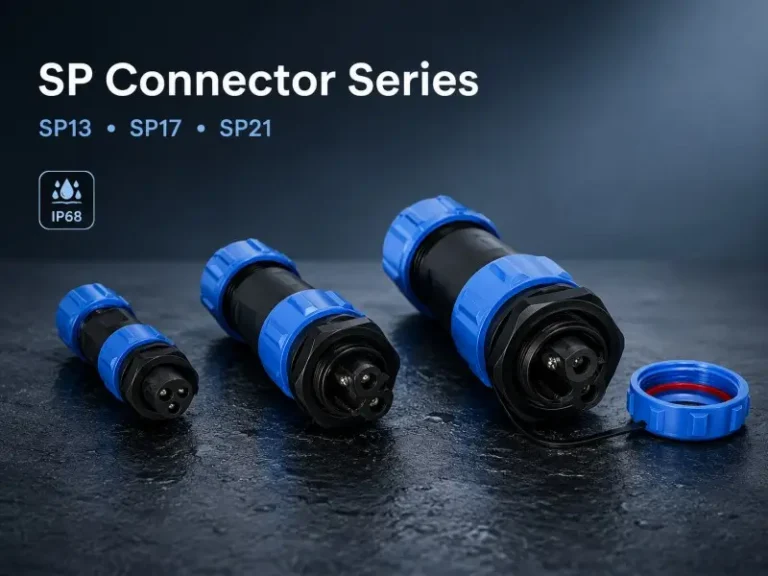
Choosing SP connector sizes comes down to three core models — SP13, SP17 and SP21 — sized to 13 mm, 17 mm and 21 mm panel holes and rated to IP68 when mated. The number after “SP” is simply the panel cutout diameter in millimetres, so the family scales from compact 13 mm sensor work up to 21 mm high-current power without changing its threaded, sealed design.
This guide compares the three by panel hole, cable diameter, pin count and current, then gives a simple method to pick one with confidence. SP is one branch of the broader aviation connector family, which also covers GX, M12 and rectangular MIL-spec types.
What Is the SP Connector Series?
An SP connector is an IP68-rated threaded circular connector built for waterproof power and data links, sealed against dust and water ingress when mated and locked.
The series spans several shell sizes — SP11, SP13, SP16/17, SP20/21, SP28 and SP29 — but three sizes carry most real-world demand: SP13, SP17 and SP21.
Every size shares the same sealing logic: a threaded coupling, dual O-ring seals, a high-temperature PPS insert (rated to about 260 °C) and a compression nut that grips the cable jacket. Contacts are brass with gold plating, typically good for 500+ mating cycles across a −40 to +85 °C range.
Because all of this stays constant across the range, choosing a size is really about matching shell diameter to your cable, pin count and current — not learning a new connector each time. For the underlying seal mechanism, see our waterproof aviation connector guide.
SP Connector Size Chart: SP13 vs SP17 vs SP21
Across the three core sizes, the panel hole grows from 13 mm to 21 mm, the cable it accepts thickens from ~6.5 mm to ~12 mm, and current capacity rises with the extra shell room. This single chart is the fastest way to shortlist before you read the per-size notes.
| Spec | SP13 | SP17 | SP21 |
|---|---|---|---|
| Panel hole Ø | 13 mm | 17 mm | 21 mm |
| Cable OD range | 4.0–6.5 mm | 4.0–7.5 mm | 8.0–12.0 mm |
| Typical pins | 2 / 3 / 4 / 5 / 6 / 7 / 9 | 2–9 | 2 / 3 / 4 / 5 / 7 / 9 / 12 (–15) |
| Current / contact | 3–25 A | 5–10 A | 5–30 A |
| IP rating (mated) | IP68 | IP68 | IP68 |
| Best for | Compact sensors, LED, solar path lights | The balanced all-rounder | High-current power, video walls, marine, renewables |
Two rules apply to every column. First, current per contact falls as pin count rises, because the contacts shrink to share the shell — a 2-pin SP21 carries far more per contact than a 12-pin SP21. Second, the IP68 rating only holds when the connector is fully mated and locked; an unplugged half has no guaranteed protection, so cap exposed faces during downtime.
Ready to spec a size? Verchil stocks SP13/SP17/SP21 with IP65/67/68 third-party test reports and lot-traceable QC — request a quote or datasheet.
SP13 Connector — the Compact 13 mm Choice
The SP13 connector packs 2 to 9 contacts into a 13 mm shell that accepts a 4.0–6.5 mm cable, making it the size to reach for when panel space is tight but you still need an IP68 seal. It is rated for roughly 3–13 A depending on pin count, which covers most sensor, LED and small-DC-power work.
Typical uses include outdoor cameras, LED screens, solar path lights and portable instruments — anywhere a small sealed feed-through beats a bulkier shell on cost and footprint.
Keep about 20 % current headroom for continuous duty, and never share a single contact between power-positive and ground. For wiring and pin-numbering on the most common low-pin layouts, our 4-pin aviation connector guide walks through the pinout step by step.

SP17 Connector — the 17 mm Middle Ground
The SP17 connector sits at a 17 mm panel hole and accepts cable up to 7.5 mm OD, making it the balanced pick when SP13 feels too delicate but SP21 is more shell than you need. It keeps the same 2–9 pin options and IP68 sealing as SP13 while giving slightly more room for current and a thicker cable jacket.
Confirm exact ratings per datasheet. SP17 is the quiet workhorse of the range: enough capacity for mixed power-and-signal harnesses on robots, lighting rigs and industrial controls, without jumping to the larger 21 mm footprint. If your build is genuinely a 16 mm panel job rather than 17 mm, compare it against GX16 and SL16 in our aviation 16 mm connector guide instead.

SP21 Connector — the 21 mm High-Current Choice
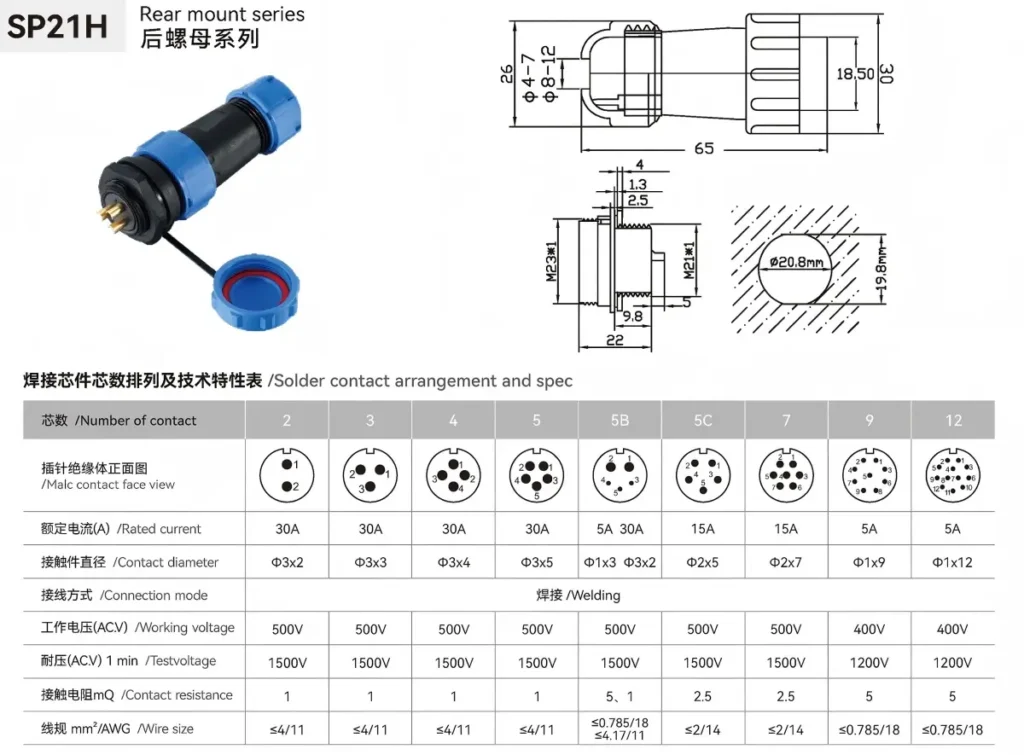
The SP21 connector uses a 21 mm shell and an 8.0–12.0 mm cable range, carrying the highest current in the family — up to roughly 15–30 A depending on the pin configuration.
It is the model for power-heavy and outdoor work where both amperage and a dependable seal matter at once. With pin options up to 12 (and 15 on some variants), SP21 handles three-phase motor sets, large-scale LED video walls, marine navigation gear and solar or storage DC buses. The socket carries a hinged waterproof cap so the exposed face stays protected when unplugged.
Because the welded/threaded tail forms one integral seal, SP21 holds IP68 reliably even under repeated outdoor exposure. Where the power side becomes the limiting factor, our power-rated aviation connector guide explains how contact size sets the real current ceiling.
The Wire-OD Trap: Why Pin Count Isn’t Your First Filter
Most buyers pick an SP size by pin count or current first — and that is the wrong order, because the cable’s outer diameter (OD) often decides the size for you.
Each shell only seals over a fixed OD window: SP13 grips 4.0–6.5 mm, SP17 grips 4.0–7.5 mm, and SP21 grips 8.0–12.0 mm. If your cable measures 9 mm across, an SP13 simply cannot close its compression nut around it and hold IP68 — no matter how few pins you need, you are pushed up to SP21.
We call this the wire-OD trap: a design that looks like a 3-pin SP13 job on paper but is forced to SP21 by a fat, multi-core jacket. So measure the cable OD before you count pins. Where a cable still has to pass a separate enclosure wall, pair the connector with a sealed waterproof cable gland rather than forcing it through the connector seal alone.
How to Choose: A 3-Step SP Sizing Method
The fastest way to land on one model is to filter in this order — OD first, then load, then environment — so you never get trapped by a spec you checked too late.
- Match the cable OD. Measure your cable’s outer diameter and pick the shell whose window it falls in (SP13 ≤6.5 mm, SP17 ≤7.5 mm, SP21 8–12 mm). This usually eliminates one or two sizes immediately.
- Count pins and current. Total every power, signal and ground line, add ~20 % current headroom for continuous duty, and remember current per contact drops as pins rise. Use gold-plated contacts for signal, tin or silver for pure power.
- Confirm panel and environment. Check the panel thickness the thread must engage and the real IP need — IP68 only counts when mated, so cap unused faces. Outdoors or submerged, the SP welded-tail seal is the safe call.
Work top to bottom and one model usually stands out: SP13 for compact sealed signal, SP17 for the balanced middle, SP21 for high-current outdoor power. When you have a shortlist, Verchil’s sealed SP connectors are available across all three sizes, with free samples on standard parts and 7-day prototyping on custom work.
SP vs SL vs GX — and Where SP16 Fits
The series, not the size, decides how a connector seals and how serviceable it is.
- SP uses a welded cable tail for one integral, immersion-grade IP68 seal — best for permanent harsh-environment runs.
- SL uses a detachable threaded tail that still reaches IP67 but is far easier to open and re-terminate in the field.
- GX is the budget, indoor or light-outdoor option.
One caution: SP/SL and GX use different shell and thread specs and are not cross-compatible, so always pair plugs and sockets from the same series. And if you have specifically searched for SP16, note that 16 mm sits between SP13 and SP17 and is usually treated as part of the 16 mm size class alongside GX16 — for that exact decision, our aviation 16 mm connector guide compares GX16 vs SP16/SL16 directly.
FAQ: SP Connector Sizes
What does the number in SP13, SP17 or SP21 mean?
It is the panel cutout diameter in millimetres — SP13 needs a ~13 mm hole, SP17 ~17 mm and SP21 ~21 mm. Larger numbers give more room for higher pin counts, thicker cable and higher current.
SP13 vs SP21 — which should I choose?
Match the cable first: SP13 seals over 4.0–6.5 mm cable for compact, lower-current jobs, while SP21 takes 8.0–12.0 mm cable and carries far more current for power and outdoor work. If your cable is thick or your load is high, SP21; otherwise SP13.
What wire diameter fits each SP size?
SP13 accepts 4.0–6.5 mm, SP17 accepts 4.0–7.5 mm and SP21 accepts 8.0–12.0 mm cable OD. Check this before pin count — see the wire-OD trap above.
Is an SP connector waterproof when it’s unplugged?
No. Every SP size only reaches IP68 (per IEC 60529) when fully mated and locked, because the seal forms between the two halves. Fit the dust/waterproof cap on any exposed face during storage or downtime.
SP vs GX — which is more waterproof?
SP. Its welded tail and dual O-ring seal hold IP68 for immersion, while a basic GX shell is built for indoor or light-outdoor use. Choose SP for any wet, submerged or washdown site.
Need help sizing for your cable and current? Send your cable OD, pin count and environment and Verchil’s engineers will spec SP13/SP17/SP21 for you — contact us or message WhatsApp.