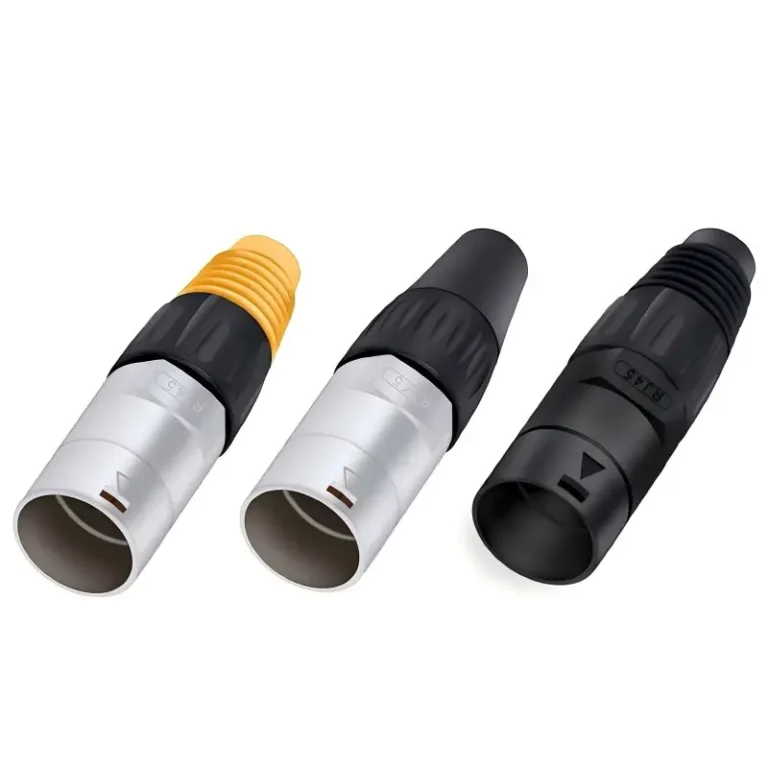
An rj45 female connector waterproof is the panel- or device-side socket (the 8P8C receptacle) that a cable plug mates into — not the cable end itself. On its own it is only finger-protected (about IP20); it reaches IP65/IP67/IP68 only when a sealed plug is mated and tightened, or a dust cap is closed.
Are you actually buying the socket side, or the plug side? Most “waterproof RJ45” guides quietly assume you want a female-to-female barrel coupler and stop there. Since the female (receptacle) side has its own panel cutout, its own sealing job, and its own catch — it stops being waterproof the moment nothing is plugged in — it deserves a guide of its own. Below: what the female side really is, how it differs from the male plug, what hole to cut in your panel, and where the IP rating quietly drops to IP20.
What an RJ45 Female Connector Waterproof Actually Is: 4 Receptacle Forms
On the data side, “female” means the receptacle — the recessed 8-contact cavity you push a plug into, defined by the IEC 60603-7 modular interface. Industry references are blunt about it: as Amphenol LTW notes, the waterproof RJ45 female connector is a recessed socket design embedded in a device or panel. That single sentence hides four physically different parts, and picking the wrong one is the most common spec mistake:
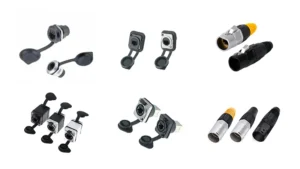
- Panel-mount bulkhead socket — a threaded receptacle (commonly M20–M25) that bolts through a chassis wall; the sealed plug mates from the outside. This is the workhorse for enclosures and equipment ports.
- Outdoor keystone jack — a snap-in jack for wall plates and patch panels; outdoor-rated versions add a gasketed shutter or housing.
- Feed-through coupler, female end — the female-to-female barrel that joins two already-crimped plugs (what most listings mislabel as simply “the female connector”).
- Device-integrated port socket — a sealed RJ45 receptacle built directly into a camera, AP, or PLC, where the seal is shared between the socket flange and the mating plug.
Verchil’s panel-mount socket families (for example the ZB100 / WB100 / PC100 series) are the bulkhead-receptacle type rather than barrel couplers — worth confirming against the model before you order, because the four forms are not interchangeable. You can compare the live socket variants on the RJ45 waterproof connector product page.
Female (Socket) Side vs Male (Plug) Side: Where the Seal Lives
The female and male halves do not just face each other — they carry different sealing responsibilities, and that is the part buyers miss. Both share the 8P8C modular interface standardized under IEC 60603-7, so they always mate the same way. What differs is where the water is stopped:
| Aspect | Female side (receptacle / jack / socket) | Male side (plug) |
|---|---|---|
| Role | Fixed; mounted in panel, device, or coupler | Moving; crimped on the cable end |
| Contacts | 8 spring contacts in a recessed cavity | 8 blade contacts on the 8P8C head |
| Seal it owns | Panel-interface gasket + mating-face seal/cap | Cable gland compressing the jacket |
| What it does NOT seal | The cable jacket — that is the plug’s gland | The panel opening — that is the socket’s flange |
Because the socket’s own gasket only seals the panel interface, the female side never waterproofs the cable by itself — the plug’s gland does that. Given that split, a sealed run needs both halves specified together; a metal-shell receptacle on an unsealed plug is still a leak. For the full panel context across jack types, see the network connector category. (If your real question is bandwidth, PoE heat, or shield continuity rather than the connector body, the waterproof Ethernet connector selection guide covers that side.)
Panel Cutout Sizes & Mounting for a Waterproof RJ45 Socket
Once you know it is the bulkhead socket you want, the next blocker is the hole. Cutout depends on whether the receptacle is a keystone module or a threaded bulkhead:
- Keystone snap-in uses a roughly standardized rectangular opening (around 14.5 × 16 mm for a standard keystone aperture). The jack clips in; the panel-side seal comes from the surrounding faceplate, not the jack alone.
- Threaded bulkhead (M20 / M22 / M25) needs a round hole near the thread’s major diameter plus, on most designs, a flat or keyway to stop the body rotating when you torque the lock nut. Panel thickness has a maximum the thread length allows.
I have seen a stadium-camera retrofit stall for a day because the installer drilled clean round holes for sockets that needed an anti-rotation flat — the lock nuts would not hold seal under vibration. The fix was on the drawing the whole time.
Do not treat the millimetres above as final. Exact cutout diameter, flat dimensions, gasket seat, and panel-thickness limit must come from the specific socket’s drawing (Verchil publishes per-model socket drawings such as the ZB100 / WB100 series) — these are design-dependent and need factory confirmation before you cut metal. For the bolt-up details and gasket specs, request the drawing via the RJ45 waterproof socket page.


The Unmated IP Downgrade: Why an Exposed Socket Is Only ~IP20
Here is the catch that defines the female side. An IP rating describes the mated, sealed state. Per IEC 60529 (the standard behind the IP code), an open receptacle sitting with nothing plugged in and no cap is essentially IP20 — protected against fingers and >12.5 mm objects, with the second digit at 0, meaning zero water protection. The waterproof housing you paid for does nothing until something closes the front.
The rating climbs in stages:
- Unmated, no cap → ~IP20. Bare cavity, open to spray and dust.
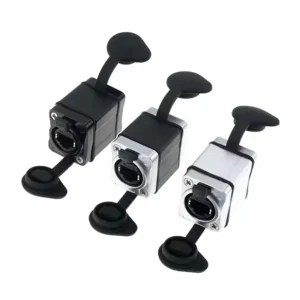
- Unmated, hinged dust cap closed → commonly IP54 up to about IP65, depending entirely on the cap and gasket design. Confirm the capped figure per datasheet; it is not automatic.
- Mated with a correct sealed plug, gland tightened → IP65 / IP67 / IP68. Verchil’s own product page states the point plainly: the IP65/IP67 level is reached only when the dust cover is buckled or the matching plug is inserted and tightened, and in the exposed state the internal contact is not waterproof — so a cap is advised whenever the port is idle.
The practical rule: spec the cap, not just the connector. A service port that sits unmated half its life (think a maintenance jack on an outdoor cabinet) is an IP20 hole between uses unless it has a tethered cap. For outdoor and comms-cabinet builds where idle ports are common, the outdoor & communication equipment connector solutions page shows capped-socket layouts, and the IP65 RJ45 waterproof connector guide breaks down IP65 vs IP67/IP68 if you are deciding the mated target.
Frequently Asked Questions About RJ45 Female Connector Waterproof
Is a waterproof RJ45 socket sealed when nothing is plugged in?
No. An exposed receptacle is roughly IP20 — finger-protected but with no water protection at all. It only reaches its rated IP65/67/68 when a sealed plug is mated and tightened, or a dust cap is closed over it. Always fit a cap on idle outdoor ports.
What is the difference between an RJ45 female connector and a male connector?
The female part is the receptacle (the recessed 8-contact socket on a panel, device, or coupler). The male part is the plug — the 8P8C head crimped on the cable. They mate per IEC 60603-7, but the plug’s gland seals the cable while the socket’s gasket seals the panel; you need both specified to seal a run.
What size hole do I cut for a panel-mount waterproof RJ45 socket?
It depends on the type: a keystone jack uses a rectangular aperture (around 14.5 × 16 mm), while a threaded bulkhead socket uses a round hole near its M20–M25 thread diameter plus an anti-rotation flat. Always cut to the specific socket’s drawing, not a generic figure.
Is a keystone jack waterproof outdoors?
A bare keystone jack is not — it is an indoor part by default. Outdoor use requires a sealed, gasketed housing or a weatherproof faceplate around it, and the assembly is only rated when the front is mated or shuttered.
Female-to-female coupler or panel receptacle — which do I need?
Use a feed-through coupler (female-to-female) to join two existing cables in line. Use a panel-mount receptacle to bring a sealed Ethernet port through an enclosure or device wall. They solve different problems and are not substitutes.
Does the socket alone determine the IP rating?
No. The rating is a property of the mated pair plus the seal state. A high-rated socket on an unsealed plug, or left uncapped, will not hold its rating. Match the socket, plug, and cap as a set.
Conclusion: Buy the Right Half, Then Seal the Front
Choosing an rj45 female connector waterproof comes down to three honest checks: confirm you need the socket form factor (bulkhead, keystone, coupler-female, or device port — they are not interchangeable), match the panel cutout to the actual socket drawing rather than a generic number, and remember the rating only exists when the front is mated or capped — exposed, it is IP20. Verchil supplies the panel-mount socket families with ISO 9001 production, lot-traceable five-stage QC, and third-party IP65/67/68 test reports, and can provide the per-model socket drawing and a free standard sample before you commit. If a barrel coupler or a full picks-list is what you actually need instead, the honest pointer is the RJ45 waterproof connector roundup. To get the right socket drawing and a quote, request a custom spec or chat selection directly on WhatsApp.