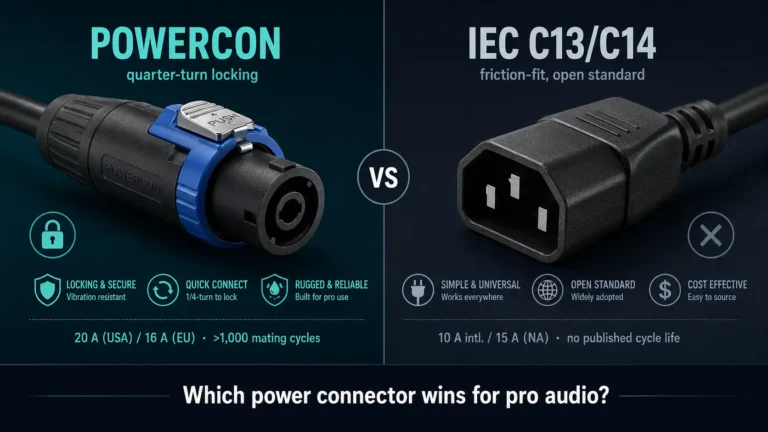
Quick Look: PowerCON vs IEC C13/C14
| Spec | PowerCON (standard 20 A, NAC3FCA/FCB) | IEC C13/C14 (IEC 60320) |
|---|---|---|
| Locking mechanism | Quarter-turn Quick Lock, positive mechanical retention | None — plain friction fit |
| Current rating | 20 A (USA) / 16 A (EU), 250 V AC | 10 A @ 250 V (international); commonly 15 A in North America |
| Load-break rating | Not rated for live disconnection (“connector without breaking capacity” per IEC 61984 / VDE 0627) | Not designed for live disconnection either |
| Mating-cycle life | > 1,000 cycles (standard); > 5,000 cycles on the sealed TRUE1 variant | No mating-cycle figure published in IEC 60320 |
| Environmental sealing | IP20 standard; IP65 available on the TRUE1 sub-family | No IP rating published; open contact design |
| Ecosystem | Single-source Neutrik design (patented, trademarked); “compatible” third-party parts exist but are not genuine Neutrik parts | Open multi-vendor global standard — any C13 plug fits any C14 inlet |
| Best fit | Touring, live sound, rental stock, anywhere cables get walked on or kicked | Fixed installs, studio racks, IT/AV gear that stays put |
Live-sound techs keep asking the same question backstage: does a locking PowerCON connector actually outperform a standard IEC kettle-plug cordset, or is it just theater? The honest answer depends on what the cable has to survive. This guide compares both systems on the specs that are actually documented — current rating, locking mechanism, sealing, and mating-cycle life — and scores them against a weighted model built for touring and live-audio use, not a generic office environment.
Meet the Contenders
PowerCON (Neutrik’s locking AC connector system). PowerCON is a three-pole, quarter-turn locking AC power connector designed and manufactured by Neutrik. The standard 20 A series (NAC3FCA cable connector / NAC3FCB inverse, plus NAC3MPA/MPB chassis sockets) ships in the blue-in/grey-out color coding that prevents accidentally connecting two power sources together. Neutrik’s own datasheet for the NAC3FCA lists a mechanical lifetime of “> 1000 mating cycles”, a Quick Lock latching system, and a rating of 20 A / 250 V AC under UL 1977 in the US and 20 A / 250 V AC under EN 61984 in Europe (commonly expressed as 16 A on European gear). The connector’s own installation manual classifies it as a “connector without breaking capacity according IEC 61984 / VDE 0627” — meaning, like almost every AC power connector on this list, it is built to be mated and unmated only when not carrying live load.
- Pro 1: Twist-lock retention means the cable cannot pull free by vibration, a foot catching the lead, or a coiled cable snagging during strike — it has to be deliberately rotated to release.
- Pro 2: Rated 20 A (USA) / 16 A (EU), giving more headroom than a 10 A international IEC cordset for the same 250 V circuit.
- Pro 3: A documented mechanical lifetime (>1,000 cycles standard, >5,000 cycles on TRUE1) gives buyers a number to plan replacement cycles around, rather than guessing.
- Pro 4: The TRUE1 sub-family (NAC3FX-W / NAC3MX-W) extends the same locking geometry to an IP65-sealed, load-breakable connector for outdoor and wash-down environments, without leaving the PowerCON ecosystem.
- Con 1: It is a single company’s patented, trademarked design — not an open standard — so genuine replacement parts and chassis sockets have to come from Neutrik or its licensed channel.
- Con 2: The standard 20 A series is IP20 only; it is not weatherproof unless you specifically buy the TRUE1 variant, which is a different part number and does not intermate with the standard series.
IEC C13/C14 (the IEC 60320 “kettle plug” family). IEC C13/C14 is the connector pair found on the back of nearly every desktop PC, rack amp, and generic power cordset worldwide — a female C13 cable connector mating to a male C14 inlet on the equipment chassis. It is defined by the IEC 60320 international standard, which is why any C13 cordset from any manufacturer fits any C14 inlet on any brand of gear. A reference chart cross-referencing the IEC 60320 current ratings lists C13/C14 at 250 V, 10 A internationally, with a commonly used 125–250 V, 15 A rating recognized in North America. The connector has no locking feature of any kind; it relies on the friction of the pins seating in the socket, which is enough for equipment that sits still in a rack but not for a cable that gets coiled and uncoiled every night.
- Pro 1: It is a genuinely open, globally standardized interface — no single company controls it, so cordsets are inexpensive, available from dozens of manufacturers, and interchangeable across brands.
- Pro 2: Because nearly every piece of rack gear ships with a C14 inlet, replacement cordsets are usually a same-day purchase at any electronics retailer, with zero compatibility research required.
- Pro 3: The connector’s simple friction-fit geometry makes it fast to plug and unplug repeatedly during setup and teardown, with no twist or release step to remember.
- Pro 4: It is well understood by every electrician, venue tech, and safety inspector on the planet, which simplifies compliance sign-off on fixed installations.
- Con 1: No locking mechanism means the connector can separate if the cable is pulled, stepped on, or snagged — a real liability on any stage or floor cable run that isn’t taped down.
- Con 2: IEC 60320 does not publish a mating-cycle or durability figure for C13/C14, because the standard treats it as a semi-permanent equipment lead rather than a connector meant for daily connect/disconnect — buyers get no documented number to plan around.
Features Face to Face
1. Mechanical retention and locking — PowerCON wins. This is the difference the whole comparison hinges on. PowerCON’s quarter-turn Quick Lock requires a deliberate twisting motion to release; IEC C13/C14 is a plain friction-fit connection with no locking feature at all, which is exactly why touring crews routinely add a separate strain-relief clip or cable tie to C13/C14 runs that get walked on or kicked. For any cable run where an accidental disconnect means dead speakers mid-set, the locking connector is not a nice-to-have.
2. Current and voltage headroom — PowerCON wins. PowerCON’s standard series is rated 20 A in the US and 16 A in Europe at 250 V, against IEC C13/C14’s international rating of 10 A at 250 V (commonly 15 A under the North American UL listing). For amp racks and lighting fixtures pulling sustained current, the extra headroom on PowerCON translates to lower running temperature and less contact wear over the life of the connector.
3. Environmental sealing — tie, with a caveat. Neither connector’s standard version is weatherproof: the standard 20 A PowerCON series is IP20, and IEC 60320 does not publish an IP rating for C13/C14 at all, since it was never designed as a sealed connector. Where PowerCON pulls ahead is optionality — the TRUE1 sub-family offers an IP65-sealed, load-breakable version of the same locking geometry for outdoor stages, while IEC C13/C14 has no equivalent sealed variant within its own family.
4. Mating-cycle life — PowerCON wins, with an honest gap noted. Neutrik documents >1,000 mating cycles for the standard 20 A PowerCON and >5,000 mating cycles for TRUE1. IEC 60320 does not publish a comparable cycle-count figure for C13/C14 at all — not because it performs worse, but because the standard was written for a connector expected to be seated once and left alone, not unplugged nightly. That is a structural design difference worth knowing before you spec either connector for a load-in/load-out schedule, not a documented head-to-head cycle-life score.
5. Ecosystem openness — IEC C13/C14 wins. PowerCON is Neutrik’s patented, trademarked design; the company’s own April 2019 “TRUST THE ORIGINAL” anti-piracy statement confirms it actively enforces that ownership against unauthorized copies. IEC C13/C14, by contrast, is a fully open international standard — any manufacturer can produce a compliant part, and every C13 cordset interchanges with every C14 inlet regardless of brand. If sourcing flexibility and multi-vendor interchangeability matter more than locking security, this is the category IEC wins outright.
The Stage Power Fit Score — Verchil’s weighted model for touring and live-sound buyers
A spec sheet alone doesn’t tell you which connector fits a touring rig, so we built a simple weighted scoring model specifically for that use case. This is Verchil’s own framework, not an industry-standard rating — the weights reflect what actually breaks a show (an unlocked connector kicked loose mid-set) versus what mainly matters for fixed installs (multi-vendor sourcing). Each connector is scored 1–10 on five criteria, multiplied by its weight, and summed.
| Criterion | Weight | PowerCON score | PowerCON weighted | IEC C13/C14 score | IEC weighted |
|---|---|---|---|---|---|
| Locking security | 30% | 9 | 2.70 | 3 | 0.90 |
| Current headroom | 25% | 8 | 2.00 | 5 | 1.25 |
| Environmental sealing | 20% | 5 | 1.00 | 3 | 0.60 |
| Mating-cycle life | 15% | 8 | 1.20 | 4 | 0.60 |
| Ecosystem openness | 10% | 3 | 0.30 | 9 | 0.90 |
| Stage Power Fit Score (/10) | 100% | — | 7.20 | — | 4.25 |
Scoring notes: locking security and current headroom are scored directly from the documented specs above. Environmental sealing scores reflect that both standard connectors are unsealed, with PowerCON scoring slightly higher because the TRUE1 upgrade path exists within the same product family. Mating-cycle life scores PowerCON higher because it has a published number to plan around, while IEC C13/C14’s lack of a published figure is scored as a real gap for a use case built around daily connect/disconnect — not as evidence the connector performs worse. Ecosystem openness scores IEC C13/C14 higher because it is a genuinely open multi-vendor standard, while PowerCON’s score reflects its single-source, patented design.
Under this touring-weighted model, PowerCON scores 7.20/10 against IEC C13/C14’s 4.25/10 — a result that should be read as “better suited to touring and live-sound duty,” not as a universal verdict. Re-weight the model toward ecosystem openness and multi-vendor sourcing (a fixed rack-install priority) and the gap narrows considerably.
The radar chart and weighted-breakdown bar chart below visualize the same five criteria, so you can see at a glance where each connector earns its score.
Stand-Out Features Worth Knowing
PowerCON TRUE1’s sealed, load-breakable design. The single biggest capability gap in this comparison isn’t in the standard connectors — it’s in PowerCON’s sealed sibling. Neutrik’s NAC3FX-W datasheet documents an IP65 rating when mated, over 5,000 mating cycles, and a “connector with breaking capacity (CBC)” classification — meaning, unlike the standard 20 A series, it can be connected or disconnected under load or live. For outdoor festival stages and wash-down environments where equipment genuinely needs to be hot-swapped, this is a capability IEC C13/C14 simply does not offer in any variant.
IEC C13/C14’s total sourcing freedom. The flip side is that IEC C13/C14 answers a question PowerCON structurally cannot: what if you need a replacement cordset at 11 p.m. from whatever electronics shop is still open? Because the interface is an open international standard rather than one company’s patented design, that is never a problem. It is the right connector for gear that lives in a rack and rarely moves, where locking security matters less than same-day replaceability.
Which One Should You Use?
Use PowerCON if you run touring or live-sound rigs where cables get coiled, kicked, and re-run every night. The quarter-turn lock is the entire reason to choose it — it turns “the cable got bumped” from a dead channel into a non-event. Start with Verchil’s PowerCON guide for wiring and model-number details, or go straight to the PowerCON connector range to check current stock.
Use PowerCON TRUE1 if the rig lives outdoors or gets hosed down between sets. IP65 sealing plus load-break capability solves a problem neither the standard PowerCON series nor IEC C13/C14 can address. Verchil’s PowerCON TRUE1 guide covers the sealed variant’s specs and non-intermating relationship with the standard series in detail.
Use IEC C13/C14 if the equipment is staying in a rack and you want maximum sourcing flexibility. For amp racks, network switches, and studio gear that isn’t unplugged nightly, a standard IEC cordset is inexpensive, universally available, and perfectly adequate — save the locking connector budget for the cables that actually take abuse.
Need help specifying either system for a build, or sourcing PowerCON connectors alongside other locking audio connectors like XLR? See Verchil’s XLR connector range, or request a quote — Verchil’s engineering team is also reachable directly on WhatsApp for fast spec questions.
FAQ
Can I replace a PowerCON connector with a standard IEC C13/C14 cordset?
Not directly — the two connectors have different physical interfaces and neither mates with the other. If the equipment has a PowerCON chassis socket, it needs a PowerCON cable connector; a C14 inlet needs a C13 cordset. Some manufacturers offer gear with a C14 inlet specifically so it can accept generic cordsets, but that’s a design choice made by the equipment maker, not a field conversion you can perform on either connector.
Why is PowerCON rated for more current than IEC C13/C14?
PowerCON’s standard series is rated 20 A in the US and 16 A in Europe at 250 V, versus IEC C13/C14’s international rating of 10 A at 250 V (commonly 15 A under North American UL listings). The difference comes down to connector and contact geometry rather than the wiring behind it — always check the actual cordset’s gauge and your circuit breaker rating too, since the connector rating is only one link in the chain.
Does PowerCON really cost more than an IEC C13/C14 cordset, and is the difference worth it?
Locking connectors generally carry a price premium over generic friction-fit cordsets, since they require licensed tooling and additional machined parts — but no reliable published data compares aggregate PowerCON and IEC C13/C14 pricing across the market, so we won’t quote a multiplier here. The better question is whether your use case needs the lock: for cables that get kicked, coiled, and re-run nightly, the retention benefit is usually worth the premium; for a rack that never moves, it usually isn’t.
Does powerCON TRUE1 change this comparison?
Yes, for outdoor and wash-down use specifically. TRUE1 adds IP65 sealing and load-break capability (per Neutrik’s own “connector with breaking capacity” classification) that neither the standard PowerCON series nor IEC C13/C14 offers. It’s a different part number from the standard series and does not intermate with it, so specify TRUE1 deliberately rather than assuming any PowerCON part is weatherproof.
Is a “PowerCON-compatible” connector the same as a genuine Neutrik PowerCON?
No. PowerCON is Neutrik’s patented, trademarked design, and the company has publicly stated it actively enforces that ownership against unauthorized copies. A well-made compatible connector can match the published mechanical and electrical interface, but it is a different product from a genuine Neutrik part — it doesn’t carry Neutrik’s name, certification, or warranty.