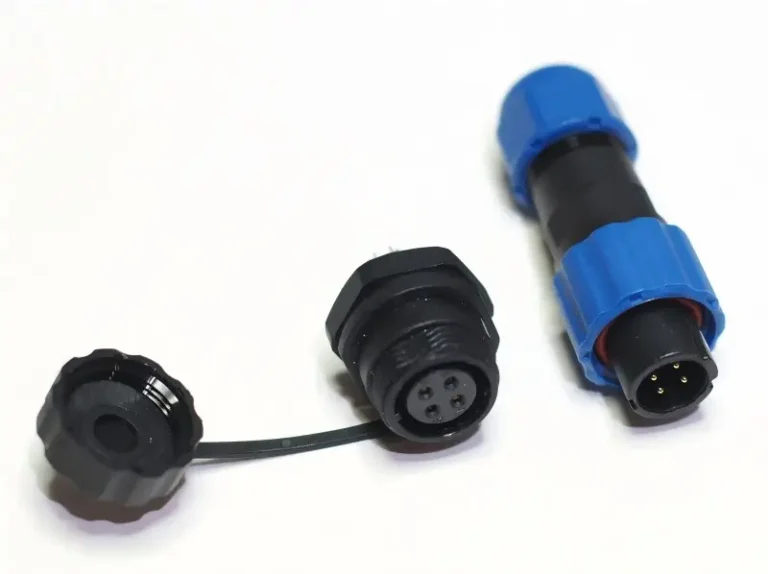
A 4-pin waterproof connector seals four contacts in one housing — typically power, ground, and two signal or data lines — for multi-wire circuits exposed to water, dust, and vibration. Common types include circular M12, rectangular, inline butt, aviation GX, and JST micro, rated IP65–IP69K (IEC 60529) and 3–30A per pin.
Wiring an outdoor camera, an RGB light bar, or a sensor that needs four sealed conductors — power, ground, and two signals? Because the fourth pin adds a second signal or data line beyond power, ground, and one signal, the 4-pin handles richer circuits than a 3-pin: video + audio + power for CCTV, or RGB + common for lighting. This guide covers the pin configuration, types, IP ratings, selection, and installation. If you need only three conductors, see our 3-pin waterproof connector guide; for the full IP system, see our waterproof connector types & IP ratings guide.
What is 4 Pin Waterproof Connector?
The 4 pin waterproof connector is an electrical connector whose four independent conductor contact points are encapsulated in a sealed housing, which can effectively prevent water, dust and pollutants from invading the connection point.
Because the 4-pin layout carries power, ground, and two signal/data lines in one sealed housing, it fits richer circuits than a 3-pin: CCTV (power + video + audio), RGB lighting (three colors + common), or a sensor with dual outputs.
Because the exact pin assignment varies by application and coding, always confirm the datasheet pinout — especially for M12 connectors, where A/B/D coding defines the contact arrangement.
In-depth interpretation of IP level: IP67 vs IP68 vs IP69K
Because the full IP rating system is covered in depth in our waterproof connector types & IP ratings guide, here’s the quick reference for 4-pin selection:
| IP Rating | Dust Protection | Water Protection | Typical Use Case |
|---|---|---|---|
| IP65 | Fully dust-tight | Protected against low-pressure water jets | Outdoor lighting, enclosures |
| IP67 | Fully dust-tight | Immersion up to 1 meter for 30 minutes | Marine, automotive, handheld tools |
| IP68 | Fully dust-tight | Continuous immersion beyond 1 meter (manufacturer-specified) | Underwater equipment, deep marine |
| IP69K | Fully dust-tight | High-pressure, high-temperature water jets | Agricultural, food processing, industrial washdown |
For most outdoor and marine 4-pin applications, IP67 is the minimum; underwater or washdown needs IP68/IP69K. See IEC 60529 for the full classification.
5 Types of 4-Pin Waterproof Connector
4-pin waterproof connectors come in five practical types — circular M-series (M8/M12/M16), rectangular, inline butt, aviation GX, and JST micro — differing mainly by locking method, current, and mounting.
This type of connector is a circular thread structure, which is named according to the size standardization (the number represents the thread diameter, and the unit is millimeter). M12 4-pin connectors use coding keys that physically prevent mismating: A-coded for sensors, DC power and outdoor cameras (the dominant 4-pin type); B-coded for PROFIBUS/fieldbus; D-coded for 100 Mbps industrial Ethernet. The keying geometry is standardized under IEC 61076-2-101 — always match the device’s code, since an A-coded plug won’t seat in a D-coded socket.
- Locking mode: Screw-thread coupling
- IP level: usually IP67-IP68
- Applicable scenarios: industrial sensors, PLC, factory automation, outdoor cameras
The rectangular shell is widely used in automotive and ship wiring harness. The common locking mechanism is push-lock or sliding lock.
- Locking mode: Push-lock clasp or lever lock
- IP level: IP65-IP67
- Applicable scenarios: car, trailer wiring, LED light strips
It is used for cable intermediate docking rather than panel installation, externally wrapped heat shrinkable tube and containing sealant.
- Applicable scenarios: rapid on-site maintenance, trailer wiring, car line splicing
Heavy-duty circular connectors with Bayonet locking ring are suitable for high-vibration environments.
- Applicable scenarios: military, aerospace, heavy machinery, outdoor audio and video equipment
see our waterproof electrical connectors guide for industrial brand series, for higher pin counts and currents, see our 6-pin waterproof connector guide.
Compact sealed connectors based on the JST connector series are commonly used in small electronic devices, drones, and LED controllers.
- Applicable scenarios: UAV, RC remote control vehicle, compact outdoor electronic equipment
Evaluation of key electrical specifications
Beyond IP rating, four electrical specs decide a 4-pin connector’s fit: rated current per pin, working voltage, contact resistance, and temperature range — verify all four against your load.
| Specification | Typical Range | Why It Matters |
|---|---|---|
| Rated Voltage | 12V DC – 600V AC | Ensures insulation safety margin |
| Rated Current per Pin | 3A – 30A | Prevents overheating at contact points |
| Contact Resistance | < 5 mΩ | Low resistance = less voltage drop |
| Operating Temperature | -40°C to +105°C | Critical for automotive and outdoor use |
| Wire Gauge Compatibility | AWG 28 – AWG 10 | Must match your cable cross-section |
| Mating Cycles | 500 – 5,000+ | Important for frequently connected devices |
Points to note
Because contact resistance generates heat that a sealed housing can’t dissipate, derate the rated current by 20–30% in high-temperature environments.
For full conductor and AWG selection, see our waterproof wire connectors guide.
Material and workmanship quality
The long-term performance of an Outdoor waterproof connector largely depends on the materials used in the following three core parts:
Housing material
- Nylon (PA66): the most common; good chemical resistance, light weight, cost-effective
- Polyurethane (PU): Excellent flexibility at low temperature, suitable for harsh outdoor environments
- Stainless steel / nickel-plated brass: for industrial or marine environments requiring strong corrosion resistance
Sealing material
- Silicone: the widest temperature range (-60°C to +200°C), UV aging resistance
- Ethylene propylene diene monomer (EPDM): high quality sealing material in outdoor and UV exposure environment
- Nitrile butadiene rubber (NBR): outstanding oil and fuel resistance, commonly used in automotive applications
Contact Pin material
- Copper alloy (brass): standard conductivity, cost-effective
- Phosphor Bronze: More elastic and suitable for frequent insertion and extraction applications
- Gold plating (0.2-3 μm): for signal pins to prevent oxidation and ensure low contact resistance in low current applications
Real industry application scenarios
The 4-pin waterproof connector dominates six environments — marine, automotive, solar, CCTV, agriculture, and outdoor LED — with the M12 A-coded variant leading industrial and camera use.
Ship and yacht wiring
Salt water is extremely corrosive. Marine-grade waterproof connectors (typically IP68, tin-plated copper contacts) are used for wiring of navigation lights, bilge pumps, fish finders and VHF radios. ABYC E-11 standard regulates the ship electrical installation specification.
Car and off-road modification
LED light strips, winches, reversing cameras and trailer harnesses are all configured with 4-pin. Waterproof connectors for automobiles must be able to withstand vibration, temperature cycling, and oil and fuel erosion.
Solar and renewable energy
Solar panel arrays require reliable outdoor waterproof DC connections. Although MC4 is the mainstream connector in the solar industry, 4-pin waterproof connector is also widely used in solar charging controller wiring, battery connection and hybrid inverter installation.
Security camera and CCTV
Because an outdoor IP camera needs power (12V DC), video, and sometimes audio on one sealed connector, the 4-pin layout maps perfectly — the M12 A-coded connector dominates this segment.
Agricultural machinery
Tractors, irrigation systems and harvesters must use IP69K grade connectors that can withstand high-pressure flushing when operating in muddy, humid, and high-vibration environments.
Outdoor LED lighting
Landscape lights, street lights and stadium floodlights use 4-pin connectors to carry L1 (fire line), L2 / N (zero line), ground line, and control / dimming signal lines in a single waterproof interface.
How to choose a suitable 4 Pin Waterproof Connector: Purchase List
According to the following framework, make well-documented, specification-driven procurement decisions:
Step 1 – Clarify the use environment
Is the connector only exposed to rainwater or needs to be completely immersed in water? → Rainproof at least choose IP67; choose IP68 for Immersion Scene
Is there chemical exposure (salt spray, fuel oil, cleaners)? → According to this, select the shell and sealing material
Step 2 – Confirm electrical requirements
What is the maximum current per wire? → Select the contact specification here (never exceed the rated current)
System voltage level? → Confirm that the insulation rated voltage is higher than the system voltage, and leave a margin
Step 3 – Select the connector type
Panel installation or Inline? → Panel installation M12 / M16; rectangular Inline type is selected for wire harness docking.
Do you need locking mechanism? → the strongest holding force selection thread lock; push-lock is frequently plugged and selected
Step 4 – Matching Line Diameter
The inner diameter of the wire entry grommet of the connector must match the outer diameter of the cable to ensure the sealing effect.
Step 5 – Verification Certification
Because uncertified connectors often overstate their IP rating, prioritize UL Listed, RoHS, and CE marked products. Verchil’s 4-pin waterproof connectors are tested and certified to IEC 60529, UL, and RoHS for verified performance.
Step 6 – Assessing Mating Cycles
Permanent fixed installation scenario: 500 times of insertion and extraction life is enough
Equipment requiring on-site maintenance: Select contacts with 1,000-5,000 insertion / extraction life classes
Installation best practice
Even the highest grade 4 wire waterproof connector, if improperly installed, will also fail in advance. Please follow the following professional operation specifications:
Precise wire stripping – too long wire stripping will cause bare copper wire to be exposed outside the grommet, forming a seepage channel.
Dielectric Grease – Apply before the contact pin to prevent oxidation (ship environment is particularly important).
Tighten the thread lock connector according to the specified torque – insufficient torque will damage the O-ring seal; excessive torque will lead to cracking of the shell.
Reserve the Drip Loop when routing – ensure that the cable moves so that the water drips away from the connector surface, rather than flowing to the connector.
Avoid cable tension – use a Cable Clamp to eliminate mechanical stress at the connector cable inlet.
Test before installation – verify the conductivity with a multimeter, and perform a water spray test to confirm that the seal is intact.
Common mistakes, be sure to avoid
In the immersion scene, IP65 – IP65 is selected to only prevent splashing water and non-immersion protection level.
The mismatch between the wire diameter and the inner diameter of the grommet – the gap between the cable and the retaining ring will destroy the waterproof seal.
The use of untin-plated copper contacts in the marine environment – ordinary copper contacts are extremely fast corroded in salt fog environment.
Ignore the temperature range – connectors that do not meet the low temperature specifications will become brittle and cracked.
Mixing metric and inch thread connectors – may be able to cooperate in appearance, but cannot be sealed normally.
Frequently Asked Questions
What is the use of the 4 pin waterproof connector?
It is suitable for any application that requires four wires – power supply, grounding and two signal lines – and is in a humid protective environment. Common uses include ship wiring, automotive lighting, outdoor cameras and solar installation.
What is the difference between IP67 and IP68?
IP67 connector can withstand immersion in 1 meter water depth for 30 minutes; the rated continuous immersion depth of IP68 connector is more than 1 meter, and the specific depth and duration are specified by the manufacturer.
Can 4 pin waterproof connector be used in 12V automotive applications?
Yes. Most automotive 4-pin waterproof connectors have a rated voltage of 12V-32V DC and a rated current of up to 20A per pin, which fully meets the wiring requirements of LED lamps, sensors and accessories.
What diameter is the standard 4 pin waterproof connector suitable for?
Depends on the connector series. Consumer-grade products are usually adapted to AWG 18-22 wire diameters; the heavier connectors (M16 and above) can accept AWG 12-16. Please be sure to refer to the manufacturer’s wire diameter specification.
Can waterproof connectors be reused?
Yes. Most threaded locks or push-lock 4-pin waterproof connectors can be plugged and unplugged repeatedly, with life ranging from hundreds to thousands of times, depending on the product quality grade.
Where can I check the authoritative technical standards for waterproof connectors?
IEC 60529 standard defines the IP level; ABYC E-11 standard regulates the ship’s electrical system; UL 508 is suitable for North American industrial control equipment.
Should I use a 2-pin, 3-pin, or 4-pin waterproof connector?
Use 2-pin for a single power circuit, 3-pin for power + ground + signal, and 4-pin when you need two signals or data lines (CCTV power+video+audio, RGB lighting, or dual-output sensors). Because every extra pin adds cost and a potential leak path, match the pin count to your actual conductors — and if you need power plus four signals (RGB+W, fieldbus, PTZ cameras), step up to a 6-pin waterproof connector.
Conclusion
Although a 4-pin waterproof connector seems simple, it plays a vital role across marine, automotive, agricultural, and outdoor electrical systems. Because the right choice balances IP rating, material compatibility, electrical specs, connector type, and installation, treat even a four-contact connection as an engineering decision tailored to your environment. When in doubt, choose a higher IP rating and ampacity — the extra cost is negligible next to the cost of a field failure.
Verchil designs and manufactures 4-pin waterproof connectors and custom sealed assemblies — circular M12, rectangular, inline, and aviation configurations rated IP67/IP68/IP69K and certified to IEC 60529, UL, and RoHS. Explore the series — 2-pin, 3-pin, and 6-pin waterproof connector guides — or browse Verchil’s waterproof connector range. For custom 4-pin or M12 assemblies, contact our engineering team.