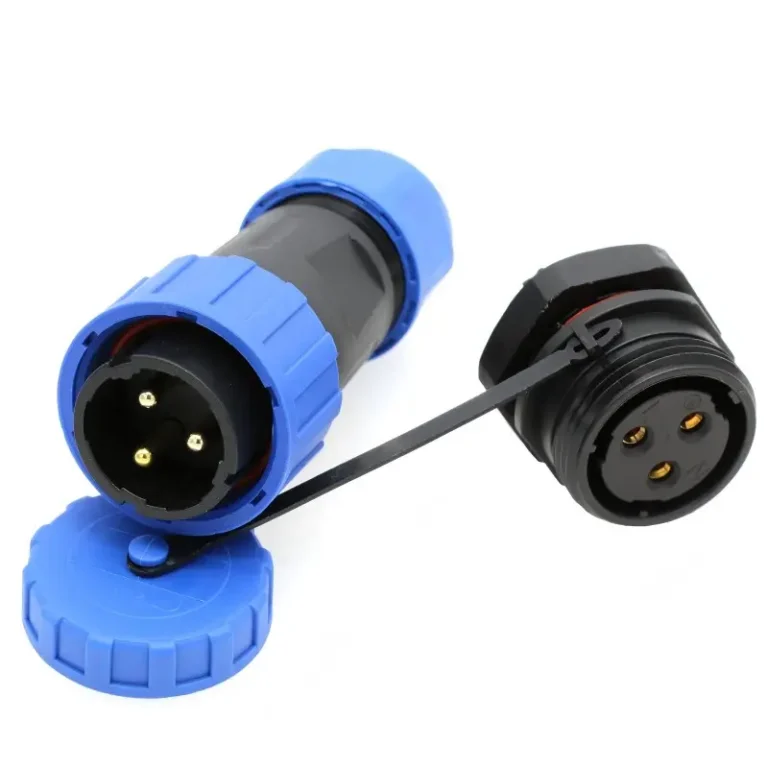
A 3-pin waterproof connector seals three contacts in one housing — typically Pin 1 for power (VCC), Pin 2 for ground (GND), and Pin 3 for signal, data, or a second power line. Rated IP65–IP69K (IEC 60529) and 1–40A, it suits any sealed three-conductor run: sensors, RGB lighting, and trailer harnesses.
Wiring a sensor, an RGB LED run, or a trailer harness that needs three sealed conductors — power, ground, and signal? Because the third pin lets one sealed connector carry a signal or second power line alongside power and ground, the 3-pin is the workhorse for any three-wire circuit exposed to rain, dust, or vibration. This guide covers pin assignments, IP ratings, the 3-pin vs 3-way distinction, selection, and step-by-step installation. If you only need a single power circuit, see our 2-pin waterproof connector guide; for the full IP system, see our waterproof connector types & IP ratings guide.
What is 3 Pin Waterproof Connector?
The 3 pin waterproof connector is an electrical connector with three sealed joints, three pins usually perform their respective duties:
- Pin 1 – power supply (positive electrode / VCC)
- Pin 2 – grounded (negative / GND)
- Pin 3 – signal, data or second power line
This type of product is also often referred to as 3 way wire connector waterproof – especially when it is designed to join or branch three separate lines in a single sealed housing, such as the Y-type split of outdoor lamps or the T-type split of trailer harnesses.
Because the third pin distinguishes a 3-pin connector from a simple 2-pin power link, its assignment defines the use case. Because this maps directly to sensors (power + ground + signal) and RGB or dual-circuit lighting, the 3-pin is the default for any sealed three-conductor run.
What is the actual working principle of the 3 Pin Waterproof Connector?
A waterproof 3-pin connector keeps water out at three sealing points — the wire-entry seal, the mating O-ring, and the locking compression — with premium parts adding a fourth overmolded TPE boot.
A well-designed waterproof 3 pin connector seals in three key positions:
- Wire entry seal – flexible silicone washer tightly clamps each wire to prevent moisture from seeping into the connector body along the cable insulation layer.
- O-ring – A compressed rubber ring, located between the plug (male) and the receptacle (female), prevents water from seeping directly from the connection interface.
- Positive locking tab or screw ring – The compression force of an O-ring is continuously maintained in the case of vibration, thermal cycling or wire pulling.
Some high-end connectors also add a fourth protection: overmolded TPE boot is coated at the cable inlet to provide mechanical stress relief and further improve IP protection performance.
IP level detailed explanation: the most important single specification index
Because the full IP rating system is covered in depth in our waterproof connector types & IP ratings guide, here’s the quick reference for 3-pin selection:
| IP Rating | Dust Protection | Water Protection | Typical Application |
|---|---|---|---|
| IP65 | Dust-tight | Protected against water jets from any direction | Outdoor enclosures, wall-mount fixtures |
| IP67 | Dust-tight | Immersion up to 1 m / 30 minutes | Automotive, garden lighting, consumer electronics |
| IP68 | Dust-tight | Continuous immersion beyond 1 m (manufacturer-specified depth) | Marine, submersible pumps, underground cabling |
| IP69K | Dust-tight | High-pressure, high-temperature water jets | Agriculture, food processing, heavy machinery |
Practical purchase recommendations:
- Outdoor non-immersed environment (garden, solar, CCTV): minimum IP65, recommended IP67
- Cars & Ships: Minimum IP67
- Immersed or underground wiring: must IP68
- Farm, food factory, car washing equipment: must IP69K
See IEC 60529 for the full classification.
Technical specifications complete reference: engineers must read
A 3-pin waterproof connector spans three spec classes — micro/signal (1–5 A), standard (5–20 A), and heavy-duty (up to ~40 A) — pick the class first, then match wire gauge and temperature.
| Application Type | Recommended AWG | Cross-Section |
|---|---|---|
| Signal / Low Current | 22–26 AWG | 0.14–0.34 mm² |
| General Lighting / Sensors | 18–22 AWG | 0.34–0.75 mm² |
| Automotive / Power Lines | 14–18 AWG | 1.0–2.5 mm² |
| Heavy-Duty Power | 10–14 AWG | 2.5–6.0 mm² |
It must be confirmed that the terminal crimp range of the connector is consistent with the actual wire specification. The specification mismatch is the primary cause of high resistance contact and premature failure.
For full conductor and AWG selection guidance, see our waterproof wire connectors guide.
| Connector Class | Rated Current | Rated Voltage | Example Series |
|---|---|---|---|
| Micro / Signal | 1–3 A | 60V DC | JST SH, Molex Pico-Lock |
| Standard | 7.5–13 A | 250V AC / 48V DC | Deutsch DT, TE SUPERSEAL |
| Heavy-Duty | 20–40 A | 600V AC / 120V DC | Amphenol AT, Molex MX150 |
Verchil manufactures 3-pin waterproof connectors across all three classes — micro/signal, standard, and heavy-duty — in circular and rectangular formats to match these specs.
| Material | Corrosion Resistance | Best For |
|---|---|---|
| Tin-plated copper | Moderate | Dry/indoor automotive, cost-sensitive |
| Gold-plated copper | Excellent | Signal lines, marine, high-cycle |
| Nickel-plated | Good | High-vibration, high-temperature |
| Material | Key Properties | Common Applications |
|---|---|---|
| Nylon PA66 | Lightweight, UV-resistant | Automotive OEM, outdoor LED |
| Glass-filled Nylon | Higher strength, dimensional stability | Marine, industrial |
| ABS | Economical | Consumer electronics, indoor |
| TPE / TPR Overmold | Flexible, impact-resistant | Cable entry strain relief |
The working temperature range
Most industrial grade 3 pin waterproof connectors have a rated operating temperature of −40°C to +105°C. High temperature automotive applications may require connectors of +125°C or +150°C grade – please be sure to check the manufacturer’s datasheet for confirmation.
What is the difference between 3 Pin Connector and 3 Way Wire Connector Waterproof?
These two terms are interrelated, but technically different – confusing the two may lead to procurement errors.
| Term | Meaning | Typical Use Case |
|---|---|---|
| 3 pin waterproof connector | A connector with 3 electrical contacts in a waterproof housing | Joining two ends of a 3-wire cable run |
| 3 way wire connector waterproof | A connector that branches or splices 3 wires/cables in a sealed housing | Y-splits, T-taps, multi-branch outdoor wiring |
Timing of use:
- Connect the sensor to the wire harness → Use 3 pin waterproof connector (two-piece structure of male plug + female receptacle)
- Plug a 12V power supply into two LED branches → Use 3 way wire connector waterproof (T or Y connector)
Some products can meet two functions at the same time; be sure to confirm the institutional form of the connector before purchasing.
Purchasing guide: 4 steps to select the right connector
Step 1 – Matching IP Levels by Environment
| Condition | Minimum IP | Suggested IP |
|---|---|---|
| Indoor / protected | IP54 | IP65 |
| Outdoor / rain exposure | IP65 | IP67 |
| Submerged / underground | IP67 | IP68 |
| Pressure-wash environment | IP68 | IP69K |
Step 2 – Calculate the current load and select the wire specification
Use the formula: current (A) = power (W) ÷ voltage (V) — for example, a 60W 12V LED bar draws 60 ÷ 12 = 5A.
Next, the connector with a rated current of 120-130% of the calculation result is selected as the safety margin. The wire AWG specification must be consistent with the connector terminal specification-do not force too large wire into too small terminal.
Step 3 – Consider the Mating Cycle (Plug and Pull Cycles) requirements
How many times does the connector need to be plugged during maintenance, inspection or reconfiguration?
| Mating Frequency | Required Cycle Rating |
|---|---|
| Permanent installation | 50–100 cycles |
| Occasional service | 500 cycles |
| Frequent field maintenance | 1,000+ cycles |
Step 4 – Select the appropriate locking mechanism
- Lever-lock – wearing gloves can also be easily operated; suitable for on-site maintenance personnel
- Screw-thread M type spiral lock – fixing force is the strongest; most suitable for high vibration environment
- Push-snap latch – the fastest connection speed; it is common in LED and consumer auto parts
- Bayonet lock – both safe and fast; widely used in industrial circular connectors
Industrial Application Guide
The 3-pin waterproof connector anchors four demanding fields — automotive, marine, solar, and agriculture — each driven by a different stressor: vibration, salt, UV, and high-pressure washdown.
Car and Racing Car Modifications
The 3 pin waterproof connector is embedded in almost every modern vehicle for:
- Connection of oxygen sensor, temperature sensor and pressure sensor
- LED headlamp and DRL (Daylight Lamp) circuit
- Connector for trailer hook and traction harness
- Refit lamps and auto parts wiring
Installation personnel note: be sure to use OEM specified ratchet crimp tool to handle terminal. Pressing with hand pliers or general pointed jaw pliers will lead to inconsistent geometry of the contact points and accelerated failure.
Ships and yachts
Brine is one of the most corrosive environments for electrical connectors. Standard automotive connectors will corrode and fail within a few months in a ship environment.
Selection requirements for ship applications:
- Minimum IP68 rating
- Gold-plated or tin-plated nickel contacts
- Glass fiber reinforced nylon or marine grade polymer shell
- The wire inlet is configured with a rubber-filled cable gland
Solar energy and outdoor LED lighting
3 pin IP67 waterproof connector is the core component of the on-site installation of solar arrays and outdoor LED networks, allowing lamp passages, junction boxes and solar panels to be connected in series, extended and repaired without rewiring.
Key selection criteria for this application:
- The shell must have UV stability (in line with IEC 60068-2-5 UV resistance standard)
- Pre-install wire seal to reduce on-site installation error rate
- The rated operating voltage must be compatible with a 24V DC or 48V DC solar system
- The minimum operating temperature range covers −30°C to +85°C
Agriculture and Irrigation
Agricultural machinery, field sensors and irrigation controllers operate in humid, muddy and highly corrosive environments, and usually need to withstand high-pressure water pipe flushing.
IP69K grade 3 pin connector can withstand:
- High pressure steam cleaning (80 bar / 1160 psi)
- Fertilizer and pesticide chemical erosion
- Seasonal large temperature difference changes
- The continuous vibration of the motor and the pump
Step-by-step installation guide
Tools required: Wire stripper, ratchet crimp tool corresponding to the terminal size, Connector, Multimeter
Step 1 – Preparation of wire ends
The insulation layer is stripped according to the length specified by the connector manufacturer, usually 5-7 mm. Avoid cutting or cutting copper core strands.
Step 2 – first into the wire seal
Because the seal can’t be fitted after crimping, thread the silicone wire seal onto the cable before terminating — the single most common installation error.
Step 3 – Pressing terminal
Using OEM specified crimp die. Check each crimping point one by one: the conductor crimping section should be completely filled, and the insulation crimping section should hold the insulation layer without cutting in.
Step 4 – Insert the terminal into the shell
Each terminal is pushed into a corresponding numbered cavity until a clear clapping sound is felt and heard. Incomplete insertion will lead to seal failure.
Step 5 – Fixed wire seal
Push the seal to flush with the back end of the shell. Make sure that each seal is not overturned or folded.
Step 6 – Docking and locking the connector
Join the plug (male) with the receptacle (female) and fully activate the locking mechanism. Please lock the screw locking ring according to the specified torque (M8 / M12 is usually 0.4-0.8 Nm).
Step 7 – Test before closing
Use the conduction mode of the multimeter to verify each pin one by one. The pull test of each wire is carried out to confirm that the terminal is fixed. Do not rely solely on visual inspection as a final confirmation.
Frequently Asked Questions
What is the difference between Weatherproof and Waterproof connectors?
“Weatherproof” is a marketing term, there is no corresponding standard definition – usually only means that the connector can resist light rain or wet. A true waterproof connector must have an IP67 or IP68 rating certified to IEC 60529.
Can 3 pin waterproof connector be used for 12V automotive DC cabling?
Yes. Most standard 3 pin waterproof connectors are rated for 12V and 24V DC automotive systems. Please confirm that the current rating meets your load requirements.
What kind of 3 way wire waterproof is the most suitable for outdoor LED lighting?
For outdoor LED applications, it is recommended to select IP67 grade 3 pin press lock connector with pre-installed seal.
Can 3 pin waterproof connector be reused?
Yes. The high-quality connector design supports multiple insertion / extraction cycles. However, the silicone seal will be aged due to extreme temperature cycles and chemical contact – please check the seal condition regularly. If there are signs of wear on the sealing surface, the shell should be replaced.
How to confirm that the connector is properly sealed after installation?
Visually confirm that all wire seals are flushed, the docking locking mechanism is fully in place, and no insulation layer is clamped. For critical applications, low-pressure gas tightness test (0.5-1.0 bar) or immersion test verification according to IP level can be performed.
What do the 3 pins on a waterproof connector do?
Typically Pin 1 carries power (VCC), Pin 2 ground (GND), and Pin 3 a signal, data line, or second power feed. Because the exact assignment varies by manufacturer, always check the datasheet pinout before wiring — reversing power and signal can damage sensors or electronics.
Should I use a 2-pin, 3-pin, or 4-pin waterproof connector?
Use 2-pin for a single power circuit, 3-pin for power + ground + signal (sensors, RGB), and 4-pin when you need an extra signal or a second switched circuit. Because every extra pin adds cost and a potential leak path, match the pin count to your actual conductors. See our 2-pin and 4-pin guides — or step up to a 6-pin waterproof connector when you need power plus four signals.
Summary
| Selection Factor | What to Specify |
|---|---|
| IP Rating | IP67 (outdoor/auto), IP68 (marine/underground), IP69K (agriculture/food) |
| Wire Gauge | Match AWG to terminal crimp spec; never force-fit |
| Current Margin | Select rating 20–30% above your peak current load |
| Contact Material | Gold-plated for marine/signal; tin-plated for general automotive |
| Housing Material | UV-stable nylon for outdoor; glass-filled nylon for marine/industrial |
| Locking Type | Screw for vibration; lever for gloved hands; snap for speed |
| Brand | Verchil for custom 3-pin assemblies; TE/Deutsch for automotive; Amphenol for marine; M12 for industrial |
Although a 3-pin waterproof connector isn’t an ordinary consumable, the right specification protects your system, cuts field failures, and lowers total cost of ownership. Whether it’s a single garden-lamp circuit or a full industrial sensor network, use this guide as the standard reference for every project.
Verchil designs and manufactures 3-pin waterproof connectors and custom sealed assemblies — micro/signal, standard, and heavy-duty classes in circular and rectangular formats, rated IP67/IP68 and certified to IEC 60529, UL, and RoHS.
Explore the series by pin count — 2-pin, 4-pin, and 6-pin waterproof connector guides — or browse Verchil’s waterproof connector range. For custom 3-pin sealed assemblies, contact our engineering team.