A TRS insert cable is the single most misunderstood cable in a rack — not because it is complex, but because two cables that look identical can be wired in opposite directions. This guide covers what an insert cable does, the send/return wiring that actually matters, and how to spec one that works with your console the first time.
New to TRS in general? Start with the complete TRS connector guide. This article is specifically about the insert (Y-insert) cable.
What a TRS Insert Cable Actually Is
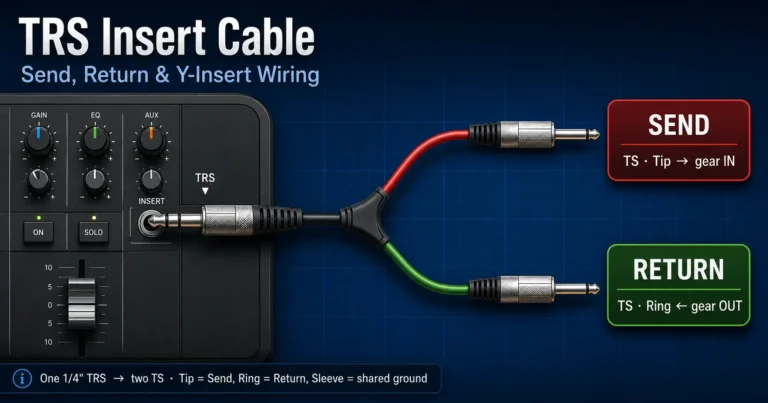
A TRS insert cable is a Y-cable: a single 1/4-inch TRS (Tip/Ring/Sleeve) plug on one end, splitting into two TS (Tip/Sleeve) plugs on the other. The single TRS end goes into your mixer’s insert jack; the two TS ends go out to a piece of outboard gear and back.
The reason it needs three conductors on the console side is that an insert jack does two jobs at once. As Yamaha’s pro-audio team describes it, an insert “provides both an output (or ‘send’) and an input (or ‘return’) on a single 1/4-inch TRS jack that’s internally wired as a pair of connections”. The insert cable breaks that one jack back out into two normal mono connections:
- Tip → one TS plug (the send — signal leaving the console)
- Ring → the other TS plug (the return — signal coming back)
- Sleeve → the ground, shared by both TS plugs
Because both TS sleeves tie back to the single TRS sleeve, the two legs share a common ground — a detail that matters when you build or troubleshoot one.
Where Insert Cables Fit: The Channel Insert Point
An insert lets you patch a single piece of outboard gear — a compressor, EQ, or gate — into one channel’s signal path, before that channel reaches the rest of the mix. The signal chain is a simple loop:
INSERT OUT (tip) → outboard IN → outboard OUT → INSERT IN (ring)
This is why inserts are the standard way to hang a hardware compressor on a vocal or a gate on a snare: the processor sees only that one channel, and the processed signal drops right back into the same strip. If your desk has only one physical insert jack per channel, the Y-style insert cable is what makes the whole out-and-back loop possible on a single connector.
Send and Return: The Tip/Ring Wiring That Trips People Up
Here is the part that causes the most failed patches. The industry-standard convention is Tip = Send, Ring = Return, with a shared sleeve ground — this is how the majority of modern consoles are wired.
But it is not universal. As multiple pro-audio references stress, some manufacturers wire it the other way, with the ring as send and the tip as return — so you have to check the manual for your specific mixer before you build or buy. A cable made for a tip-send desk plugged into a ring-send desk will still pass signal, but the send and return are swapped — you will hear the loop break, get a level jump, or lose the processor entirely.
The mechanical wiring itself — which lug is tip, which is ring — is the same TRS pinout used everywhere. If you are terminating your own, follow the TRS pinout reference and just confirm the send/return orientation against your console’s documentation.
Why an Insert TRS Is Unbalanced (Not the Same as a Balanced TRS)
This is the second common trap. A TRS plug on an insert cable looks identical to a balanced TRS plug — but it is doing something completely different.
On a balanced cable, the three conductors carry one signal (hot on tip, cold on ring, ground on sleeve) so interference cancels — the mechanism explained in how a balanced TRS connector rejects noise. On an insert cable, the same three conductors carry two separate unbalanced signals: send on tip, return on ring. There is no cold/inverted leg, so an insert connection is unbalanced by nature.
Practically, that means: keep insert cables short to limit noise pickup, and don’t expect the noise immunity of a balanced run. It also means you cannot substitute a balanced TRS-to-TRS cable for an insert cable — the wiring is not the same.
Choosing or Specifying an Insert Cable
When you buy or spec an insert cable, four things matter more than the label on the jacket:
- Send/return orientation — the single most important spec. Match your console (tip-send vs ring-send). When in doubt, ask for the wiring diagram.
- Length — keep it short (usually 0.5–2 m / 18 in–6 ft). Inserts are unbalanced, so long runs invite hum.
- Connector quality — the TRS end takes the wear from repeated patching; a well-machined, tight-tolerance plug (gold or nickel contacts) resists the intermittent-contact faults that plague cheap insert cables.
- Strain relief at the Y — the split point is the first thing to fail on a flexed cable; a molded or reinforced junction lasts far longer.
Off-the-shelf insert cables exist in fixed configurations (for example, the widely used Hosa DOC-series direct-out/insert adaptors), but they assume the standard tip-send wiring — which is exactly why the orientation check above matters.
Custom & Made-to-Order Insert Cables
Because send/return orientation, length, and connector spec all depend on your console and rack, insert cables are a natural made-to-order item. Verchil builds insert and Y-insert assemblies to spec — tip-send or ring-send, any length, with panel-grade TRS and TS connectors and reinforced Y-junctions.
Tell us your console model (or its insert wiring) and the gear you’re patching, and we’ll build the loop to match. Contact Verchil for a custom insert cable (RFQ), or see our TRS connectors for the plug side.
Frequently Asked Questions
Is an insert cable the same as a Y-splitter cable?
Physically it looks the same (one TRS to two TS), but the wiring purpose is different. An insert cable carries send on the tip and return on the ring — an out-and-back loop. A stereo Y-splitter carries left and right — two one-way signals. Don’t substitute one for the other.
Can I use a balanced TRS cable as an insert cable?
No. A balanced TRS-to-TRS cable carries a single balanced signal, while an insert needs the tip and ring split into two separate mono connections. You need an actual insert (Y) cable.
How do I know if my mixer is tip-send or ring-return?
Check the console’s manual or block diagram — it will state the insert wiring. Most modern desks are tip-send/ring-return, but some are reversed, so verifying beats assuming.
Why is my inserted compressor doing nothing (or killing the channel)?
The two most common causes are swapped send/return (your cable’s orientation doesn’t match the desk) and the insert plug not seated fully — an insert jack often needs the plug pushed to the second detent to engage both contacts. Reseat first, then check orientation.
Are insert cables balanced?
No. Each leg is unbalanced, because the tip and ring carry two independent signals rather than a hot/cold pair. Keep them short to minimize noise.
Conclusion
An insert cable is mechanically simple — one TRS, two TS, a shared ground — but it fails in the field for two avoidable reasons: send/return orientation that doesn’t match the console, and the mistaken assumption that it’s a balanced cable. Get the orientation right, keep it short, and it will patch your outboard gear cleanly for years.
Back to the hub: the complete TRS connector guide. For related conversions, see TRS to RCA and XLR to TRS.
Sources
- Yamaha Music — How to Use Inserts
- Home Studio Doctor — Studio Wiring Basics: Insert Cables
- Mission Engineering — What Is a TRS Cable?
- Sound on Sound Forum — Correct cable wiring for using Inserts
- GroupDIY Audio Forum — Unbalanced TRS insert standard (community discussion)