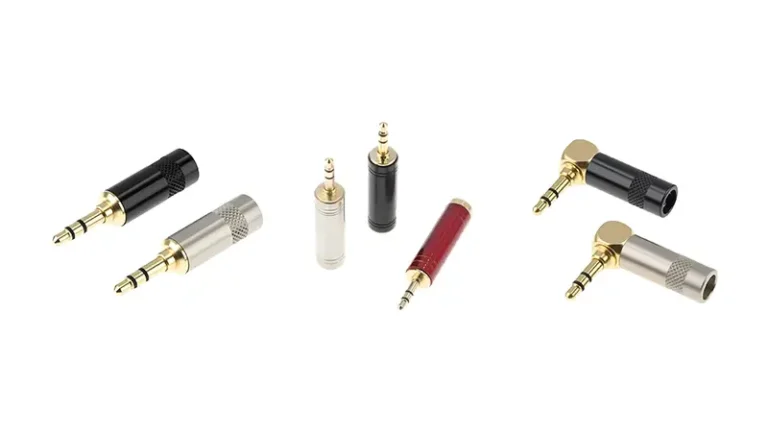
A TRS connector is a 3-conductor audio plug (Tip-Ring-Sleeve) available in three standard sizes: 6.35mm (1/4 inch), 3.5mm (1/8 inch), and 2.5mm. It carries either a balanced mono signal or an unbalanced stereo signal, identified by two black insulating rings separating its three metal contacts.
Ever wondered why your headphone jack has two black rings while your guitar cable has only one? That single visual difference separates the TRS connector from its TS counterpart — and determines whether you’ll hear pristine, noise-free audio or constant hum. This guide breaks down TRS wiring, the three standard sizes (6.35mm, 3.5mm, 2.5mm), balanced vs. unbalanced behavior, and how to spot the right connector before you plug anything in.
TRS Connector Anatomy: What Tip, Ring & Sleeve Actually Do
The name describes three electrically isolated contacts on the shaft, separated by two insulating bands. According to Wikipedia’s reference entry on the phone connector family, this design has been in continuous use since the late 19th century, originally for telephone switchboards.
- Tip — carries the left audio channel (stereo mode) or the positive/hot signal (balanced mode)
- Ring — carries the right channel (stereo) or the negative/cold inverted signal (balanced)
- Sleeve — always the ground/shield
The wiring assignment depends entirely on the equipment, not the connector. Audio-Technica’s support team confirms that the same 1/4″ TRS plug may be wired either stereo or balanced, and interchanging them can degrade signal performance — always check the device spec sheet.
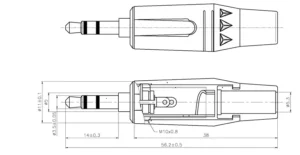
TRS Connector Sizes: 6.35mm vs 3.5mm vs 2.5mm
Three diameters dominate the market, and each owns a specific use case:
| Size | Common Name | Primary Use |
|---|---|---|
| 6.35mm (1/4″) | Phone jack, quarter-inch | Studio monitors, audio interfaces, headphone amps, guitar pedals (TRS insert) |
| 3.5mm (1/8″) | Mini-jack, aux | Smartphones, laptops, consumer headphones, lavalier mics |
| 2.5mm (3/32″) | Sub-mini | Older phones, two-way radio headsets, RC controllers |
If you need OEM-grade 6.35mm or 3.5mm TRS plugs for assembly, Verchil’s audio connector range covers all three standard sizes with gold-plated contacts and full balanced-wiring options.
How a Balanced TRS Connector Rejects Noise
A balanced TRS connection uses common-mode rejection to cancel interference. Per Wikipedia’s balanced audio reference, the technique allows cable runs up to 100 feet (30 m) with minimal noise pickup, while unbalanced TS lines should stay under 25 feet (7.6 m).
The mechanism in 3 steps:
- The Tip carries the original signal (hot, +)
- The Ring carries an inverted copy of the same signal (cold, −)
- At the destination, the device re-inverts the cold signal and sums it with the hot. Any interference picked up identically on both wires gets cancelled out, while the audio signal doubles in level.
This is why studio monitors, mixers, and audio interfaces use balanced 1/4″ TRS connectors — and why guitarists should not swap a TS for a TRS hoping to reduce hum (a passive guitar pickup outputs an unbalanced signal regardless of the cable used).
For demanding installations — broadcast studios, live venues, or industrial control rooms — explore Verchil’s audio connection solutions for custom balanced cable assemblies and panel-mount options.
TRS Connector vs TS vs TRRS: The 3-Way Comparison
This is the highest-volume search intent around the keyword. Here’s the corrected side-by-side:
| Feature | TS | TRS Connector | TRRS |
|---|---|---|---|
| Conductors (poles) | 2 | 3 | 4 |
| Insulating rings on plug | 1 | 2 | 3 |
| Signal type | Unbalanced mono | Balanced mono OR unbalanced stereo | Stereo + mic |
| Typical use | Electric guitar, synth | Studio monitors, headphones, line-level gear | Smartphone headsets, gaming |
| Noise rejection | Low | High (when balanced) | Low |
Focusrite’s support team warns explicitly against connecting an unbalanced-stereo TRS (e.g. headphones) directly to a balanced-mono TRS input — one channel will be lost and signal quality may suffer.
For balanced applications beyond TRS — particularly long mic runs and stage use — see how the XLR connector compares in pin layout and noise rejection.

Common Applications & Quick Troubleshooting
Where you’ll encounter a TRS connector:
- Professional headphones — 1/4″ TRS unbalanced stereo (HD600, ATH-M50x, etc.)
- Studio monitors — 1/4″ balanced TRS line input
- Audio interfaces — line in/out, headphone output
- Insert/Y-cables — 1/4″ TRS splits to dual TS for outboard processing
- Synthesizers & MIDI pedals — 3.5mm TRS for CV/Gate or TRS-MIDI
Quick fault-finding checklist (4 steps):
- Inspect the contacts — gold-plated tips resist oxidation; if you see green corrosion, replace the connector
- Confirm full insertion — a loose plug may sit on the ring contact instead of the sleeve, causing phase issues
- Swap the cable — substitute a known-good cable to isolate whether the fault is in the plug, cable, or jack
- Check device wiring spec — confirm the source/destination expects stereo TRS vs balanced TRS (per Audio-Technica’s guidance above)
Still struggling with intermittent signals after these checks? The plug itself may be out of spec — contact Verchil’s technical team with your device model for a wiring-confirmation reply within 24 hours.
Conclusion
Choosing the right TRS connector comes down to three checks: confirm the size (6.35mm, 3.5mm, or 2.5mm), verify whether your device expects balanced mono or unbalanced stereo wiring, and count the rings on the plug to avoid mixing it up with TS or TRRS. Pair that knowledge with gold-plated contacts and shielded cable, and you’ll eliminate 90% of the buzz, dropouts, and phase issues most home-studio users blame on their gear.
Frequently Asked Questions
Is a TRS connector balanced or unbalanced?
Either — it depends on the wiring at both ends. A 1/4″ TRS used for studio line-level signals is typically balanced (tip = hot, ring = cold, sleeve = ground). A 3.5mm TRS in headphones is unbalanced stereo (tip = left, ring = right). The connector shape alone doesn’t determine the signal type.
Is 3.5mm the same as TRS?
No — 3.5mm is the diameter (size), TRS is the conductor configuration. You can have a 3.5mm TS, 3.5mm TRS, or 3.5mm TRRS plug. Most 3.5mm aux cables for phones and laptops are TRS (two insulating rings), carrying unbalanced stereo audio.
Can I use a TRS cable for an electric guitar?
Not recommended. Passive guitar pickups output an unbalanced signal, and some effects pedals expect a TS-only connection. Plugging a TRS plug into a TS-only pedal jack may short the ring contact to ground, causing signal loss or even pedal damage. Stick with a TS instrument cable for guitars, or browse Verchil’s TRS connector products when your setup specifically calls for balanced or stereo wiring.
Can a TRS plug fit into a TRRS jack?
Yes, mechanically it inserts and you’ll usually get audio output. However, you’ll lose any microphone functionality, and depending on the device’s wiring standard (CTIA vs OMTP), the audio channels may be reversed or attenuated. For headsets with a built-in mic, use a TRRS cable.
How do I tell a TRS cable from a TS cable?
Count the black insulating rings on the metal plug. One ring = TS (mono, unbalanced). Two rings = TRS (balanced mono or stereo). Three rings = TRRS (stereo plus mic). This visual check works on every standard 1/4″ and 3.5mm phone-style connector.
What’s the maximum length for a TRS cable run?
A balanced 1/4″ TRS connection can run up to 100 feet (30 m) with negligible noise pickup, thanks to common-mode rejection. An unbalanced 3.5mm TRS aux cable should stay under 25 feet (7.6 m) — beyond that, expect audible hum, high-frequency rolloff, and ground-loop interference.