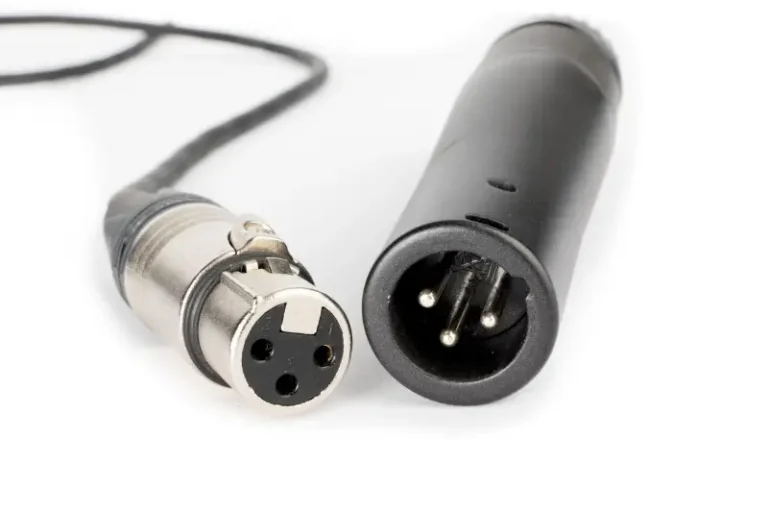
A low profile XLR connector is a compact XLR plug with a right-angle or adjustable cable exit that reduces the depth behind a panel from 60–80 mm to 20–35 mm. It carries the same 3-pin balanced audio as a standard XLR, but saves space in racks, bags, pedalboards, and broadcast panels — fully compatible with all standard XLR sockets.
Pushing a rack against the wall only to find the XLR plugs won’t fit behind it? Building a location-sound bag where every millimeter and gram counts? When space, weight, or cable management becomes the constraint, standard bulky XLR plugs fall short — and the low profile XLR connector becomes the professional’s choice. Because it delivers the same reliable balanced audio in a far smaller body, it saves space, reduces cable stress, and keeps installations clean. This guide covers the definition, types, applications, the 6 best models, buying factors, and step-by-step DIY installation.
What Is a Low Profile XLR Connector? Definition & Types
Low profile XLR connectors – also known as compact XLR connectors, slim XLR plugs, or low clearance XLR connectors – are XLR connectors designed to minimize physical footprint.
Unlike standard inline XLR connectors that extend several centimeters straight out from the socket, the low profile design routes the cable at a right angle or adjustable angle, keeping it close to the device surface. Because the cable exits sideways rather than straight back, the connector dramatically reduces its footprint in depth, width, or both — depending on the model.
Although the body is smaller, most low profile XLR connectors keep the standard 3-pin balanced configuration and remain fully compatible with all standard XLR sockets and cables. For the underlying connector fundamentals, see our XLR connector guide.
The concept of ‘Low profile’ covers the following different design types:
- Fixed right angle (fixed 90°) – cable is perpendicular to the connector body.
- Adjustable angle – cable outlet can rotate between multiple angles (usually 30° – 150°) to achieve maximum flexibility.
- Ultra-thin body (Slim body, reduced diameter) – narrow connector housing, suitable for high density panel arrangement.
- Chassis mount (reduced depth) – panel mount socket with minimal protrusion depth at the rear end, suitable for shallow chassis.
Low Profile XLR Connector vs Standard XLR Connector: What’s the difference?
Understanding the difference between low profile XLR connectors and traditional plugs helps to understand why it is the first choice in many professional application scenarios.
| Feature | Standard XLR Connector | Low Profile XLR Connector |
|---|---|---|
| Cable exit direction | Straight out (inline) | Right angle or adjustable |
| Depth behind panel | 60–80 mm | 20–35 mm |
| Cable bend stress | High (sharp bend at plug) | Minimal (natural curve) |
| Weight | Standard | Up to 40% lighter |
| Best for | General-purpose use | Tight spaces, touring, broadcast |
| Panel density | Limited | High-density installations |
Bottom line: When space isn’t limited, a standard XLR connector is perfectly sufficient. Once back-panel clearance, weight, or cable management becomes a constraint, the low profile XLR connector is the right professional choice.
Key features of Low Profile XLR connectors
Not all low profile XLR connectors have the same quality. When evaluating products, the following specifications are most critical:
Adjustable Angle vs Fixed Angle Cable Exit
The most important functional difference is whether the cable exit angle is fixed or adjustable. A fixed right-angle connector has a precise 90° cable exit — because it’s reliable and simple, it works well, but it only adapts to a single direction. Because the adjustable model lets the cable exit rotate through a wide range (often two rotating sections covering 30°–330°), it achieves precise routing in any direction without mechanical stress.
When the cable exit direction may change — location audio bags, pedalboards, modular rack systems — the adjustable angle connector offers significantly more flexibility.
Cable Outer Diameter Compatibility
Low profile connectors are usually designed for thinner cables. Most standard-cap models support a maximum cable diameter (OD) of 3.4 mm, while large-cap models accept 3.8–6.0 mm. Compatible slim cables include Belden 1804A, Mogami W2901/W3031/W2697, and Sommer Isopod SO-F22. Because a cable OD exceeding the strain-relief range is one of the most common installation errors, always confirm cable compatibility before ordering.
Housing Material
For touring and live sound reinforcement applications, zinc die-cast or all-metal housings are essential. Although the connector of the plastic shell is lighter, it lacks the mechanical durability required for repeated use. For recording studios and fixed installation occasions, both materials are generally acceptable.
Contact Quality
Gold-plated contacts are corrosion-resistant and can maintain stable electrical performance in thousands of insertion and extraction cycles. For any high-frequency use environment-tour equipment, radio studios, professional AV installation-gold-plated contacts are worthy of priority.
Pin Configuration
Most low profile XLR connectors are 3-pin (balanced audio) designs. However, 4-pin and 5-pin low profile models for intercom, headset and DMX applications also exist. Before purchase, please confirm that the number of pins matches the actual application.
Locking Mechanism
Some low profile XLR connectors integrate a locking system to prevent accidental disconnection during the performance. For tour production and on-site sound reinforcement, a low profile XLR connector with locking function is a crucial security guarantee.
6 Real-World Uses for Low Profile XLR Connectors
Low profile XLR connectors are widely used in almost all areas of professional audio. The following are the most common actual use scenarios:
Location Audio and Film Production
Outdoor recorders and production sound mixers using bag-based rigs, are highly dependent on low profile XLR connectors to reduce cable volume and weight. By using compact XLR connectors at each connection point, the cable weight of the entire recording package can be reduced by up to 40%, with significant advantages over long production days.
Rack-Mounted Studio and Touring Systems
In the rack system where the equipment is installed close to the wall or the road case lid, the standard XLR plug can not be inserted normally. The low profile XLR connector with right-angled outgoing line can compress the required back-end clearance from 70-80mm to 25-35mm-so that the rack can be completely placed on the wall, significantly increasing the effective rack density.
Stage and Floor Monitoring
Stage ground connection-monitor wedge input, floor pocket panel, DI box output-the advantage of using low profile XLR connector is that the cable is drawn parallel to the ground, rather than protruding upwards, Because the cable exits parallel to the floor rather than protruding upward, it reduces both tripping hazards and the risk of crushing damage from foot traffic.
Broadcast Consoles and Television Production
The broadcast environment has extremely high requirements for the density and accuracy of the connector panel layout. The ultra-thin body and right-angle outlet design of the Low profile XLR connector allows each panel to accommodate more connection ports, making the back of the broadcast console more neat, and achieving faster recognition and operation in live production.
Pedalboard Audio Systems
The guitar player and bass player that transmit XLR signals on the compact effector board use a low profile XLR connector to keep the entire signal chain flat and tidy on the board. The Low profile design allows tight arrangement of connectors between the pedals to avoid cable accumulation problems caused by standard XLR plugs.
Custom Equipment Builds and Shallow Panels
DIY equipment manufacturers and OEM manufacturers who use custom chassis often need to install XLR sockets on chassis with extremely small back-end protrusion depth. The Low profile chassis-mounted XLR connector makes it possible to build a complete XLR I/O panel on a chassis that is too shallow to accommodate standard sockets.
6 Best Low Profile XLR Connectors
Below are six low profile XLR connectors that balance compact size, build quality, and value across touring, broadcast, and studio use.
1. Neutrik NC3MRX (RX Series)
Because it’s the successor to Neutrik’s proven RC series, the NC3MRX right-angle connector offers improved contact integrity and cable strain relief. Its insert rotates into 7 × 45° positions before the back cover is secured, giving flexible cable orientation in a rugged nickel housing with silver contacts. Best for: touring and high-reliability installs.
2. Switchcraft AAA3FBLPPKG
Although it entered the low profile market more recently, the Switchcraft AAA series delivers pro-level performance at roughly $8. Its zinc-diecast right-angle female body is lightweight and field-repairable. Best for: budget-conscious pros who need reliable, repairable connectors.
3. Cable Techniques LoPro CT-LPXLR-3M-K
Because Cable Techniques specializes in low profile audio connectors, its LoPro line is purpose-built for tight spaces. This 3-pin male features a black-matte shell, gold contacts, and an adjustable cable-exit angle. Best for: location sound bags where weight matters.
4. Cable Techniques CT-BX3F-N (B-Shell)
When you need maximum exit-angle flexibility, this 3-pin female B-shell adjusts from 60° to 300° around either the 6 o’clock or 12 o’clock position. It uses a zinc-diecast shell with gold-plated contacts (~$9.99) and is compatible with slim cables like Belden 1804A and Mogami W2901. Best for: complex routing on pedalboards and racks.
5. Neutrik RC Series (Classic)
Although superseded by the RX series, the original RC right-angle connector remains widely used. Its compact profile and 45° indent positions made it the long-standing touring standard. Best for: matching existing RC-equipped rigs.
6. Verchil Custom Low Profile XLR
Because off-the-shelf connectors don’t always fit OEM and bulk needs, Verchil manufactures custom low profile XLR connectors and cable assemblies — right-angle and adjustable, with metal housings and gold-plated contacts, built to your cable OD and angle specs. Best for: integrators, rental companies, and OEM builds needing volume pricing. Explore our XLR connector range or contact our technical team for custom specs.
| Model | Type | Contacts | Approx. Price | Best For |
|---|---|---|---|---|
| Neutrik NC3MRX | Right-angle male | Silver | $$ | Touring |
| Switchcraft AAA3F | Right-angle female | — | $8 | Budget pro |
| Cable Techniques LoPro | Adjustable male | Gold | $$ | Location sound |
| Cable Techniques CT-BX3F-N | Adjustable female | Gold | $9.99 | Complex routing |
| Neutrik RC Series | Right-angle | Silver | $$ | Legacy rigs |
| Verchil Custom | Right-angle/adjustable | Gold | Bulk/OEM | Integrators |
How to Choose a Low Profile XLR Connector for Your Scenario
To choose the low profile XLR connector that best suits your needs, just answer the following five questions:
What are the specific spatial restrictions?
It is clear whether you are faced with insufficient back-end clearance, too small left and right spacing of connectors, limited cable outlet direction, or coexistence of multiple restrictions. This determines whether you need a right-angle, ultra-thin body or an adjustable-angle design.
Do you need a fixed angle or an adjustable angle outlet?
If the cable must be drawn in a specific direction – or the direction may change in different use cases – the flexibility provided by the adjustable angle model is not achievable with a fixed right-angle connector.
Male or female?
Determine which end of the signal chain requires a compact connector. The male low profile XLR connector is usually used to insert the cable end of the fixed device input. The female is used to connect the fixed output terminal.
What is the outer diameter of the cable?
The outer diameter (OD) of the cable is measured before selecting the connector. The low profile connector of the standard cap usually supports a maximum of 3.4mm OD, and the large cap version can be extended to 6.0mm. The mismatch of cable outer diameter is the primary reason for the failure of low profile XLR connector installation.
Used for tour, permanent installation or recording studio?
Tour/on-site sound reinforcement – Priority selection of all-metal shell, locking mechanism, gold-plated contact.
Permanent Installation/Broadcasting – Right-angle or adjustable-angle type, rugged housing, ultra-thin profile.
Recording studio/home recording – any qualified low profile design can be; adjustable angle type has the highest flexibility.

How to Install a Low Profile XLR Connector: 7 Steps
The process for installing low profile XLR connectors is basically the same as other XLR connectors – but there are several important considerations for adjustable angle models. Here are the complete installation steps:
Tools required
- Wire strippers
- Soldering iron and solder
- 1.5mm hexagonal wrench – An adjustable angle model with a fixed screw cap is essential
- Heat shrink tubing and heat gun
- Cable tester
Step by step installation process
Step 1: Strip the cable jacket
Remove about 12–15 mm of outer jacket. Loosen and twist the shield braid, then pre-tin only about 4 mm at the end. Before soldering, slide a small 2:1 heat-shrink tube onto the untinned part of the shield.
Step 2: Slide the Housing On Before Soldering
Because this is the most frequently skipped step, slide the connector housing, strain relief, and all cap assemblies onto the cable before any soldering. If you forget, you’ll have to desolder everything and start over.
Step 3: Pre-tinning of contacts and wires
A small amount of solder is coated on each contact cup and the end of each wire to ensure that the solder joints are clean and reliable.
Step 4: Solder per the Standard XLR Pinout
- Pin 1 = Ground/Shield
- Pin 2 = Hot/Positive
- Pin 3 = Cold/Negative
Step 5: Insert the component into the shell
Put the soldered pin assembly into the XLR housing. For the adjustable angle model, gently bend the cable to the preset outlet direction before installing the colored boot.
Step 6: Set the cable outlet angle
For the adjustable angle connector, Once the cable is guided to the required exit position, install the boot. Use a 1.5 mm hex wrench to tighten the set-screw flush with the shell — because over-tightening can crack the boot, stop once it’s flush.
Step 7: Fix and test
Lightly pull the cable to confirm that the tie or cable has been correctly positioned at the outlet of the cap. Assemble the remaining shell parts, and then use the cable tester to verify the connectivity of the three pins, and confirm that the polarity is correct.
Frequently Asked Questions
Does Low profile XLR connector affect audio quality?
No. The correctly assembled low profile XLR connector transmits the same balanced audio signal as the full-size connector. The reduced body size and the beveled outgoing line only affect the physical form – without affecting the impedance, signal integrity or noise suppression characteristics of the balanced connection.
Is the Low profile XLR connector compatible with standard XLR sockets?
Compatible. The Low profile XLR connector uses the same 3-pin interface as all standard XLR connectors and is fully compatible with any standard XLR socket and cable. The ‘Low profile’ only describes the design form of the connector body and has nothing to do with the mating interface.
What cable diameters does the Low profile XLR connector support?
Most standard low profile XLR connectors support cables up to 3.4mm OD. The large cap or extended strain relief version is compatible with cables from 3.8mm to 6.0mm OD and covers the specifications of most slim and standard professional microphone cables. Be sure to check the specification table of the selected connector before purchase.
What is the difference between Low profile XLR connector and right angle XLR connector?
The right angle XLR connector refers to the design of a fixed 90-degree outlet. Low profile XLR connector is a broader concept-covering fixed right angle type, adjustable angle type, ultra-thin body type and chassis mounted socket. All right-angle XLR connectors belong to the low profile category, but not all low profile XLR connectors are right-angle designs.
Can Low profile XLR connectors be used for tours?
Absolutely. Many low profile XLR connectors use the same mechanical standards as full-size tour connectors – all-metal housings, gold-plated contacts, and high insertion/extraction cycle life. For the tour, please give priority to the die-cast zinc alloy shell, and choose the model with integrated locking mechanism in the case of accidental disconnection risk.
What’s the best low profile XLR connector for a pedalboard?
For pedalboards, an adjustable-angle connector works best — the Cable Techniques LoPro or CT-BX3F-N let you rotate the cable exit to route signal flat across a crowded board. Because pedalboard space is tight and cable directions vary, the adjustable exit avoids the bulk and sharp bends of standard plugs. Pair it with a slim cable (Mogami W2901 or similar) for the lowest profile.
Can I fit a standard thick microphone cable into a low profile XLR connector?
Usually not into a standard-cap model. Because standard-cap low profile connectors accept up to 3.4 mm OD, a thick touring mic cable (often 6–7 mm) won’t fit. If you need a thicker cable, choose a large-cap version rated up to 6.0 mm OD — but for the lowest profile, slim cable is recommended. Always check the connector’s cable-OD specification before buying.
Summary
The low profile XLR connector is one of the most practical, cost-effective upgrades an audio professional can make. Whether your goal is reducing cable weight in a location-sound bag, maximizing back-panel clearance in a tour rack, achieving clean wiring on a broadcast console, or building a tidier studio, the right low profile connector solves a real spatial constraint.
Because the best choice depends on your specific constraint: choose a fixed right-angle type for racks and fixed installs, an adjustable-angle type for flexible location-sound rigs, a slim body for high-density panels, and a locking model wherever accidental disconnection is a risk on stage.
Browse Verchil’s complete XLR connector range and TRS connector range, or explore our companion guides: XLR connector guide, XLR connector pinout, and XLR male connector guide. For custom low profile XLR assemblies built to your cable and angle specs, contact our technical team.