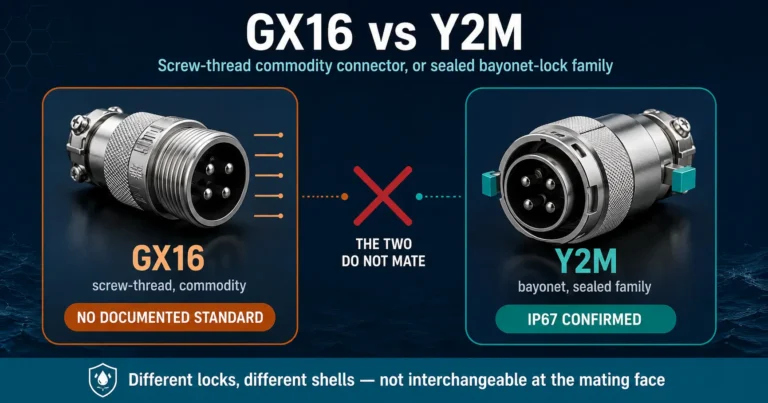
GX16 wins on cost and sourcing flexibility, Y2M wins on documented sealing and current headroom, and the two are not drop-in substitutes for each other.
GX16 is an informal 16 mm sizing convention made compatible-ish across dozens of independent factories, screw-thread locking, and sealed only on specific SKUs that say so.
Y2M is a Chinese military-derived family with a bayonet quick-lock and a sealing rating that shows up consistently across its own published datasheets.
Neither is a Verchil product — this is a straight third-party comparison — but the choice between them maps onto a real decision: do you need the cheapest 16 mm panel connector you can source, or a connector that documents its own IP rating and can be mated in one twist under a glove.
GX16 vs Y2M at a glance
| GX16 | Y2M | |
|---|---|---|
| Locking | Screw-thread | Bayonet quick-lock |
| Pin range | 2–10 (some vendors to 26+) | 2–37+ (shell scales with pin count) |
| Current rating | ~5–10 A / contact (one datasheet: 7 A @ 125 V) | Up to 25 A on 2-pin variants |
| Sealing | Base version unsealed; “waterproof” SKUs claim IP65/IP67 | IP67 confirmed on tested SKUs |
| Temperature | Vendor-dependent: −55 °C to +120 °C or −40 °C to +85 °C, depending on source | −40 °C to +85 °C |
| Shell | Zinc alloy or aluminum | Aluminum alloy, gold-plated brass contacts |
| Documented origin | No single official standard | Chinese military-industry lineage (design heritage, not a US MIL-DTL certification) |
| Typical cost | Lower, commodity | Higher, sealed + bayonet hardware |
Where GX16 and Y2M actually come from
Neither name belongs to a single company, which is exactly why the comparison gets confusing.
GX16 is not a documented international or military standard. It is a sizing convention — the “16” refers to a roughly 16 mm shell and thread diameter — that dozens of independent Chinese connector factories build to, closely enough that parts from different vendors will generally thread into the same panel cutout. A long-running EEVblog forum thread asks the obvious question — what military or industry spec is GX16 actually a clone of — and no one in the thread can point to one. That is not a defect exactly, it just means “GX16” behaves like a de facto standard rather than a governed one, and datasheet specifics such as temperature range vary by vendor as a result. Renhotec’s GX16 datasheet is representative: 2 to 10 contacts, roughly 5 to 10 A per contact, a base version that is not sealed, and separate “waterproof” SKUs that carry their own IP65 or IP67 claim.
Y2M sits in a different lineage. It belongs to a genuine Chinese connector-standard family — Y2, Y2M, Y21M, Y28M, Y36M, Y50M — positioned by manufacturers as military-industry hardware, with a bayonet quick-lock and a sealed, hermetic-style body as the default rather than an add-on. Renhotec’s Y2M military-industry line and Elecbee’s published SKUs show the shell size scaling with pin count within the family — a 2-pin Y2M-2TK runs about 21 mm, while a 16-pin Y2M-16TK is closer to 36 mm — so “Y2M” covers a wider size range than a single fixed diameter. “Military-derived” here describes design heritage and finish, not a formal US MIL-DTL-5015 or MIL-DTL-38999 certification; treat it as a lineage claim, not a certificate, when a spec sheet doesn’t name a specific standard number.
The two rarely compete for the exact same job for that reason: GX16 is reached for because it’s everywhere and cheap, Y2M is reached for because it documents a seal and locks fast.
GX16 — 4 strengths, 2 trade-offs
Strengths:
- Genuinely low unit cost, sold by dozens of independent factories in parallel — commodity pricing with no single-source risk.
- Screw-thread panel mount installs with basic tooling, no special crimp or bayonet-alignment step.
- Compact 16 mm footprint fits panel space that a larger Y2M shell size cannot.
- Wide vendor choice means short lead times and easy respec if one supplier is out of stock.
Trade-offs:
- No documented originating standard, so spec details — temperature range in particular — genuinely differ between vendor datasheets rather than converging on one number.
- The base part is not sealed; “waterproof” is a separate, vendor-specific SKU claim that has to be checked, not assumed from the GX16 name alone.
Y2M — 4 strengths, 2 trade-offs
Strengths:
- Sealing is documented on the family’s own datasheets — IP67 confirmed on tested SKUs, not a bolt-on option.
- Bayonet quick-lock mates and releases in a single twist, faster and more glove-friendly than turning a threaded collar.
- Higher current headroom on low-pin variants — up to 25 A on a 2-pin Y2M, well above GX16’s per-contact rating.
- One family spans a wide pin-count and shell-size range (2 to 37-plus pins), so a design can stay in the same connector lineage as contact count grows.
Trade-offs:
- The bayonet hardware and sealed body cost more than a commodity screw-thread part — you are paying for the documented seal.
- “Military-derived” is a lineage and finish description, not a substitute for checking whether a specific MIL-DTL number is actually required by your program.
Features face to face
Locking mechanism. GX16 uses a threaded collar; Y2M uses a spring-loaded bayonet pin that locks with a quarter-turn. Winner for fast, gloved, or vibration-prone mating: Y2M — a bayonet twist is faster and less likely to back off under vibration than a threaded collar that can be under- or over-tightened.
Sealing. GX16’s base version is not sealed at all; only specific “waterproof” SKUs claim IP65 or IP67, and that claim sits with the individual vendor. Y2M’s sealing shows up as a standard, tested spec across the family’s own datasheets. Winner: Y2M, on documentation alone — you are checking one manufacturer’s tested claim rather than hunting for whichever GX16 SKU happens to say “waterproof.”
Current rating. GX16 runs roughly 5 to 10 A per contact; Y2M’s 2-pin variants reach 25 A. Winner: Y2M, for any circuit pushing more than a few amps per contact.
Pin count and shell-size range. GX16 typically spans 2 to 10 pins (a few vendors push to 26-plus); Y2M spans 2 to 37-plus across its shell-size variants. Winner: Y2M, for designs that need to scale contact count without changing connector families.
Panel footprint at low pin counts. A 16 mm GX16 shell is smaller than even Y2M’s smallest common variant (around 21 mm). Winner: GX16, when the panel cutout is the binding constraint.
Documentation consistency. GX16’s own datasheets disagree with each other on temperature range; Y2M’s published specs are more consistent across sources. Winner: Y2M.
Unit cost. GX16 is a commodity part sold in parallel by many factories; Y2M’s sealed bayonet hardware costs more. Winner: GX16.
Two charts below turn these seven rows into a single picture: a weighted comparison across five decision dimensions, and the temperature-range discrepancy that is the clearest evidence GX16 is a convention, not a standard.
What each does uniquely well
GX16: universal-sourcing economics. Because so many independent factories build to the same rough dimensions, a GX16-based design rarely faces single-source risk — if one vendor’s lead time slips, a functionally similar part is usually available from another. That is a genuine supply-chain advantage a proprietary or single-source connector cannot offer.
Y2M: a tested seal riding on a one-twist lock. Y2M is one of the few small circular families that pairs a confirmed IP67 rating with a bayonet mechanism rather than a screw thread. Most sealed screw-thread aviation connectors ask for a full turn or more to fully seat and seal; Y2M’s quarter-turn lock gets there faster, which matters on equipment mated and unmated often in the field.
Full spec comparison
| Spec | GX16 | Y2M |
|---|---|---|
| Locking mechanism | Screw-thread collar | Bayonet quarter-turn |
| Pin range | 2–10 (some vendors 26+) | 2–37+ |
| Current rating | ~5–10 A/contact (7 A @ 125 V, one datasheet) | Up to 25 A (2-pin variant) |
| Sealing (documented) | Base: none. “Waterproof” SKUs: IP65/IP67 claim | IP67 confirmed on tested SKUs |
| Temperature range | Vendor-dependent — sources disagree | −40 °C to +85 °C |
| Shell material | Zinc alloy / aluminum | Aluminum alloy |
| Contact plating | Varies by vendor | Gold-plated brass |
| Smallest shell size | ~16 mm | ~21 mm (2-pin variant) |
| Documented standard origin | None identified | Chinese military-industry lineage, not a US MIL-DTL number |
| Typical unit cost | Lower | Higher |
Use GX16 if…
- The build is cost- or volume-sensitive and a documented seal is not mission-critical — indoor equipment, prototypes, or light-duty gear where “waterproof” is a nice-to-have rather than a requirement.
- Panel space is the binding constraint and 16 mm is genuinely the largest cutout the enclosure allows.
- Supply-chain flexibility matters more than a single spec sheet — you want a part multiple independent vendors can supply on short notice.
If any of those three actually needs a real, tested seal on a threaded lock rather than a per-SKU “waterproof” claim, it’s worth comparing GX16 directly against a documented sealed threaded connector before committing — that existing guide lines GX16 up against Verchil’s SP16/SL16 series, which publishes IP68 test data at the same panel size.
Use Y2M if…
- The connector is mated and unmated often, under gloves or vibration — field service equipment, vehicles, or portable test gear where a quarter-turn bayonet beats a threaded collar.
- A genuinely tested seal matters and you want it on the manufacturer’s own datasheet, not inferred from a SKU name.
- Current draw per contact exceeds what a small screw-thread commodity part can carry — Y2M’s 2-pin variants reach 25 A where GX16 tops out around 10.
Worth knowing honestly: Verchil does not currently build a sealed bayonet-locking aviation series, so there is no direct Verchil equivalent to Y2M here. If bayonet locking is a hard requirement, a Y2M-family supplier is the right call. If it isn’t — if a documented, tested seal on a threaded lock would do the job — it’s worth looking at Verchil’s waterproof aviation connector line instead, the same both-ends design-in trade-off that applies whenever a locking mechanism changes.
Need a fast spec check before committing to a design? WhatsApp Verchil’s engineering team with your pin count, current draw, and sealing requirement, or request a quote through the contact page.
FAQ
Is GX16 an official industry standard?
No. GX16 is an informal sizing convention — a roughly 16 mm shell and thread diameter — built to by many independent factories, not a documented military or international standard. That’s why spec details like temperature range differ between vendor datasheets rather than converging on one figure.
What does Y2M stand for, and is it a real standard?
Y2M belongs to a genuine Chinese connector family (Y2, Y2M, Y21M, Y28M, Y36M, Y50M) positioned as military-industry hardware by its manufacturers. “Military-derived” describes design lineage and finish, not a specific US MIL-DTL-5015 or MIL-DTL-38999 certification — check the actual datasheet if a program requires a named standard.
Can a GX16 connector mate with a Y2M connector?
No. They use different locking mechanisms (screw-thread versus bayonet) and different shell dimensions at nearly every pin count, so they are not interchangeable at the mating face. Treat a switch between them as a both-ends design-in, not a drop-in swap.
Which is more waterproof, GX16 or Y2M?
Y2M documents IP67 sealing consistently across its own tested SKUs. GX16’s base version is not sealed at all — only specific vendor SKUs labeled “waterproof” claim an IP rating, and that claim needs checking per part rather than assumed from the GX16 name.
Is Y2M MIL-DTL certified?
Not as a blanket claim. Y2M is described by its manufacturers as military-industry lineage hardware, which is a design-heritage statement, not the same as holding a specific MIL-DTL qualification. If a spec calls for a named MIL-DTL number, verify it against the actual datasheet rather than the “military-derived” description alone.
How does GX16 compare to Verchil’s SP16/SL16 series?
That comparison already exists — see the 16 mm aviation connector guide, which lines GX16 up against Verchil’s threaded SP16/SL16 series on sealing, cycle life, and panel fit. This article focuses on GX16 against Y2M, a different third-party family with a bayonet lock rather than a thread.