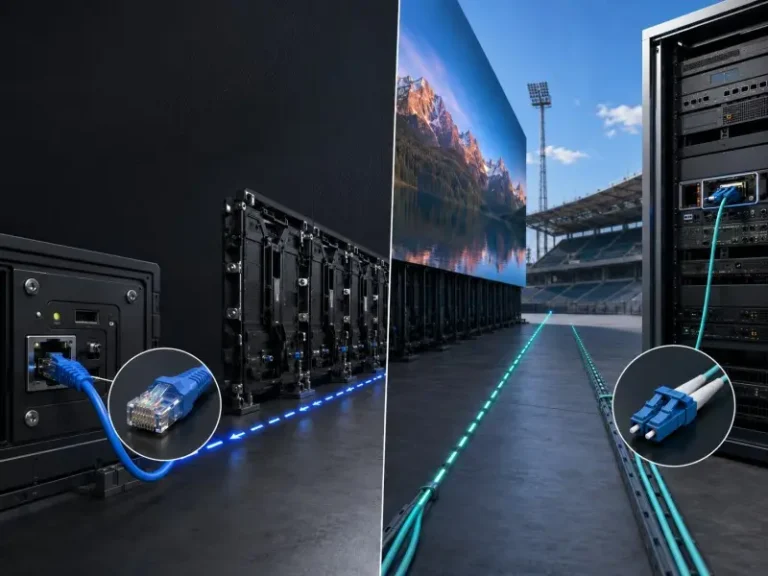
For an LED display, run Cat6 over RJ45 when the controller-to-cabinet link stays under about 80 m. Move to LC fiber once you cross 100 m, need 10 Gbps past 55 m, or fight electromagnetic interference — fiber carries the signal 300 m to 10 km+ where copper cannot.
Most LED display links never need fiber. The argument starts the moment a run gets long: a controller in a control room, a wall four buildings away, a stadium ribbon board fed from a rack two floors down. Copper wins the short, cheap, power-carrying runs. Fiber wins distance and noise. This page draws the line between them — by metres, by data rate, and by what happens to the connector once it sits outdoors.
One-Minute Compare
| Factor | Cat6 / RJ45 copper | LC fiber |
|---|---|---|
| Reliable run length | ~80–100 m | 300 m (OM3) – 10 km+ (OS2) |
| Speed at distance | 5 Gbps to 100 m; 10 Gbps to 55 m | 1.25–11.3 Gbps over the full run |
| EMI immunity | No — copper picks up noise | Yes — glass is dielectric |
| Power on the same cable | Yes (PoE / PoE+) | No — devices need separate power |
| Field termination | Crimp on site with basic tools | Precision termination or pre-terminated |
| Outdoor sealing | Mature IP65–IP68 RJ45 panel mounts | Adapter is metal-flange; needs a sealed housing |
| Relative cost per port | Lower | Higher (optics + termination both ends) |
| Best for | Runs under ~80 m | Runs over 100 m, high-EMI sites, building-to-building |
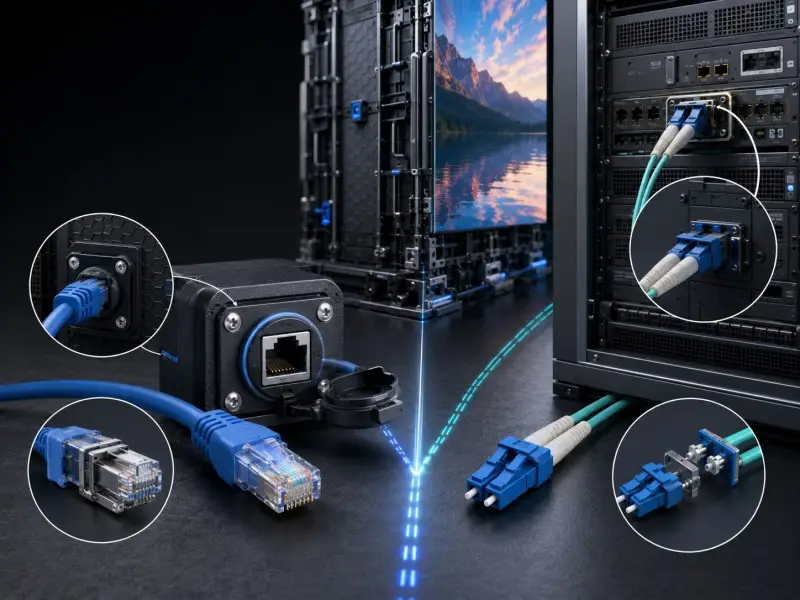
The Two Contenders
Cat6 over RJ45 — the default that covers most walls
Cat6 twisted-pair with an RJ45 connector is what ships on nearly every LED sending card and receiving card. It is cheap, field-terminable, and it carries Power over Ethernet, so a single cable can both drive data and power a small device. For indoor walls and most outdoor cabinets within a stadium or storefront, copper is not a compromise — it is the correct default.
Its ceiling is fixed by standard, not by brand. The ANSI/TIA-568 structured-cabling standard caps a twisted-pair channel at 100 m: 90 m of fixed horizontal cable plus 10 m of patch leads. Push past that and the signal degrades — bit errors, dropped frames, a wall that flickers under load.
Consistent specs (as a contender): Cat5e/Cat6/Cat6A construction, gigabit to 10-gigabit depending on category and length, PoE/PoE+ capable, field-crimp termination, IP65–IP68 panel-mount housings available for outdoor use.
Four strengths:
- Lowest cost per port — no transceivers, no media converters.
- Carries PoE/PoE+, so data and device power share one cable.
- Field-terminable with a basic crimp tool; a damaged head is a five-minute on-site fix.
- Plugs straight into the RJ45 ports already on the controller and receiving cards.
Two weaknesses:
- Hard distance ceiling: 100 m at gigabit, and only 37–55 m at 10 Gbps on Cat6 — the limit set by the IEEE 802.3an 10GBASE-T standard.
- Copper is an antenna. Near LED drivers, motors, or long parallel power runs, it picks up electromagnetic interference that fiber simply ignores.
LC fiber — the answer when distance or noise wins
LC fiber trades cost and convenience for reach. An LED system converts the electrical signal to light with a transceiver, sends it down a glass core that loses almost nothing over distance, and converts it back at the cabinet. The LC connector itself is the small, push-pull duplex coupler that terminates that glass at a panel.
The reach is the headline. The Ethernet Alliance standardized 10GbE to 400 m on OM4 multimode fiber back in 2012; OM3 reaches 300 m, and OS2 single-mode with 10GBASE-LR optics spans 10 km under IEEE 802.3ae. For a wall on a far building, that is the difference between one clean pull and a chain of powered repeaters.
Consistent specs (as a contender): single-mode or multimode, LC duplex for Tx/Rx, 1.25–11.3 Gbps, >500 mating cycles, zinc-diecast metal flange, −25 °C to +70 °C, ≤0.3 dB insertion loss on Verchil’s LC fiber panel-mount adapter.
Four strengths:
- Carries the signal 300 m to 10 km+, depending on fibre grade — far past copper’s wall.
- Immune to EMI and ground loops; the dielectric path ignores electrical noise.
- Thin, light cable that pulls easily across long building-to-building routes.
- Headroom: the same glass upgrades to higher data rates by changing only the optics.
Two weaknesses:
- Higher installed cost: transceivers or media converters at both ends, plus precision termination.
- No power down the fibre — devices still need a separate supply. And a bare LC adapter is not weather-sealed on its own; outdoor use means housing it in a sealed enclosure.
Features Face to Face
This is where the choice is actually made. Each criterion below names a winner and gives the reason, weighted by what matters on an LED job rather than by spec-sheet bragging rights. The weights: distance 30%, signal integrity and EMI 25%, outdoor sealing and ruggedness 20%, total installed cost 15%, install simplicity 10%.
Distance — winner: fiber
No contest past 100 m. Copper’s channel is capped at 100 m by ANSI/TIA-568, and 10 Gbps on Cat6 collapses to 37–55 m as alien crosstalk rises, per IEEE 802.3an. Fiber starts where copper stops: 300 m on OM3, 400 m on OM4, 10 km on single-mode. Under 80 m, the distance axis is a tie — both deliver full rate — so distance only decides the long runs.
Signal integrity and EMI — winner: fiber
LED cabinets are electrically loud. Switching power supplies, driver ICs, and bundled high-current runs all radiate noise, and copper data pairs sitting alongside them act as receiving antennas. Fiber carries light, not current, so it shrugs off every bit of that. On a clean indoor run with separated cable trays, copper holds fine. In a dense cabinet or beside a power trunk, fiber’s immunity is the deciding edge.
We saw this play out on a rental wall that flickered only at full white — peak current draw — and only on the cabinets fed by the data run zip-tied to the power trunk. The link tested clean on the bench every time. Re-routing the copper away from the trunk fixed most of it; the panels on the longest, noisiest leg were moved to fiber and never flickered again. The lesson is narrow: copper fails intermittently under load near power, and intermittent faults are the expensive kind to chase on site.
Outdoor sealing and ruggedness — winner: copper
Here copper takes a round, and the reason is practical rather than theoretical. The RJ45 ecosystem has mature, sealed panel mounts: Verchil’s IP65 RJ45 panel-mount socket is third-party tested to IP65/67/68, rated −40 °C to +80 °C, and built for outdoor Ethernet and LED-display cabinets. A standard LC adapter, by contrast, is a metal-flange coupler with no inherent ingress rating — to put it outdoors you house it in a sealed enclosure. Fiber wins the cable; copper wins the connector at the weather boundary.
Total installed cost — winner: copper
Copper is cheaper end to end. There are no transceivers, no media converters, and the cable terminates with a crimp tool a technician already owns. Fiber adds optics at both ends plus skilled termination. The honest comparison is not “fiber is expensive” but “fiber is worth it once the run is long enough that the copper alternative needs repeaters or active extenders” — at which point the cost gap narrows or reverses.
Run the numbers on the link, not the cable. A 150 m copper path cannot be a single channel: it needs a powered midpoint switch or extender, which means a weatherproof box, a power feed, and a device that can fail in the field. One fiber pull with a transceiver at each end removes all three. By the time you price the enclosure, the power drop, and the truck roll to service a far-side active device, the fiber link is often the cheaper lifetime choice — not the pricier one. Under 80 m, none of that applies and copper simply wins.
Install simplicity — winner: copper
Pull, crimp, click, done. RJ45 is field-serviceable by any installer. Fiber wants clean connectors, correct polarity, and either factory termination or a trained hand on site. For a fast cabinet swap during an event, copper is the lower-stress choice.
Stand-Out Features
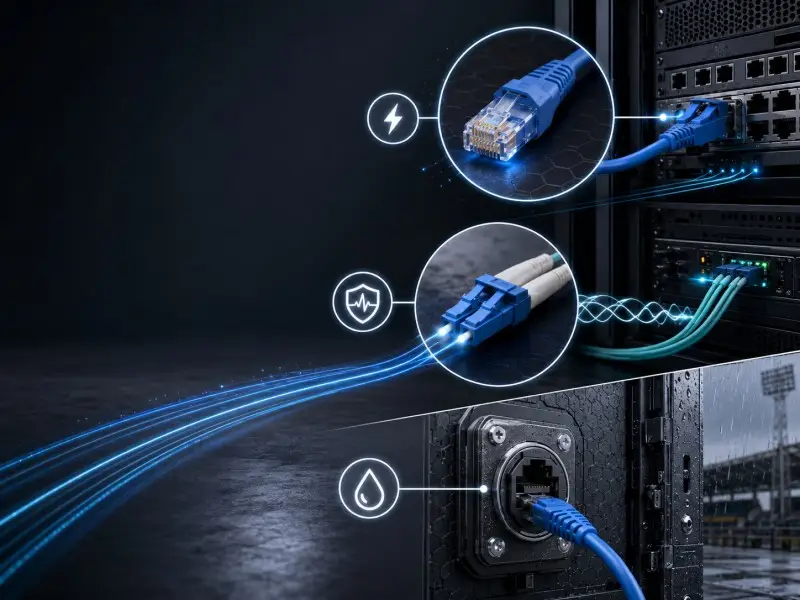
PoE on copper: Cat6 can power a device and move its data on one cable. Fiber cannot — a fibre run still needs a separate power feed at the far end, which is real cabling you have to plan for.
EMI immunity on fiber: In a high-noise cabinet, the dielectric glass path is not just “better” — it removes a whole failure mode. No ground loops, no crosstalk, no flicker traced back to a power trunk laid too close.
The sealed RJ45 panel mount: A field-replaceable, IP65–IP68 RJ45 bulkhead lets an outdoor wall survive rain and washdown while staying serviceable. It is the reason copper holds the weather boundary even when fiber holds the distance.
Conclusion: Which One for Your Wall
The medium follows the run, not fashion. Score your link by distance first, then noise, then who has to maintain it.
Use Cat6 / RJ45 copper if:
- The controller-to-cabinet run stays under about 80 m at full rate.
- You want PoE to power devices over the same cable.
- The wall is outdoors and you need a sealed, field-serviceable connector now — reach for a sealed RJ45 bulkhead socket.
Use LC fiber if:
- The run crosses 100 m, or needs 10 Gbps past 55 m.
- The path runs through electrically noisy space or between buildings.
- You are pulling a long backbone and want headroom for higher rates later — terminate it on an LC duplex panel-mount coupler.
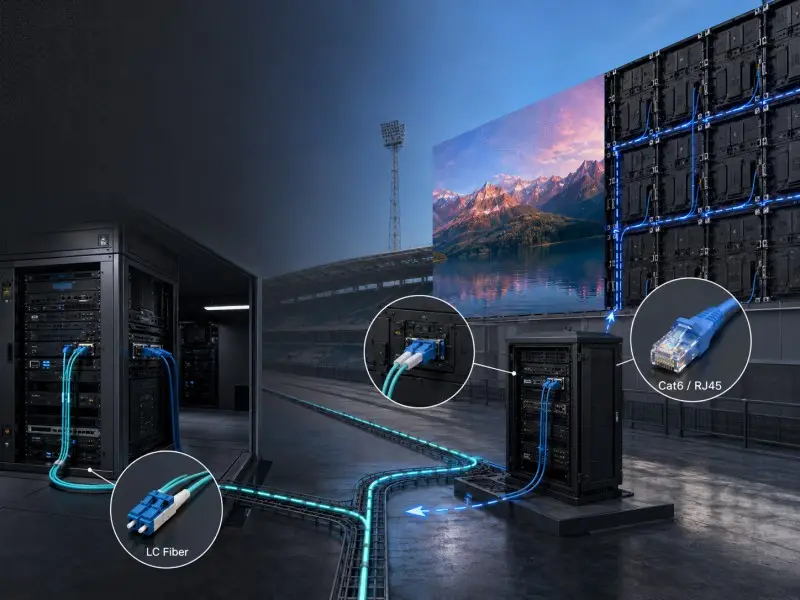
Most real installations use both: fiber for the long backbone into the structure, copper for the short, powered, serviceable links inside each cabinet. If you want to plan the whole signal-and-power chain for an LED wall, map the distances first and the connectors follow.
Send us your run lengths and environment and we will spec the link both ways — Request a quote or WhatsApp us.
FAQ
Can Cat6 run more than 100 m for an LED screen?
Not reliably. ANSI/TIA-568 caps a twisted-pair channel at 100 m, and on Cat6 a 10 Gbps link drops to 37–55 m. Past that you add an active extender or switch to fiber, per IEEE 802.3an.
How far can LC fiber go on an LED video wall?
OM3 multimode reaches 300 m and OM4 reaches 400 m at 10 Gbps; OS2 single-mode spans 10 km with long-reach optics under IEEE 802.3ae. That covers nearly any campus or stadium pull.
Is fiber worth the extra cost for a display?
Under ~80 m, usually not — copper is cheaper and carries power. Fiber earns its cost once the run is long enough that the copper alternative needs repeaters or active extenders, or where EMI is degrading a copper link.
LC or SC — which fiber connector for LED?
LC is the smaller, higher-density duplex connector and is the common choice for panel-mount LED links. SC is larger and older; both work, but LC packs more ports into the same panel space.
Do I need transceivers at both ends of the fiber?
Yes. Fiber carries light, so the signal is converted from electrical to optical at the source and back at the cabinet — a transceiver or media converter sits at each end.
Is the LC panel-mount adapter waterproof for outdoor use?
The adapter itself is a metal-flange coupler without an inherent IP rating. For outdoor walls, mount it inside a sealed enclosure or IP-rated fibre housing; for the copper side, use a sealed RJ45 panel mount rated to IP65–IP68.
Sources
- ANSI/TIA-568 structured-cabling standard — twisted-pair channel limit of 100 m (90 m horizontal + 10 m patch): ANSI/TIA-568 overview.
- IEEE 802.3an (10GBASE-T) — Cat6 limited to 37–55 m, Cat6a to 100 m: Category 6 cable reference.
- IEEE 802.3ae Clause 52 / Ethernet Alliance — 10GbE fibre reach (OM3 300 m, OM4 400 m, OS2 10 km): 10GbE standardized to 400 m on OM4.
- Verchil LC fibre panel-mount adapter — specifications (LC duplex, single/multimode, ≤0.3 dB, >500 mating cycles, −25 °C to +70 °C): product page.
- Verchil RJ45 waterproof connector — IP65/67/68 third-party tested, −40 °C to +80 °C, LED-display rated: product page.