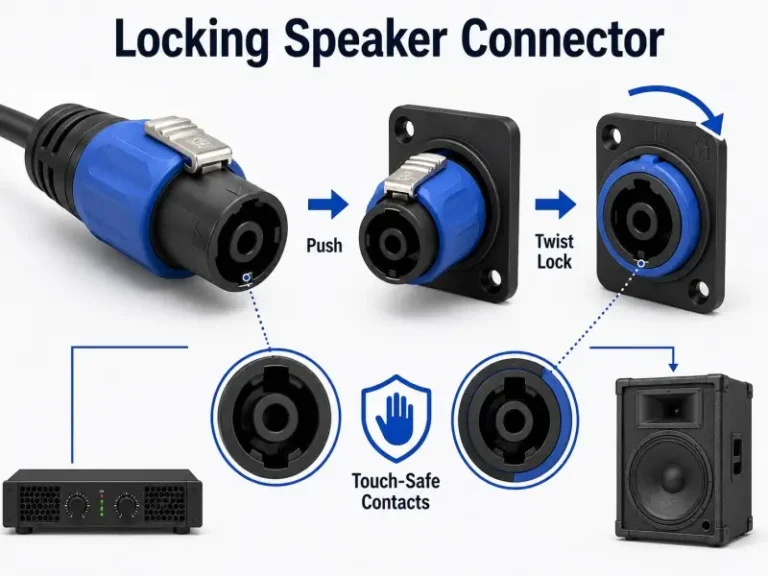
A Speakon connector is a locking speaker connector, designed by Neutrik, that joins power amplifiers to passive loudspeakers and carries far more current than an XLR or 1/4-inch jack. It comes as NL2 (one speaker circuit), NL4 (two circuits), and NL8 (four circuits), and it twist-locks so it cannot pull out mid-show.
Wiring a passive PA, or just trying to work out why your speaker cable ends in a round connector with a twist collar instead of a plug? The Speakon connector exists for one reason — to move high amplifier current to a loudspeaker safely, without the shock risk and pull-out failures of a bare 1/4-inch jack. Below: what it is, how NL2/NL4/NL8 actually differ, how to wire and lock one, and when a Speakon is the right call over an XLR.
What Is a Speakon Connector?
A Speakon connector is the locking, high-current connector that the audio industry settled on for the amplifier-to-loudspeaker link. It was developed by Neutrik, and the design solves two problems a standard plug cannot: it carries the heavy current a passive speaker draws, and it shields the contacts so no one can touch a live amplifier output. The reference details and pole variants are documented on the Speakon connector overview.
Mechanically, the plug pushes in and turns a quarter-clockwise until it clicks; a latch then holds it against vibration and foot traffic until you deliberately release it. Because the current-carrying parts sit recessed inside the housing, the connector is touch-safe even while the amplifier is running — which is exactly why touring and install rigs abandoned 1/4-inch jacks for speaker runs. If you are mapping where Speakon sits among the other families, the audio connector types guide places it next to XLR, TRS, and the rest.
Speakon Pole Counts: NL2 vs NL4 vs NL8
The number after “NL” is the pole (contact) count, and it decides how many speaker circuits the connector can carry. Per Neutrik’s own Speakon product range, the three you will meet are NL2, NL4, and NL8. Each speaker circuit needs two poles — one positive, one negative — so the math is simple:
| Speakon type | Poles | Speaker circuits it carries | Typical use |
|---|---|---|---|
| NL2 | 2 | 1 | Single passive speaker run |
| NL4 | 4 | 2 | Bi-amped cabinets, or one circuit + a spare pair |
| NL8 | 8 | 4 | Multi-way active crossovers, large rigs |

Here is the catch worth naming — call it the pole-count trap. An NL4 connector has four poles, but if the cable behind it only lands two conductors on 1+ and 1−, you have a one-circuit cable wearing a two-circuit connector. People assume an NL4 automatically means bi-amp capability; it does not, unless all four poles are actually wired. Always confirm what is landed on the contacts, not just what the shell says. For the full family and where each fits, browse the audio connector category.
Speakon vs XLR vs 1/4-Inch: When to Use Which
These three get mixed up because they all live on a stage, but they do different jobs. The short version: Speakon moves power to speakers, XLR moves balanced signal, and the 1/4-inch jack does a bit of both but locks for neither.
- Speakon — amplifier output to passive loudspeaker. High current, touch-safe, locking. Never used for microphone or line signal.
- XLR — balanced microphone and line-level signal, and it latches. This is the XLR connector you see on mics and mixer outputs; for the hardware side see Verchil’s XLR connector page.
- 1/4-inch TS/TRS — instruments and some line work, and on older systems, speaker runs. It is friction-fit, unshielded for power use, and the reason Speakon was invented.
Because a 1/4-inch speaker jack exposes live contacts and pulls out under tension, running real amplifier power through one is a safety and reliability problem. Given that, the rule of thumb is blunt: if it carries amplifier power to a speaker, it should be a Speakon; if it carries signal, it should be an XLR.

How to Wire and Lock a Speakon (NL4)
Wiring is where the pole-count trap bites, so go slowly. On a standard NL4, the convention from Neutrik’s wiring documentation is that the first amplifier channel lands on 1+ and 1−, and the second channel (for bi-amping or a daisy-chain) lands on 2+ and 2−. A single passive speaker uses 1+ and 1− only.
- Strip the speaker cable and identify positive and negative conductors; keep them consistent end to end.
- Land the main pair on 1+ (positive) and 1− (negative); land the second pair on 2+/2− only if you are actually running two circuits.
- Secure the cable in the chuck/strain relief so tension pulls on the housing, not the contacts.
- Push the plug into the chassis socket and turn a quarter-clockwise until the latch clicks; tug gently to confirm it is locked.
On current rating, Speakon contacts are built for high amperage, but the exact figure depends on the series — confirm the rated current per contact on the Neutrik datasheet for the specific part rather than assuming, because it varies across the range. For full stage and lighting builds where Speakon, power, and signal connectors run together, see Verchil’s stage lighting connector solutions, and for the locking power side of the same rig, the PowerCon guide covers the connector that does for AC what Speakon does for speakers.
Conclusion: Speakon for Power, Plan the Whole Locking Chain
A Speakon is the right tool whenever amplifier power meets a passive loudspeaker: pick the pole count for the number of circuits you actually wire (NL2 for one, NL4 for two, NL8 for four), land the conductors deliberately to avoid the pole-count trap, and twist-lock it. To be straight with you, Verchil does not manufacture Speakon-type speaker connectors — so if you found this guide while sourcing parts, here is the honest routing: for the locking AC power side of a stage or install rig, Verchil builds PowerCon connectors, and for locking balanced signal, the XLR connector range. Both come with ISO 9001 production and OEM/ODM support, and if you need a custom locking connector built to spec, send us your requirement or message the engineering team on WhatsApp.
Planning the whole locking chain is exactly where this connector meets PowerCON and the heavy-duty lines on the same truck. Verchil covers powered speaker and amplifier connections in that wider context — and states plainly that SpeakON itself is not a Verchil product line.
FAQ
What does NL stand for on a Speakon connector?
NL is Neutrik’s series prefix for the Speakon line; the number is the pole count. NL2 has two poles (one speaker circuit), NL4 has four (two circuits), and NL8 has eight (four circuits). The “L” distinguishes the speaker line from Neutrik’s other connector series.
Can I use a Speakon connector for a microphone or line signal?
No. Speakon is a high-current speaker connector with no shielding for low-level audio. Microphone and line signals belong on a balanced XLR, which rejects the noise a Speakon would pick up. Keep power on Speakon and signal on XLR.
Is an NL4 cable automatically bi-amp ready?
Not unless all four poles are wired. Many NL4 cables only land 1+ and 1−, giving a single circuit. Confirm that 2+ and 2− are actually connected before relying on a cable for bi-amping — this is the most common Speakon wiring mistake.
Is a Speakon connector waterproof?
Standard Speakon parts are not sealed. Some variants add gaskets for outdoor or stage use, but always check the specific part’s IP rating, and remember any rating applies only when the connector is mated with its matching part.
Why is Speakon safer than a 1/4-inch jack for speakers?
Its contacts are recessed inside the housing, so they cannot be touched while the amplifier is live, and the twist-lock stops the connector pulling out under cable tension. A 1/4-inch jack exposes its contacts and relies on friction alone, which is why it was phased out for power runs.
Do Speakon and PowerCon mate with each other?
No. They look related because both are Neutrik locking connectors, but Speakon carries speaker output and PowerCon carries AC mains power, and they are mechanically keyed so they cannot be cross-connected — a deliberate safety feature.