An empty stage box is a live sound enclosure that arrives punched for XLR connectors with none of them fitted — you choose the connectors and install them yourself. Two versions exist: a passive box needs no power and leaves the signal analog end to end, while a digital one converts inside the box and has to be powered.
Do you actually need a stage box?
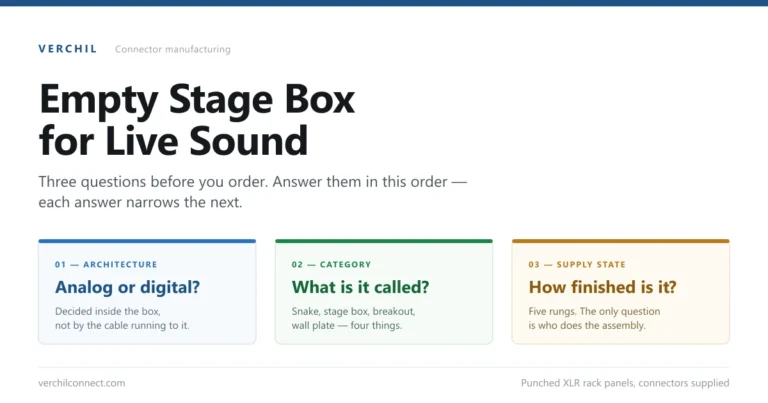
If the honest answer is “probably, but I have no idea which one,” you are in the majority — and the reason is structural. Three separate decisions hide behind one product name, and most listings answer only one of them. Work through them in sequence and the shortlist collapses. Call it the Stage Box Three-Question Method: architecture first, category second, supply state third. Every empty stage box on the market is one answer to each of the three, whatever the listing happens to call it.
Question 1 — Analog or digital: what is actually inside the box
The line between an analog and a digital stage box is drawn inside the box and not along the cable leaving it: an analog box contains nothing that needs power, while a digital one contains the converters. Cat 5 settles nothing either way — the cable carries four twisted pairs, and a passive analog box can use all four.
That last point is where most of the confusion starts, so it is worth pinning to something published. In its 2026 revision of the 1583A datasheet, Belden plainly lists the cable as “Category 5e Cable, 4 Pair, U/UTP, CMR”. Four balanced audio channels, four pairs. Nothing in that arrangement requires a converter. Both manufacturers who publish full specifications for this kind of box say so outright. Retrieved in August 2026, Radial Engineering’s Catapult TX4/RX4 specification sheet gives the audio circuit type as “Passive splitter” and the power requirement as “Passive, no power required”. Sescom’s SES-4XLRF-CAT and SES-4XLRM-CAT pages from that same retrieval carry the bullet “Passive Design Requires No Power”.
So the network cable is not the tell. The tell is whether the box needs to be plugged in.
Why a category rating tells you nothing about audio
There is a second, sharper way to see it — the two things are not even operating in the same frequency neighbourhood. Belden’s high-frequency performance table for the 1583A runs from 1 MHz to 200 MHz. As retrieved in August 2026, Neutrik’s datasheet for the NE8FDY-C6 etherCON chassis connector gives that connector’s frequency range as 1–250 MHz. Now compare the audio. Radial lists the frequency response of that passive four-channel box as “7Hz ~ 20KHz”.
A “Cat 5e” or “Cat 6” rating is a statement about behaviour above 1 MHz. Balanced analog audio does not live up there. It wants a twisted pair and a shield, and Cat 5e ships with four pairs — which is the entire reason the trick works. Running audio down a network cable is a statement about the cable, not about the signal.
The same passive box can pass digital audio too
This is the part that surprises people. Sescom’s bullet for those passive extenders reads “Send 4 Channels of Analog or Digital Audio, AES/EBU or DMX over Cat 5/6/7 Cable” — the same unpowered box, no converters, carrying digital audio. The mechanism is spelled out in Radial’s Catapult FAQ, read on 17 August 2026:
The characteristic cable impedance for AES signals is 110 Ohms. As luck will have it, Cat 5 cable has a similar characteristic impedance at 100 Ohms. This makes them compatible for use.
Belden’s own impedance column for the 1583A reads 100 ± 15 Ω straight across the band, which is the same number arrived at independently.
Read those together and the rule falls out: the boxes at each end decide whether the link is analog or digital. The cable in between is just copper with the right impedance.
What a digital stage box actually is
A digital stage box converts inside the enclosure. That makes it a powered device sitting on a network transport — Dante, AES50 and MADI are the names you will see — and it is why a single network cable can replace a multicore. The connector standards on that side come from the networking world rather than the audio world: Neutrik’s NE8FDY-C6 datasheet declares compliance with ISO/IEC 11801-1 Ed. 1.0 (2017-11) and IEC 60603-7-3 Ed.2.0 (2010-04), and lists Power over Ethernet support as “PoE type 4 class 8 (100W) acc. IEEE 802.3bt”. Locking etherCON-style shells are the category benchmark for this on stage; if you are specifying that layer, our notes on choosing an etherCON-compatible locking RJ45 cover the trade-offs.
The architecture answer also quietly settles your cabling topology. On an analog run every channel needs its own physical pair from the stage all the way back, so a branch part-way down the run is a physical tap into a fixed set of pairs — which is why analog rigs sprout extra boxes at the drum riser and the keyboard world. On a digital transport, that same branch is another port on a switch. The names for those branches are the subject of the next question.
Verchil’s own contribution on the analog side is a small one, and better named precisely than oversold: a 4-channel XLR to 1 RJ45 Cat5 extender, sold as a “Splitter XLR Box” in a female-input and a male-output version, in the XLR connector range. Boxes in this class are passive — a category-level fact, backed by the Radial and Sescom specifications above, and the reason the category exists at all. For the wider family of audio connectors these sit inside, start from the audio connector overview.
Question 2 — Stage box, snake, breakout, wall plate: four names, four things
“Stage box” is one of at least four names people use interchangeably that do not mean the same thing: a snake is the cable, a stage box is the point that terminates it on stage, a breakout or drop box is a branch part-way along the run, and a wall plate or floor box is the version fixed to the venue.
Set out one at a time:
- Snake, or multicore. The cable itself. It is sold by the metre and by pair count, and on its own it terminates in nothing.
- Stage box. The termination point at the stage end of that cable — the thing with the holes in it.
- Breakout, drop box, or sub-snake. A branch taken part-way down the run, not at either end — the fan-out at the drum riser, not the panel by the wall.
- Wall plate, or floor box. The same termination job as a stage box, except installed into the building instead of carried in a truck. Venues have these; touring rigs carry the other kind.
The reason this matters commercially rather than pedantically: search “stage box” and you will be shown all four. Order the wrong one and you get a bare aluminium panel when you wanted a finished system, or several hundred metres of cable when you wanted something with connectors in it.
One term deserves defusing, because it looks like brand jargon and is not. Listings that say “punched for D-series connectors” are referring to a standardised chassis form. Checked on 17 August 2026, Neutrik’s own datasheet for the NC3FD-L-1 XLR chassis connector states the part’s standard compliance as IEC 61076-2-103 and gives its chassis shape simply as “D”. When a supplier lists rack panels punched for D-series connectors, that is a dimensional commitment with a standard number behind it, not a house style.
Question 3 — Buy a finished stage box or build one: the same three interfaces, five stages of assembly
Buying a finished stage box and building one from an empty panel are not two different products. They are the same three mechanical and electrical interfaces sold at five different stages of assembly — and every one of those three interfaces has a published standard number behind it.
| Interface | What it joins | Standard number, and where the number comes from |
|---|---|---|
| Connector to panel | The XLR chassis connector to the metalwork it sits in | Neutrik’s NC3FD-L-1 datasheet states the part’s standard compliance as IEC 61076-2-103 |
| Panel to rack | The panel to the 19-inch structure around it | IEC published 60297-3-100 and 60297-3-105 in 2008. The first, in IEC’s words, “specifies the basic dimensions of front panels, subracks, chassis, racks and cabinets of the 482,6 mm (19 in) series”; the second is subtitled “Dimensions and design aspects for 1U high chassis” |
| Cable to jack, on the digital route | The network cable to the panel-mounted jack | Neutrik’s NE8FDY-C6 datasheet declares compliance with ISO/IEC 11801-1 Ed. 1.0 (2017-11) and IEC 60603-7-3 Ed.2.0 (2010-04) |
That is the whole argument for the DIY route, and it is a stronger one than cost. Assembling a stage box from an empty panel is not improvisation with unbranded parts — each of the three joints is dimensioned by a published standard, which is why a panel you populate yourself and a box someone else populated meet the rack, the connector and the cable on identical terms. The difference between the two is who does the labour, not whether the result is a real piece of equipment.
What you are actually being sold
None of the words used for this are standardised, which is why the same aluminium panel can be advertised five different ways depending only on where along the assembly line the supplier stopped. Ignore the adjective in the listing title and read what the supplier says actually arrives.
| Supply state | What arrives | Who does the assembly | The supplier’s own wording |
|---|---|---|---|
| Punched, empty | Holes cut and numbered to a connector standard, not one connector fitted | You | PropAudio lists its ESB080 as “Empty for customisation” and describes “8 channel holes punched out and marked 1 to 8” |
| Punched, connectors supplied | The same panel plus the connectors that fit it, shipped as separate parts in one package | You — but you are not sourcing the parts | Verchil’s panel page: “Verchil ships the panel and connectors as separate components in the same package.” |
| Connectors fitted | Connectors already installed. No cable yet | The supplier fits, you wire | Pro Audio LA sells an “8-Channel Laser-Engraved Analog Rack Panel without Cabling”, described in its own page data as a “1RU custom rack panel loaded with 8 Neutrik connectors”. Elite Core runs a separate navigation category headed “Pre-Loaded Boxes” |
| Built to order | Wired and labelled to your drawing | The supplier | Pro Audio LA’s category heading is “Custom Audio Rack Panels Built to Order”, described as “Built to spec with laser labeling and premium parts” |
| Finished system | Box, multicore and fan-out delivered as one product | The supplier | Sommer Cable groups these under “Stagebox Systems” |
All supplier pages retrieved 2026-08-17.
Notice what the ladder is actually measuring. It is not quality and it is not capability — the connector in rung one is the same connector in rung five. What changes is how many hours of somebody’s labour are already inside the box when it reaches you, and every rung above the first is a decision to buy those hours instead of spending your own. That is a legitimate thing to buy. It is just worth knowing that it is what you are buying.
Verchil sits deliberately on the second rung. We supply 1U and 2U panels that ship with their matching connectors — punched, numbered, connectors selected and included, but packed as separate parts rather than pre-installed. In practice that removes the part of DIY that actually goes wrong, which is not the screwdriver work but the sourcing: matching connector series to cutout profile, getting the counts right, and discovering at load-in that two of them are the wrong gender. Whether your count lands on a standard size or needs a custom punch is the decision that moves both the lead time and the minimum quantity, so it is worth settling before anything else — the current grid, the cutout profiles and the custom lane are all set out on that page, not repeated here. If your port count falls between the standard sizes, the fastest way to find out what it costs is to send it to us on WhatsApp and ask. If you want the background on who is doing the punching, that is on our company page.
How many holes do you need?
Returns are the number people get wrong: of the three empty boxes PropAudio publishes, one has none at all and the other two have exactly four — against eight and twelve sends.
| Sends you actually run | Returns you actually run | XLR positions needed | Nearest Verchil panel |
|---|---|---|---|
| 4 | 0 | 4 | 1U, 4-port (standard size) |
| 6 | 0 | 6 | 1U, 6-port (standard size) |
| 8 † | 0 | 8 | 1U, 8-port (standard size) |
| 8 | 2 | 10 | 1U, 10-port (standard size) |
| 8 † | 4 | 12 | 1U, 12-port (standard size) |
| 12 † | 4 | 16 | Custom 16-hole punch, or 2U 24-port off the standard grid |
| 16 | 8 | 24 | 2U, 24-port (standard size) |
† Not modelled. These three rows are the send, return and position counts PropAudio publishes for its own three empty stage boxes, cross-checked against the channel numbering printed on each unit. Retrieved 2026-08-17.
Three things the table cannot tell you:
Why the returns get cut first. The temptation is to run returns back down spare pairs of the same cable, and it works — but Radial, in the Catapult FAQ, flags the cost of doing it: yes, you can send signals in both directions simultaneously, “however, due to the differences in signal strength between mic and line-level signals, you may have crosstalk from the line-level signals onto the mic channels”. The constraint lives in the cable, not in the box, which is why adding return positions to the panel is cheap and adding return paths is not.
When this table does not apply. A touring rack should be sized for the largest room the system will ever see, because you cannot re-punch a panel in a car park. A fixed install should be sized for the room it is bolted into. Those two philosophies produce different answers from the same input count, and neither is wrong.
How to leave headroom. Step up one rung on the port ladder — 4, 6, 8, 10, 12, 24 — rather than applying a percentage. The ladder is what actually exists as a standard size, so rounding to it costs you nothing and rounding between rungs costs you a custom punch.
What shape should it be?
Form factor follows the mounting position, not the channel count — a 1U rack panel and a floor box can carry the same twelve circuits.
“1U” here is not a manufacturer’s abbreviation. IEC 60297-3-105:2008, in IEC’s own summary, “specifies the dimensions for 1U chassis mounted into IEC 60297-3-100 compliant racks/cabinets” — a standardised chassis height that any 19-inch rack will accept. So the choice between 1U and 2U is a question about how much panel width you need for the port count, not a question about whether it will fit.
Which leaves position as the real driver. A rack panel goes in the rack and travels with it. A floor box or wall plate goes into the building and stays. A stage box in a road case is the one that gets carried, dropped and rained on. Those three are the same electrical job in three different mechanical situations, and the situation should pick the format before the channel count does. Where a panel is going into a rack that will be struck and rebuilt every night, specify a lacing bar behind it at order time instead of improvising one later — it is an option on every panel size we make.
If the stage box is one element of a larger rig and not a standalone purchase, the wider picture of how power, DMX, audio and network control converge on one panel is set out in our stage lighting connector solutions.
Putting the three questions back together
The order is the method. Architecture first, because whether the box is powered rules out most of what you would otherwise be comparing. Category second, because once you know which thing you are buying, half the search results stop being relevant. Supply state last — it is purely a decision about your own time, and it is the one people answer first, which is how the wrong box ends up in the rack.
Answer them in order and the purchase becomes a shortlist. If it lands on an empty XLR rack panel with the connectors supplied alongside it, that is what we make — send us the port count and the connector series and we will quote against it.
Frequently asked questions
What size hole does a D-series XLR chassis connector need?
Ø23.60 mm, or 0.929 inches, taken from Neutrik’s own panel cut-out drawing for the NC3FD-L-1 (drawing number Zeichn. Nr. 3102 St 10 10, retrieved 2026-08-17). The distinction matters, because a widely repeated figure of 24 mm is wrong for this purpose. Neutrik’s marketing copy does describe the part as having a “Standardized D sized 24 mm panel cutout”, but on the engineering drawing 24.00 mm is the vertical centre-to-centre distance between the two screw holes — not the bore. Punch to 24 mm and the hole is 0.4 mm oversize.
Does a passive stage box need power?
No — that is what “passive” means, and the Radial and Sescom sheets quoted earlier say so in those words. The more useful question is what still needs power on that link, and the answer is your microphones. Phantom power passes straight through a passive box, but both makers attach the same condition to it: Sescom’s spec bullet reads “Supports Phantom Power, 48V, with Shielded Category Cable”, and Radial’s FAQ is blunter — if you are running AES digital audio or microphones that need phantom power, “then you must use shielded Cat 5 or Cat 6 cable”. Unshielded cable is where this goes wrong, and the box will not warn you.
My DIY box hums. Is it a pin 1 problem?
Very possibly — shield termination at the connector is the first thing to check on any hand-wired box, because it is a fault you introduce during assembly rather than one you inherit from the system. What Pin 1 is for, how shield termination turns into a ground loop, and how to check the joint you suspect are all covered in our XLR connector wiring guide.
Can I use a stage box outdoors?
Not without help. Neutrik’s NC3FD-L-1 datasheet gives the connector’s protection class as IP 40, which is a dust rating with no water rating attached — the enclosure keeps fingers and debris out and does nothing about rain. Outdoor use means either a covered position or connectors rated for the exposure; for the network side of the same problem, see our waterproof RJ45 connectors.