Nickel-Plated Brass Flexible Waterproof Cable Gland

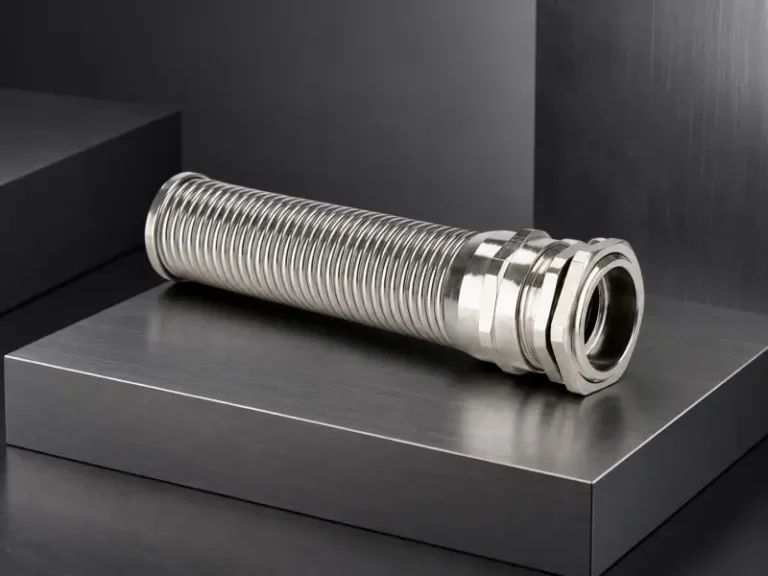
Brass Nickel Plated Flexible Waterproof Cable Gland

Thread:Metric, PG
Body Material:Brass with nickel plated
Sealing and sealing ring:NBR
Protection level:IP68
Working temperature:Static: -40℃ to 100℃, up to 120℃ for a short time.
CertificateCE IP68 Rohs Reach

This is the nickel-plated brass gland with a spiral tail on the cable side — the version to reach for when the cable does not stay still at the entry. Fifteen sizes, Metric and PG, covering cable from 3 mm to 30 mm. It is catalogued in some places as a spring gland; the part is the same. The rigid version of the same body is the plain brass cable gland.

Series and Specifications

Fifteen models: seven PG, from PG7-FL to PG29-FL, and eight Metric, from M12-FL to M40-FL. Body is nickel-plated brass with an NBR seal. Published working range is −40 °C to 100 °C static, with a short-time allowance to 120 °C, and protection is IP68.

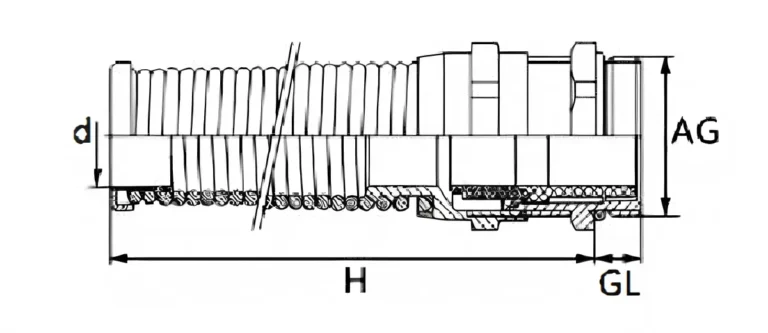
Two things decide a row before any dimension does. The first is thread standard: this line is Metric and PG only. There is no G or NPT flexible gland in brass, so if the panel is tapped to a pipe thread this series is already out. The second is a column the rigid glands do not carry — Height H, which is where the spiral shows up in the dimensions. It runs from 53 mm on the smallest model to 130 mm on the largest, and it is the figure that decides whether the gland fits the space you have, rather than the hole you have.

Metric and PG hole sizes, pitches and cross-standard equivalents are tabulated in the cable gland size chart.

Waterproof matel flexible cable gland component diagram
PG Thread Type
ModelCable Range (mm)Mounting Hole (mm)Thread GL (mm)Height H (mm)Spanner (mm)
PG7-FL3 - 6.512.5 - 12.885314
PG9-FL4 - 815.2 - 15.58.26617
PG11-FL5 - 1018.6 - 18.98.67720
PG13.5-FL6.7 - 1220.4 - 20.798822
PG16-FL10.2 - 1422.5 - 22.8109824
PG21-FL13 - 1828.3 - 28.61011130
PG29-FL18 - 2537.0 - 37.31112540
Metric Thread Type
ModelCable Range (mm)Mounting Hole (mm)Thread GL (mm)Height H (mm)Spanner Size (mm)
M12-FL3 - 6.512.0 - 12.385314
M16-FL4 - 816.0 - 16.38.26617
M18-FL5 - 1018.0 - 18.397220
M20-FL6 - 1220.0 - 20.398822
M22-FL10 - 1422.0 - 22.389024
M25-FL8 - 1625.0 - 25.31011130
M32-FL15 - 2232.0 - 32.51112035
M40-FL21 - 3040.0 - 40.51313040 / 45

The Tail Does Not Grow as Fast as the Cable

Put all fifteen models on one axis and something surfaces that the table keeps hidden: the spiral does not scale with the cable it protects.

PG7-FL is 53 mm of Height H for a cable of up to 6.5 mm — roughly eight times the cable's own diameter. M40-FL is 130 mm for a cable of up to 30 mm, a little over four times. Had the fitting simply been scaled up in proportion, M40-FL would stand about 245 mm off the panel. It stands at 130.

Height H against maximum cable diameter, Verchil brass flexible cable gland Scatter plot of all fifteen models. The horizontal axis is maximum cable outside diameter from 0 to 32 millimetres; the vertical axis is Height H from 0 to 140 millimetres. Seven PG models and eight Metric models are plotted. A dashed line shows what proportional growth from the smallest model would look like; it leaves the top of the chart at about 17 millimetres of cable diameter and would reach 245 millimetres at 30 millimetres of cable. The plotted models fall well below it, so the ratio of height to cable diameter falls from about eight at the smallest size to about four at the largest.Height H against cable diameter: the spiral does not scale up All 15 models, Verchil nickel-plated brass flexible cable gland If height scaled in proportion M40-FL would stand 245 mm off the panel. M40-FL 130 mm PG7-FL / M12-FL 53 mm 0 5 10 15 20 25 30 0 20 40 60 80 100 120 140 Maximum cable outside diameter (mm) Height H (mm) PG series (7 models) Metric series (8 models)Height-to-cable ratio falls from about 8× at PG7-FL to about 4.3× at M40-FL.
Every published model plotted against the largest cable it accepts. The dashed line is proportional growth from the smallest size — the range deliberately does not follow it.

That is not a compromise, it is the physics of the thing being protected. A cable's resistance to bending climbs very steeply with its diameter — much faster than the diameter itself. A 30 mm cable is not four or five times stiffer than a 6.5 mm one; it is in a different league, and it will not fold itself over the lip of a compression cap the way a thin one will. The thin cable is the one in danger, so the thin cable gets proportionally the most support.

Two practical consequences. On the small sizes the spiral is doing most of the work, and it should not be defeated: no cable tie inside its length and no clamp pinning the cable partway along the tail, because either one turns a graded support back into a hard corner a few centimetres further out. On the large sizes the spiral is more guard than support, and what actually protects that cable is the run itself — the radius it is given as it leaves.

Where These Glands Are Used

The flexible version earns its extra height wherever the cable works for a living at the entry. On industrial automation equipment that means robot wrists, drag chain terminations, machine doors and access panels, and any cable that gets pulled aside and re-dressed at every changeover — the places where a rigid entry slowly saws through a jacket at one fixed point.

On stage and lighting installations it goes where the rig articulates: moving head feeds, motorised truss drops, anything whose cable describes an arc every time the fixture works. Brass rather than polymer here is usually a decision about the venue rather than the fixture — permanent installations get specified in metal and stay that way.

Brass Nickel Plated Flexible Waterproof Cable Gland FAQ

Loader image

No. Whatever length is removed comes off the compliant end, and the cable then exits against a cut edge on a stiffer section — which is the hard corner the fitting exists to prevent, just relocated. Cutting it also leaves an edge on the cable side that will find the jacket every time the cable moves. If the depth is not available, change the model or change the structure, not the part.

Not in brass — this series is Metric and PG only. The flexible gland that carries pipe threads is the nylon version, with five G sizes and four NPT sizes covering cable to 25 mm: see the nylon PA6 flexible cable gland. If the thread has to be G or NPT and the body has to be brass, that is a quotation item rather than a catalogue one — send the thread designation and the cable outside diameter and we will price it.