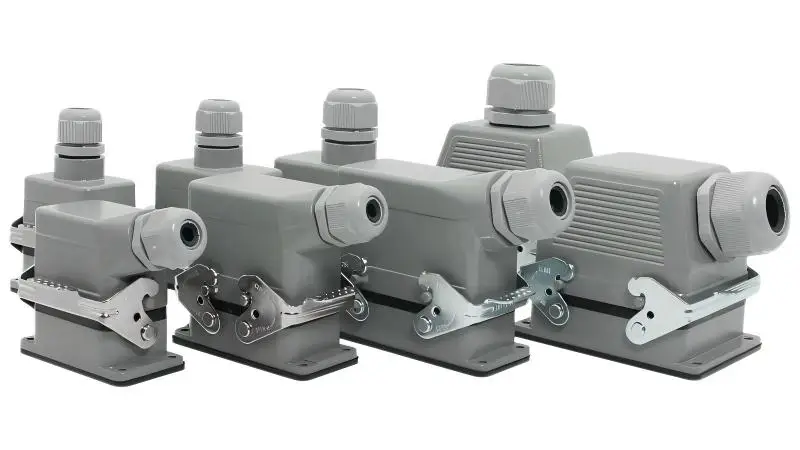
What is a heavy duty connector?
The heavy duty connector is a specially designed electrical component designed to establish a safe and reliable connection under extreme environmental conditions. They are commonly referred to as ‘industrial rectangular connectors’ and are designed to withstand dust, water, humidity, extreme temperatures, vibrations and mechanical stresses.
The definition of HDC lies in its classic three-part modular design:
Insert: the electrical core part of bearing male needle or female hole.
Hood/Housing: Protects the connected external armor (usually aluminum alloy or high-performance thermoplastics).
Locking Mechanism: Ensures that the locks or screws that remain tight are connected under vibration.
This design allows the machine to be modularly produced, meaning that each part of the factory assembly line can be pre-assembled, tested, disassembled and transported, and easily reconnected on site without the need for complex hard wiring by electricians.
Heavy duty connector vs. ordinary connector
Since there are standard round plastic connectors, why invest in heavy duty connectors? The difference is toughness and modularity. The following table is intended to help you distinguish the key differences between the two.
| The difference between Heavy duty connector and ordinary connector | ||
|---|---|---|
| Feature | Heavy Duty Connector (HDC) | Standard/Circular Connector |
| Durability | High (Metal/Thermoplastic Housing) | Low to Medium (Plastic) |
| Environment | Harsh (Dust, Water, Oil, Vibration) | Controlled (Office, Light Indoor) |
| IP Rating | Typically IP65, IP67, IP68, or IP69K | IP20 to IP40 |
| Modularity | High (Mix power, signal, pneumatic in one) | Low (Fixed pin counts) |
| Locking System | Robust Levers/Latches | Screw or Push-pull |
Anatomy of Heavy Duty Connectors: Structural Details
To make full use of overloaded connectors, you must understand their architecture. Manufacturers like TE Connectivity and Harting have standardized these components to allow interchangeability.
1. Hoods and Housings
The shell is an external armor. It is usually made of die-cast aluminum or high-grade anti-corrosion thermoplastics.
Hoods: the top part of the connecting cable.
Housings: Bottom portions mounted on equipment or panels.
2. Inserts
The plug determines the pin configuration. Modern HDC is ‘modular’, which means you can combine different modules within a heavy duty connector framework (for example, a Gigabit data module is placed next to a 40A power module). This not only saves space, but also reduces the complexity of wiring.
3. Cable Glands
The cable Gland ensures that the cable entry into the upper housing is sealed and maintains the IP protection level of the entire assembly.

7 Key Tips for Choosing the Right Heavy Duty Connector
Choosing the right components requires an analysis of specific electrical and environmental constraints. Follow the following 7 tips to ensure the success of industrial projects.
1. Determination of electrical load requirements
Before looking at the shape and size, the required current (ampere) and voltage (volt) are calculated. Heavy-duty connectors are rated according to a specific electrical threshold.
High power: motors and drives may require 100A or more.
Signal/data: The sensor requires low voltage but high shielding.
Mixed requirements: Do you need to run both power and data in one cable? If yes, look for a hybrid modular plug.
2. Assessment of environmental conditions
Where will the connector be installed? If it is outdoors, it needs to be UV resistant. If it is a food processing plant, it needs to undergo high-pressure cleaning.
Standard industry: IP65 is usually enough.
Ocean/offshore: looking for ‘high corrosion protection’ shell.
EMC environment: If close to the high frequency driver, please ensure that the shell provides electromagnetic compatibility (EMC) protection.
3. Verify IP protection level (Ingress Protection)
The IP rating indicates the ability of the heavy duty connector to block solids and liquids.
IP65: Dust-proof and water-proof.
IP68: suitable for continuous immersion in water.
IP69K: Protects against high temperature and high pressure steam cleaning (critical for the food and beverage industry).
4. Select the correct wiring technology
How will you connect the wire to the pin?
Screw connection: Simple, no special tool required, but may become loose with vibration.
Cold pressing connection (Crimp): The crimping clamp is required, but provides the most airtight and shockproof connection.
Bullet connection: fast installation speed and anti-vibration ; it is very suitable for mass production.
5. Considering the locking mechanism
The locking rod ensures that the heavy duty connector will not be disconnected during operation.
Single button: One-handed operation is easier.
Double-buckle: Provides more symmetrical locking force, suitable for larger connectors.
Screw locking: for extremely high vibration environments or IP68 applications.
6. Planning cable entrance
Check the angle of the upper cable entrance.
Top Entry: The cable is drawn vertically upward.
Side Entry: The cable is drawn at an angle of 90 degrees.
Choosing the wrong entrance will cause the cable to be stressed, resulting in premature failure of the insulation layer.
7. Towards the future through a modular system
Don ‘t just build for today. Using a modular heavy duty connector system allows you to add additional modules (such as pneumatic or fiber optic) at a later time without changing the entire housing interface.
Common industrial application scenarios
The versatility of heavy duty connectors makes them ubiquitous in many industries.
Rail and transport: Coupling of carriages for rolling stock. These must comply with strict fire and smoke standards (EN 45545).
Renewable energy: Wind turbines use HDC for pitch control and generator connection in the engine room because they can withstand salt spray and vibration.
Robots: Robots need complex hybrid connections (power + encoder data) in a very small space.
Mechanical manufacturing: Injection molding machines and packaging machines rely on HDC to achieve rapid mold replacement.
For more information about the connector industry safety standards, please refer to the relevant documentation of the IEEE Standards Association.
How to install heavy duty connectors?
Installation usually involves three main steps:
Stripping: Remove the insulating layer of the wire.
Connection: Use crimping, screws, or shrapnel to insert wire into the pin.
Installation: Insert the plug into the upper housing and base to ensure that the sealing gasket is in place, and tighten the cable joint to secure the cable and relieve stress.
Can I mix different brands of heavy duty connectors?
Although many brands meet the ‘Harting standard’ (sizes 6B, 10B, 16B, 24B), it is generally recommended to keep the upper shell and the base from the same manufacturer to ensure IP protection level. However, if the inserts follow the same size standard, they can usually be exchanged between different brands.
What is the cause of the failure of the heavy duty connector?
The most common reasons include:
Improper assembly: lack of gaskets or cable joint loose lead to water.
Pin damage: Forced connection when pins are not aligned.
Overcurrent: A connector rated 10A is used in 16A applications, resulting in melting.
Heavy duty connectors are the cornerstone of modern industrial connections. It provides the robustness required to maintain the operation of the production line and the flexibility to adapt to new technologies. By focusing on environmental protection, correct wiring and modular design, engineers can ensure that their systems remain safe and efficient.
Whether you ‘re upgrading an existing facility or designing a new machine, prioritizing high-quality HDC is an investment in reliability. Remember to verify your voltage requirements and IP level before purchasing to avoid expensive downtime.